Riverland
The Brazor River is the country's physical and economic spine. It irrigates fields, moves freight, connects cities and estates, and turns water into national wealth.
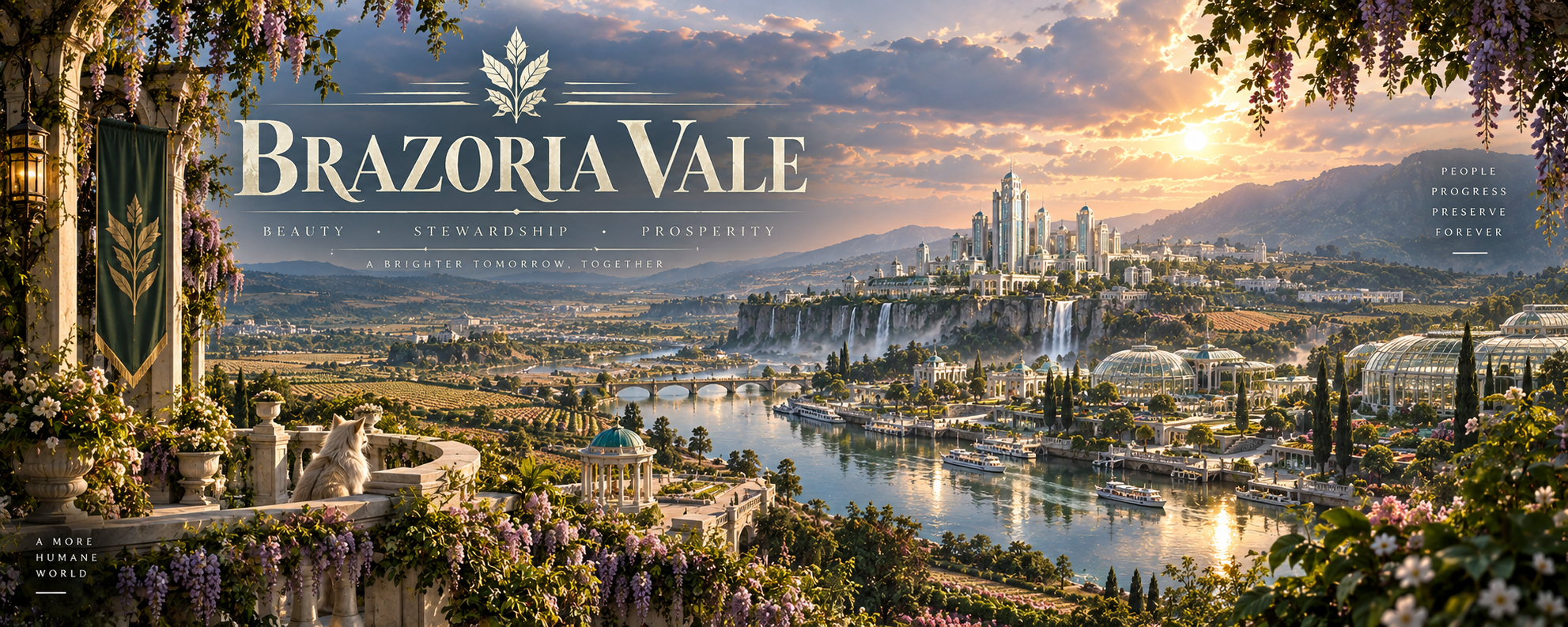
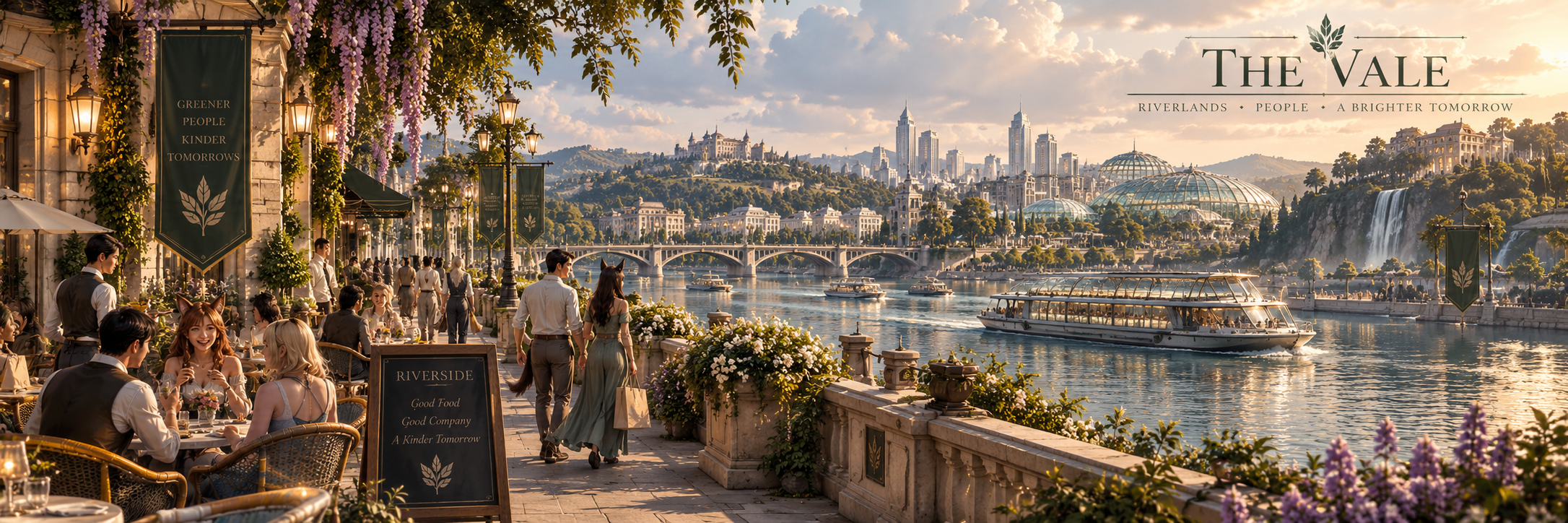
The Riverland Realm
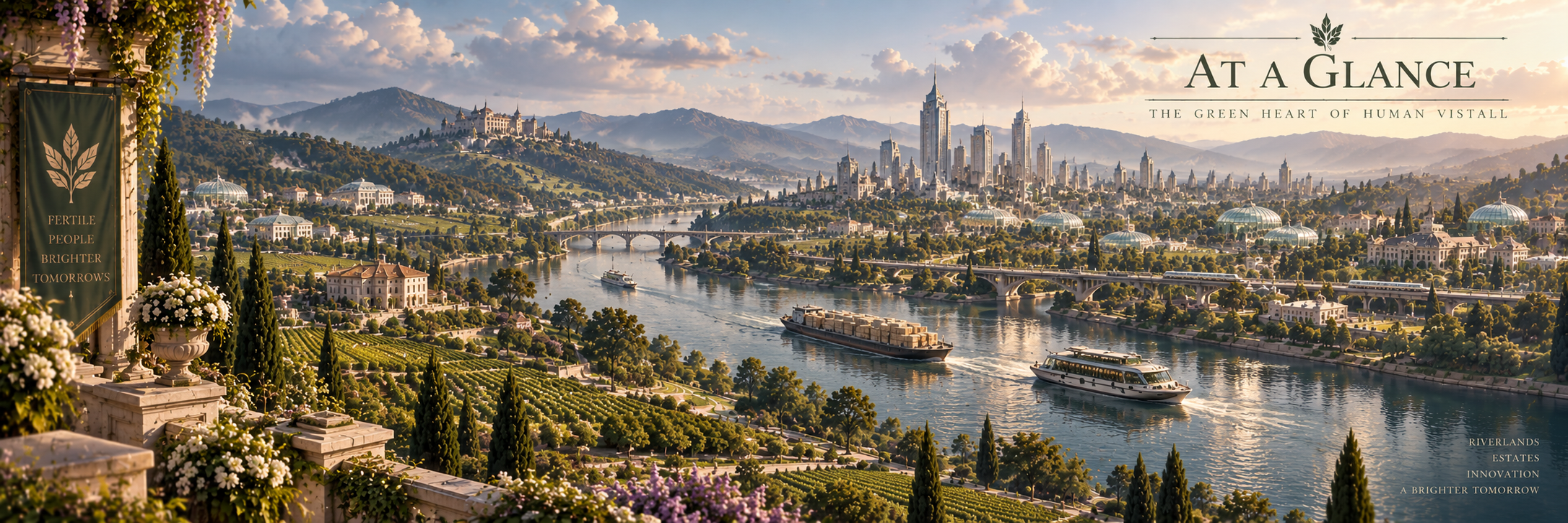
Brazoria Vale is a wealthy human-controlled riverland built along the fertile basin of the Brazor River. Orchards, agricultural estates, greenhouse belts, medical campuses, river cities and old family holdings spread across a country whose prosperity has been cultivated as carefully as its gardens.
The Vale considers itself the reasonable middle path of human Vistall. The Pecos Crown is too brutal. San Aurelo is too rigid. Mesquite Reach is too unstable. Brazoria instead speaks of stewardship, responsible care, biological welfare and civilized custody.
Demi-humans are consequently far more visible here than in most human-controlled lands. They accompany households through cafés and markets, live inside family homes, travel on river holidays, receive specialized healthcare, wear tailored clothing and are frequently showered with attention, gifts and affection.
Brazorians rarely imagine themselves as cruel for this. Many sincerely adore the demi-humans in their care. They call them companions, pets and members of the household.
They are still property under Brazorian law.
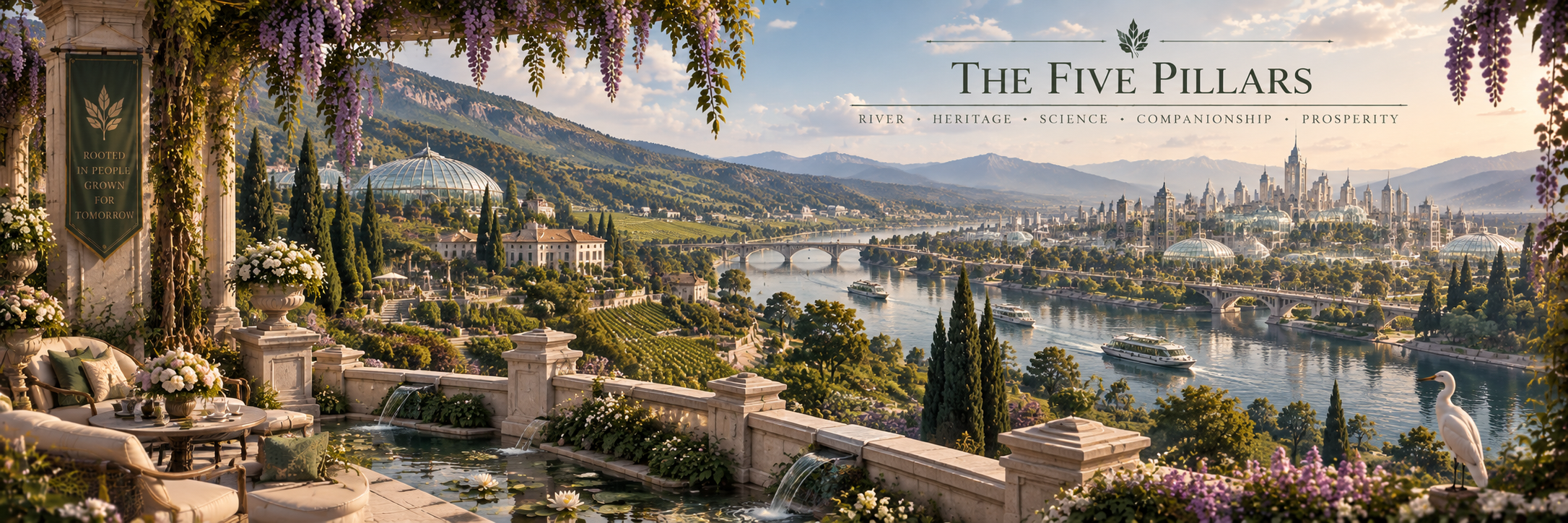
The Brazor River is the country's physical and economic spine. It irrigates fields, moves freight, connects cities and estates, and turns water into national wealth.
Old agricultural houses still shape Vale society. Estates, orchards, conservatories, archives and family names pass through generations, turning inheritance into authority.
Brazoria is a continental center of genetics, medicine, ancestry analysis and biological classification. Its research institutions helped refine the modern Purity Grid.
Demi-humans are embedded in household life as beloved pets and companions. Mixed breeds are widespread and affordable, while verified purebreds can command extraordinary prices.
Agriculture, river commerce, biotech and inherited estate wealth make Brazoria one of Vistall's most comfortable human realms. Prosperity lets control wear beautiful clothes.
The Brazorian Contradiction
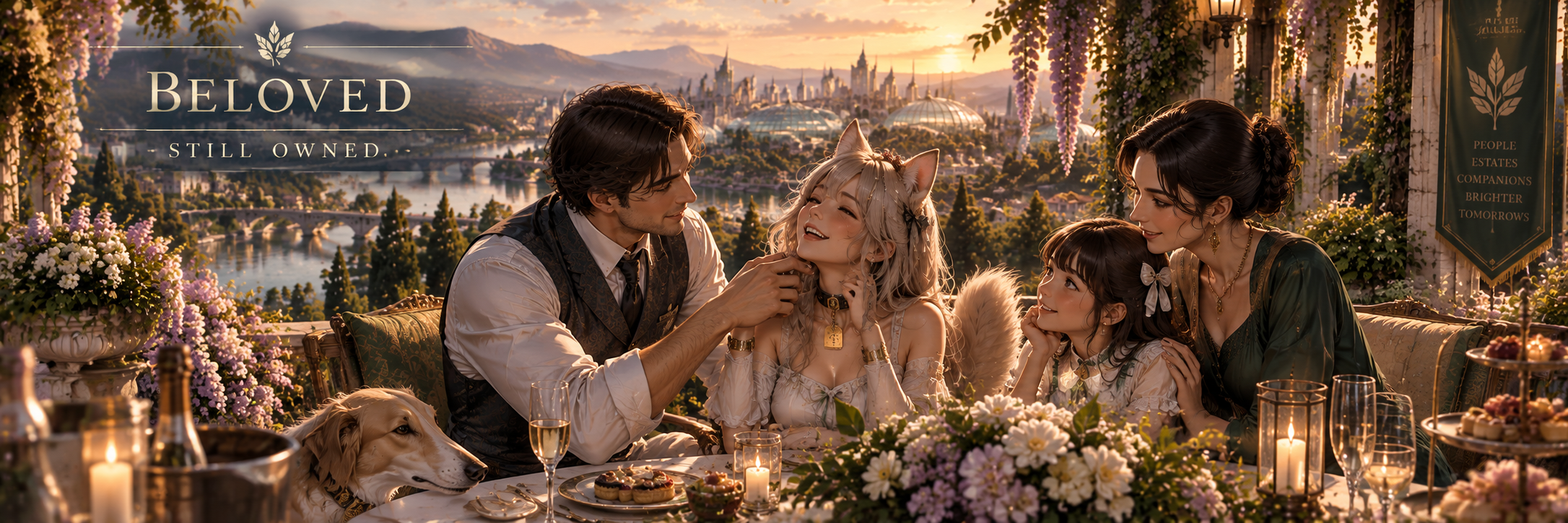
Brazoria Vale may offer the highest standard of material care available to an owned demi-human anywhere in human-controlled Vistall. Many are well fed, medically monitored, comfortably housed, beautifully dressed, entertained, accommodated and deeply loved.
That care is real. So is the ownership.
Brazorians frequently describe their demi-humans as family, and in many households the affection is sincere. Children may grow up beside them. Owners may protect them, spoil them, grieve them and build daily routines around them. Brazorian law does not interpret that love as equality. A beloved demi-human remains under human custody.
“They're safer with families.” “They're cared for.” “Good owners love their companions.” “You should see how the Crown treats them.” Brazoria's defense rarely requires these statements to be false. It only requires everyone to avoid the question they do not answer: whether another person's comfort makes ownership just.
National Profile

Places • People • Identity
The river feeds farmland, carries freight, supports passenger ferries and ties the Vale's cities, estates and agricultural regions together. The same waterway that built Brazoria's prosperity has also become one of its most closely watched escape corridors.
The Vale's administrative and corporate center, where river transport, high-speed transit, medical research, biotechnology and national government converge.
A smaller estate city shaped by old families, flowering river neighborhoods, agricultural wealth and crossings that connect the eastern Vale to increasingly sensitive border routes.
Agricultural goods, orchard produce, medicinal crops, seed stock, medical research and biotechnology systems move outward from Brazoria into the rest of Vistall.
Human Brazorians are taught that their prosperity proves the success of responsible stewardship. Many sincerely consider their country the humane middle ground of human Vistall.
Brazoria uses the phrase to represent stewardship, prosperity and responsible guardianship. The question the Vale avoids is simpler: who gets to decide what care permits?
National Custody Law
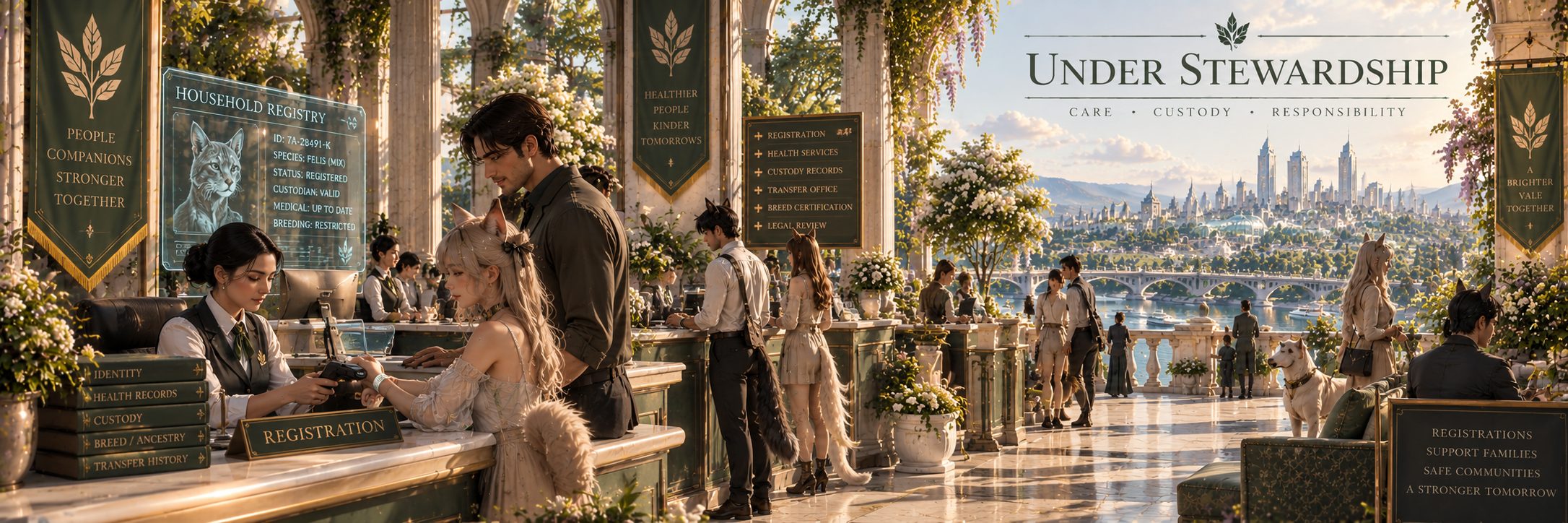
Brazorian law begins with a distinction it considers fundamental. Humans possess civic personhood. Demi-humans possess protected biological status.
A demi-human may be loved, educated, medically cared for, socially integrated and treated as a member of a household. None of those conditions create independent civic standing. Their legal life remains attached to a recognized human, estate, institution or licensed custodian.
The most common public classification. A private human custodian assumes responsibility for housing, food, registration, medical care and lawful supervision. Companions may participate extensively in household and public life but cannot independently terminate custody.
Demi-humans registered to large agricultural houses or old family estates. They may function as companions, household members, agricultural assistants or lineage assets while remaining legally attached to the estate.
Clinics, universities, conservatories and licensed research institutions may hold legal custody. Placement may be temporary, long-term or court ordered under welfare, medical or biological-protection statutes.
Rare, purebred, endangered or unusually valuable bloodlines may receive enhanced state protection. Greater value can bring stricter movement, breeding, transfer and custodial controls.
Every legally held demi-human must be tied to an approved biological and household record. Brazoria treats this as ordinary stewardship infrastructure rather than exceptional surveillance.
Brazoria generally considers shifting a natural biological behavior that should be accommodated rather than prohibited. Full animal forms are commonly permitted on private property, estates and licensed recreation grounds.
Public shifting remains regulated. Urban districts, transit systems, river zones and large or dangerous morphologies may require owner authorization, location-specific permits or additional safety controls. War-form shifting is heavily restricted outside emergencies, licensed work or medical circumstances.
Custodians are legally responsible for maintaining appropriate welfare. Brazoria regards neglect as a failure of stewardship and may remove a demi-human from an owner who cannot meet national care standards.
Protected Biological Status
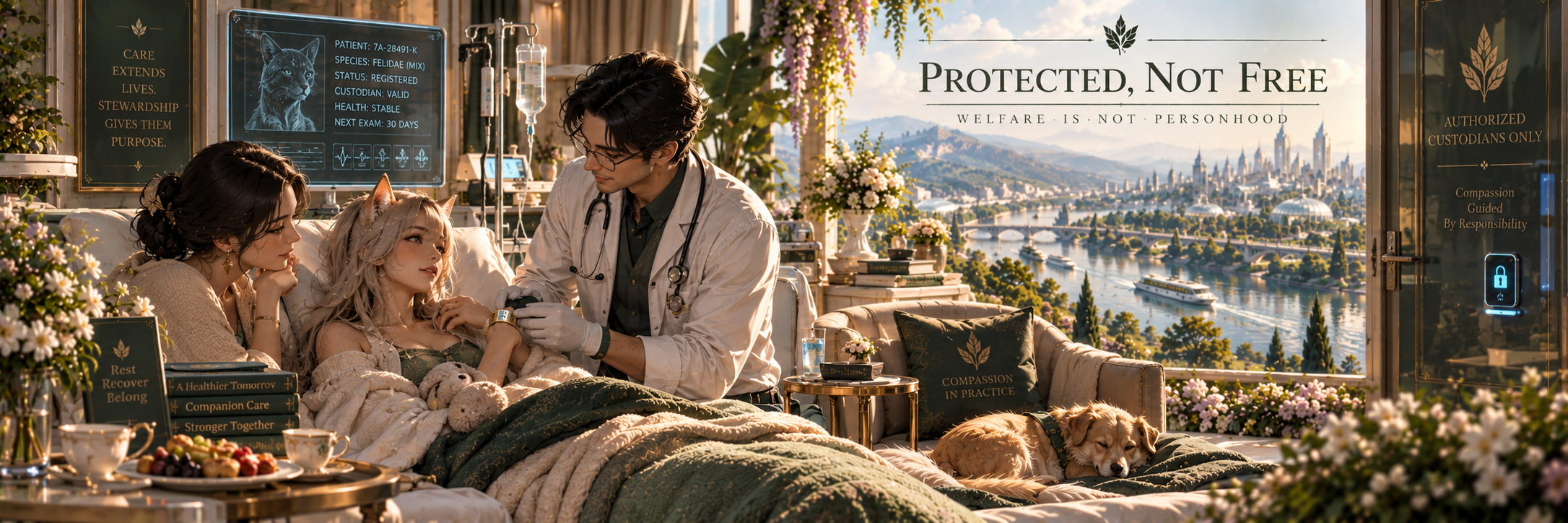
Brazoria has some of the strongest demi-human welfare standards in human-controlled Vistall. Those protections are real. They are also built around the assumption that a demi-human requires a human custodian.
A serious welfare violation can trigger inspection, medical intervention and removal from the household. Owners may face fines, criminal charges, ownership suspension or permanent disqualification.
The removed demi-human is then placed with an approved relative, licensed household, foster-style companion home, estate, conservatory or institutional ward.
Freedom is not the default remedy. Custody is reassigned.
A demi-human may have an expensive wardrobe, private bedroom, excellent doctor and generous personal allowance while possessing no independent legal claim to the house, the account or the right to walk away from either.

Household Custody
Brazoria avoids the crude language of markets when discussing domestic companions. Respectable households rarely speak of buying or selling. They speak of placement, matching, adoption, transition and family continuity.
Money still changes hands. Ownership still changes hands. Brazorian etiquette simply insists that the transfer sound caring.
Licensed breeders place young or adult companions into approved households. Mixed breeds are broadly accessible, while documented purebreds can involve substantial fees, waiting lists and pedigree contracts.
Agencies match households according to species, temperament, age, children, existing companions, accommodations, desired traits and household resources.
Prominent families and agricultural houses may arrange private transfers through estate networks, lineage agreements or long-standing breeder relationships.
A companion may legally be gifted if the recipient is eligible and accepts custody. Registration, medical files, pedigree records and household identification are transferred with them.
Companions can pass through wills, household continuity provisions or family estates. Brazoria prefers keeping them with familiar households when a qualified human heir exists.
Purebred, rare or protected companions may be subject to breeder contracts, lineage restrictions or state review that can override ordinary inheritance wishes.
Brazorian inheritance law prioritizes continuity of care, but continuity does not mean independent choice.
Death of an owner does not automatically free the companion.
Ownership does not provide unrestricted breeding authority. Registered breeding generally requires current health records, fertility classification, lineage documentation and an approved match or breeding contract.
Purebred and protected lines face greater scrutiny because pedigree integrity, genetic health and commercial value are treated as matters of national stewardship.
Abandonment is illegal. Brazoria treats dumping or deliberately leaving a registered companion without care as both cruelty and a biological-registry violation.
Owners who can no longer provide care are expected to surrender custody through a licensed agency, breeder-return system, municipal companion service, approved household transfer or institutional placement.
Verified abuse can result in immediate removal, welfare charges, financial penalties, ownership suspension, inspection of other household companions and permanent loss of custody privileges.
Once seized, the demi-human becomes a protected ward awaiting another approved placement.
The system is designed to prevent a companion from becoming unwanted, untreated or abandoned. It is not designed to let that companion become legally self-owning.

National Government
Brazoria Vale is officially governed through a parliamentary civic system centered in Brazor Station. Human citizens elect representatives, debate public policy and participate in a government that presents itself as transparent, scientifically informed and socially responsible.
That democracy exists within the boundaries of recognized human citizenship. Demi-humans may be protected by legislation, discussed in public hearings, represented by custodians and studied by government experts, but they do not vote or participate as equal civic persons.
Elected government also shares the political landscape with old agricultural houses, research foundations, medical institutions and corporations whose expertise and money shape much of the policy later presented as public stewardship.
The Vale Assembly is the country's principal legislative body. Its elected human representatives establish national law, approve budgets and regulate the systems that sustain Brazorian life.
Assembly committees regularly consult corporate laboratories, estate associations and research institutions whose recommendations can move rapidly from private proposal to national policy.
The Board of Stewardship is the country's dominant biological and custodial regulator. Where the Assembly writes broad law, the Board determines how much of that law is applied to bodies, bloodlines, households and institutions.
Its voting membership draws from medicine, genetics, law, public health, estates and corporate science. No demi-human has ever held a voting seat.
The Vale Premier serves as head of government and is selected through the governing majority or coalition of the Vale Assembly. The office coordinates national policy and appoints the civic cabinet responsible for public administration.
Recognized adult human citizens may vote, campaign, organize political parties and hold national office. Demi-humans may become the subject of petitions, welfare campaigns and legislative debate, but cannot independently exercise those civic powers.

Administration & Regulation
Coordinates national biological policy, custody classifications, heritage protection, institutional placement, research permissions and companion standards. It sits at the center of Brazoria's regulatory web.
Controls ferry permits, irrigation, water rights, flood defense, river patrols, aquatic work licensing and environmental monitoring. Because the Brazor is also a major escape route, ecological management and movement surveillance frequently overlap.
Maintains pedigree certification, mixed-breed ancestry files, breeder licenses, transfer histories, fertility records, heritage flags and breeding registrations. False pedigrees and concealed ancestry fall under its investigative authority.
Handles welfare inspections, abuse complaints, surrender services, emergency placement and owner eligibility. Its officers function more like social workers and care inspectors than police, though they can remove companions from unsafe households.
Regulates crop systems, irrigation quotas, greenhouse production, seed banks, estate licensing, agricultural technology, food safety and rural biological labor standards.
A private association representing Brazoria's largest agricultural and lineage estates. Its voluntary standards frequently become formal policy, giving old families influence far beyond ordinary lobbying.
Hear disputes involving ancestry, medical custody, conservatory status, research exemptions and biological classification. Continued custody may be upheld when judges determine that ongoing care serves the subject's best interest.
Municipal councils manage ordinary city services, transit, public spaces, local development, licensing and neighborhood regulations while remaining bound by national stewardship and biological law.
Government registries and regulatory agencies rely heavily on privately developed genetic databases, scanners and classification tools supplied by the Helix Vale Consortium.
The Vale Assembly makes law. The Board of Stewardship interprets biological and custodial policy. The River Authority, Lineage Registry, Welfare Service and Agricultural Commission administer daily systems. The Estate Council influences them. Helix Vale supplies much of the data they depend upon.
Corporate Power
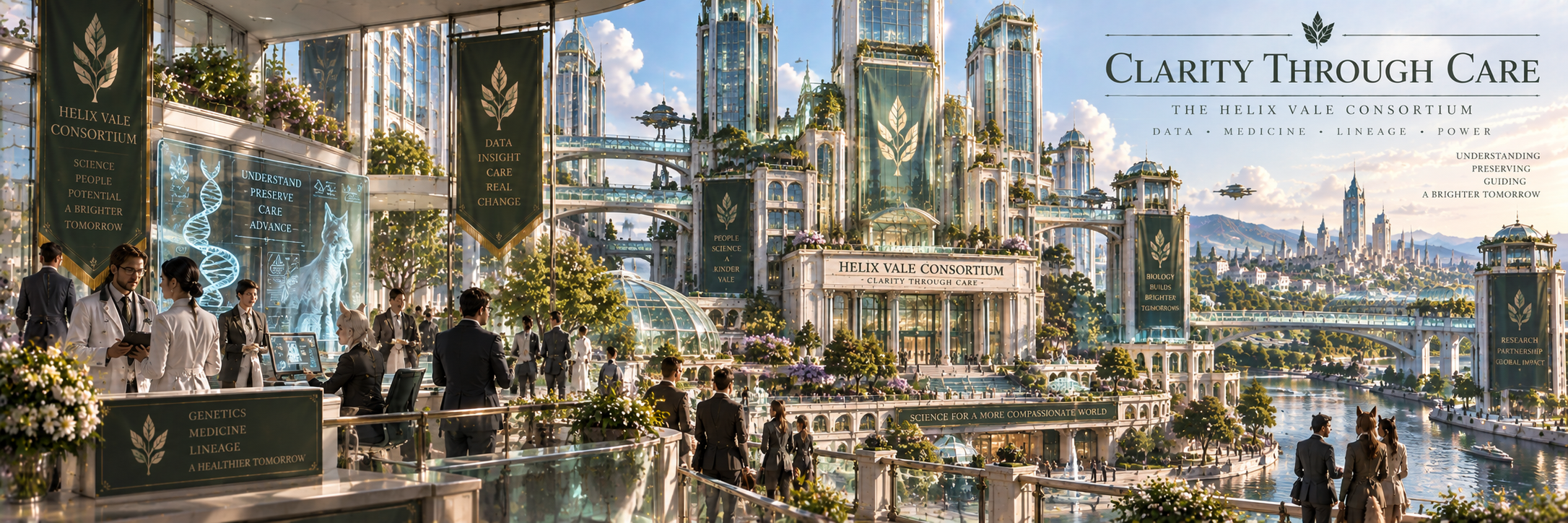
The Helix Vale Consortium is not a government ministry. It does not formally command the Vale Assembly, appoint the River Authority or own the Board of Stewardship.
It maintains ancestry systems they consult, develops scanners they trust, certifies bloodlines they regulate, funds research they cite and employs experts who later advise national policy.
Helix research helped refine the modern Purity Grid and continues to support the ancestry, morphology and classification technologies used throughout Brazoria's medical and regulatory systems.
Purebred value depends on confidence. Helix genetic analysis helps verify lineage, identify mixed ancestry, screen hereditary conditions and support the certificates that turn pedigree into social and commercial prestige.
Helix systems track morphology, fertility, hereditary conditions, shifting biology, rare-line traits and other medical information used by clinics, breeders, registries and government agencies.
Helix technology moves beyond Brazoria. Classification and scanning systems are licensed or contracted to other human powers, allowing the Vale to profit from biological control systems far harsher than its own domestic model.
Government agencies depend on specialists capable of interpreting increasingly complex genetic and morphological data. Many of those specialists are trained, funded or directly employed by Helix-linked institutions.
Pedigree registries, medical files, border scans, fertility records and conservatory databases are deeply integrated with Helix systems. Replacing the company would mean rebuilding much of the country's biological infrastructure.
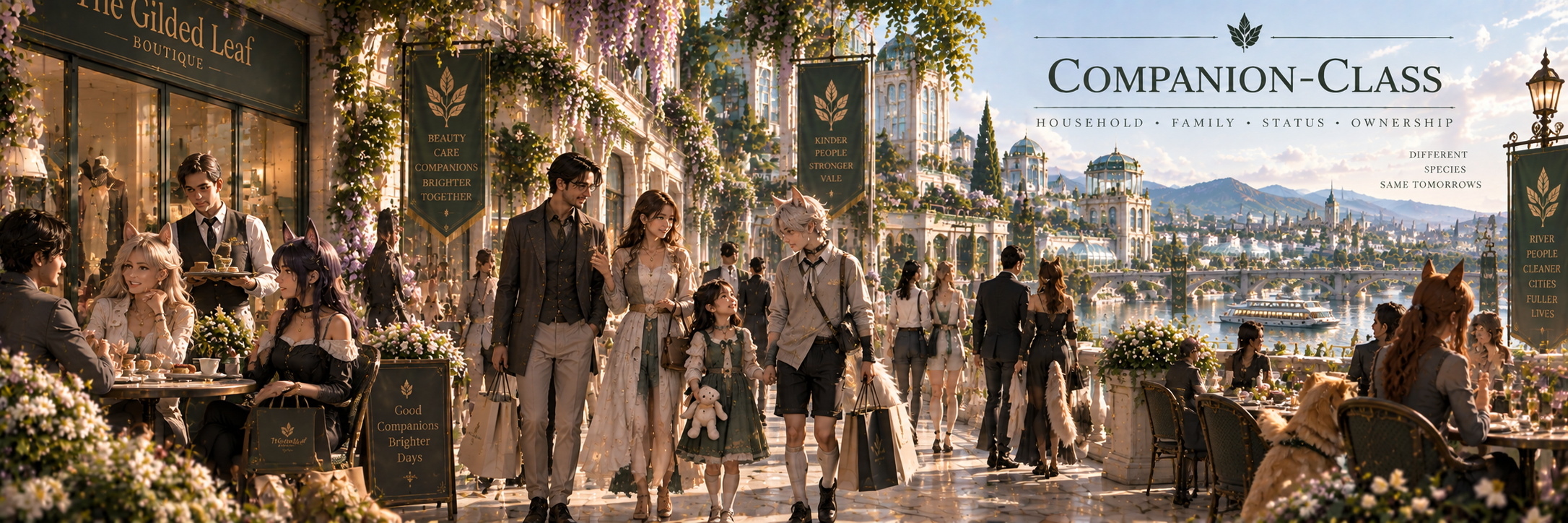
Domestic Status
Demi-humans are common throughout Brazoria Vale. Where other human-controlled states often center labor, containment or exclusion, Brazoria places the household companion at the center of its relationship with them.
A companion may live inside the family home, eat at the family table, travel on holidays, receive gifts, appear in photographs and grow up beside human children. They may be treated emotionally as family while remaining legally attached to a human custodian.
Brazoria does not consider those ideas contradictory. To most Brazorians, loving a demi-human and owning them are entirely compatible.
Companions often have bedrooms, clothing, hobbies, possessions, favorite foods, family traditions and deeply personal relationships with the humans who raise them.
Their civic identity remains connected to a human custodian who holds authority over residence, registration, transfer and many major legal decisions.
The cultural expectation is primarily affection, presence and household belonging. A domestic companion is not automatically considered a servant simply because they are owned.
Phrases such as “our fox,” “their spaniel” or “the family’s Great Dane” are socially normal. Ownership is woven directly into ordinary family language.
Species, ancestry, pedigree, health, shifting status, current custodian and transfer history remain part of the official record behind an otherwise ordinary domestic life.
A healthy and beautifully presented companion reflects well on a household. Rare verified purebreds can signal considerable wealth, lineage and social prestige.
Respectable Brazorians favor words such as companion, household companion, family-raised, purebred, mixed-breed and protected dependent. Openly describing a domestic companion as livestock, stock or a slave is considered crude and socially offensive.
The preferred vocabulary changes the tone of ownership. It does not remove the ownership itself.

Ordinary Companion Life
For many domestic companions, daily life in Brazoria is comfortable, social and deeply intertwined with the household that owns them. The restrictions are often easiest to miss precisely because so much ordinary freedom exists around them.
Companions wear ordinary human fashion. Tail-friendly trousers, wing-backed coats, ear-safe accessories, custom formalwear, grooming products and decorative registration jewelry support an enormous companion-fashion market.
Private bedrooms are common in households that can afford them. Some companions have full suites, attached baths or garden access. Their privacy is respected by custom, but it is not legally equivalent to a human's private residence.
Demi-humans have human bodies and commonly eat ordinary meals at the table with their households. They cook, keep favorite snacks, order in restaurants and may receive specialized nutrition when their animal traits require it.
Cafés, shopping districts, parks, theaters, museums, ferries, festivals, vacations and recreation grounds are ordinary parts of companion life. Hobbies, games, art, sports and supervised shifting are generally encouraged.
Brazoria offers advanced species-specific medicine, preventative care, shift treatment, morphology specialists, dental services, reproductive medicine and genetic screening. Good owners are expected to keep healthcare current.
Hugging, cuddling, gifts, nicknames, shared naps, ear or tail grooming and family photographs are normal. Some companions are raised beside one human child and remain emotionally inseparable from them into adulthood.

Public Culture
Brazoria does not primarily understand demi-humans as workers who happen to live in homes. It understands them as companions who may sometimes work.
That distinction matters enormously to Brazorians. They regard industrialized cruelty, casual neglect and public humiliation as marks of an uncivilized owner. Good stewardship is expected to look affectionate.
A companion may cook, garden, babysit or help around the house, but respectable domestic culture does not treat constant service as their defining purpose.
Pecos-style labor ownership is widely considered barbaric. Brazorians believe civilized people house companions comfortably and integrate them into family life.
Demi-humans are visible in shops, parks, cafés, clinics, festivals and family photographs. Public presence is normal rather than treated as biological contamination.
Brazorians recognize intelligence, emotion, preferences and relationships while still believing those qualities can exist inside legitimate human ownership.
Companion care is a social measure of character. A respected owner knows their companion's preferences, maintains their health, provides good food and clothing, encourages hobbies, allows reasonable privacy and includes them openly in family life.
Brazoria supports companion boutiques, grooming salons, breeder clubs, family social groups, species-care guides, holo forums and lifestyle media devoted to responsible ownership. Advice on nutrition, shifting, adolescence, behavior and multi-companion households is ordinary popular culture.
Even touching etiquette reflects that intimacy. Handling another household's companion without permission is considered rude. Younger Brazorians increasingly address the demi-human directly before touching ears, tails or wings, while more traditional households still expect the custodian to answer.
“Ours eats better than I do.” “She has her own room.” “He's family.” “She comes everywhere with us.”
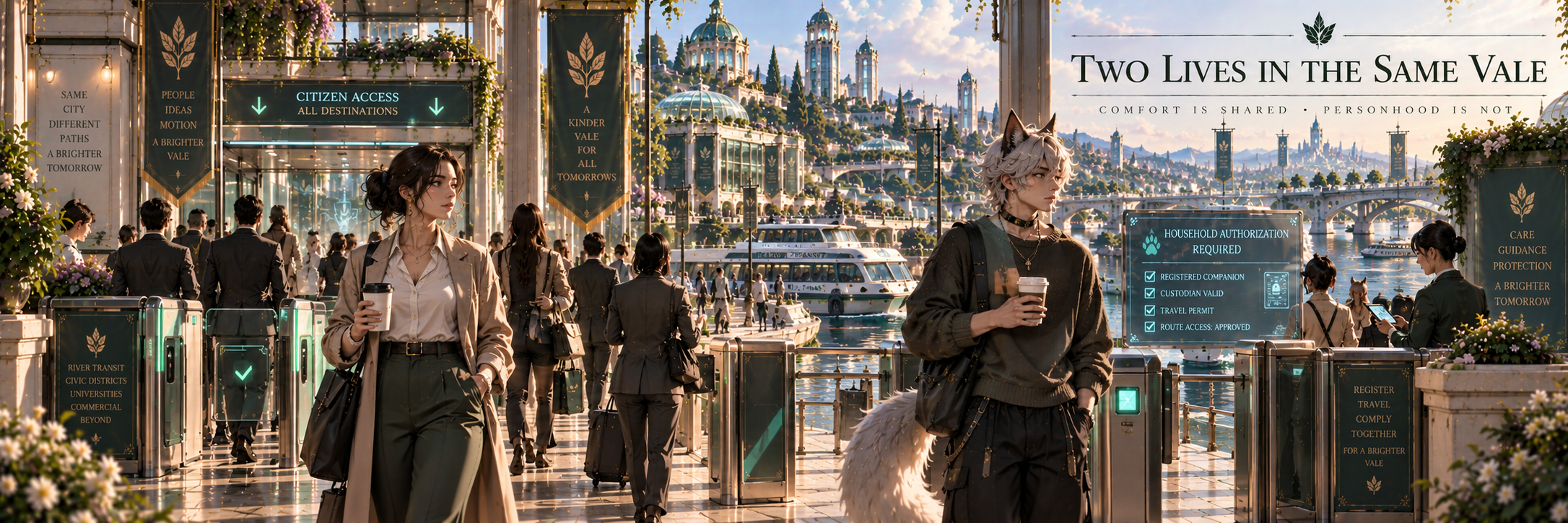
Ordinary Life Compared

Lineage & Classification
Every demi-human has ancestry. Brazoria Vale turns that ancestry into a formal language of breeds, lines, percentages and pedigrees.
Breed is not a measure of intelligence, health, character or personhood. It is a human-created system for describing biological inheritance and documenting descent. In everyday Brazorian life, however, those classifications can affect price, prestige, breeding rights and even the amount of government interest a companion attracts.
A companion whose registered ancestry meets Vale standards for a recognized single animal line. Purebred does not mean visually identical. Color, height, hair, eyes, body shape and temperament may vary considerably within the same pedigree.
A companion carrying two or more recognized animal lineages. Their appearance may blend those lines openly or strongly favor one ancestor. Mixed ancestry is ordinary throughout Brazoria and does not imply poor health or instability.
A deliberately planned cross between selected lines, usually created for appearance, size, temperament, shifting traits or household compatibility. Fashionable designer mixes may command prices rivaling or exceeding ordinary purebreds.
Parentage may be incomplete, records may conflict, or generations of mixing may resist clean classification. The companion may be perfectly healthy; Brazorian institutions simply dislike biological uncertainty they cannot neatly document.
Rare does not mean pure. A rare line may be purebred, mixed, uncertain or expressed through an unusual genetic throwback. Scarcity can come from endangered ancestry, isolated populations, unusual coloration, extinct-animal markers, rare shifts or mythic-linked traits.
Purebred describes lineage structure. Rare describes scarcity. A common purebred may be far less commercially valuable than an unusual mixed companion carrying a rare inherited trait.
Mixed ancestry does not always announce itself visually. A companion who appears entirely foxlike may still carry distant wolf, feline or other ancestry. Another may visibly inherit one parent's ears and another parent's tail.
For that reason, Brazorian pedigree culture relies heavily on records, genetic screening and lineage certification rather than appearance alone.
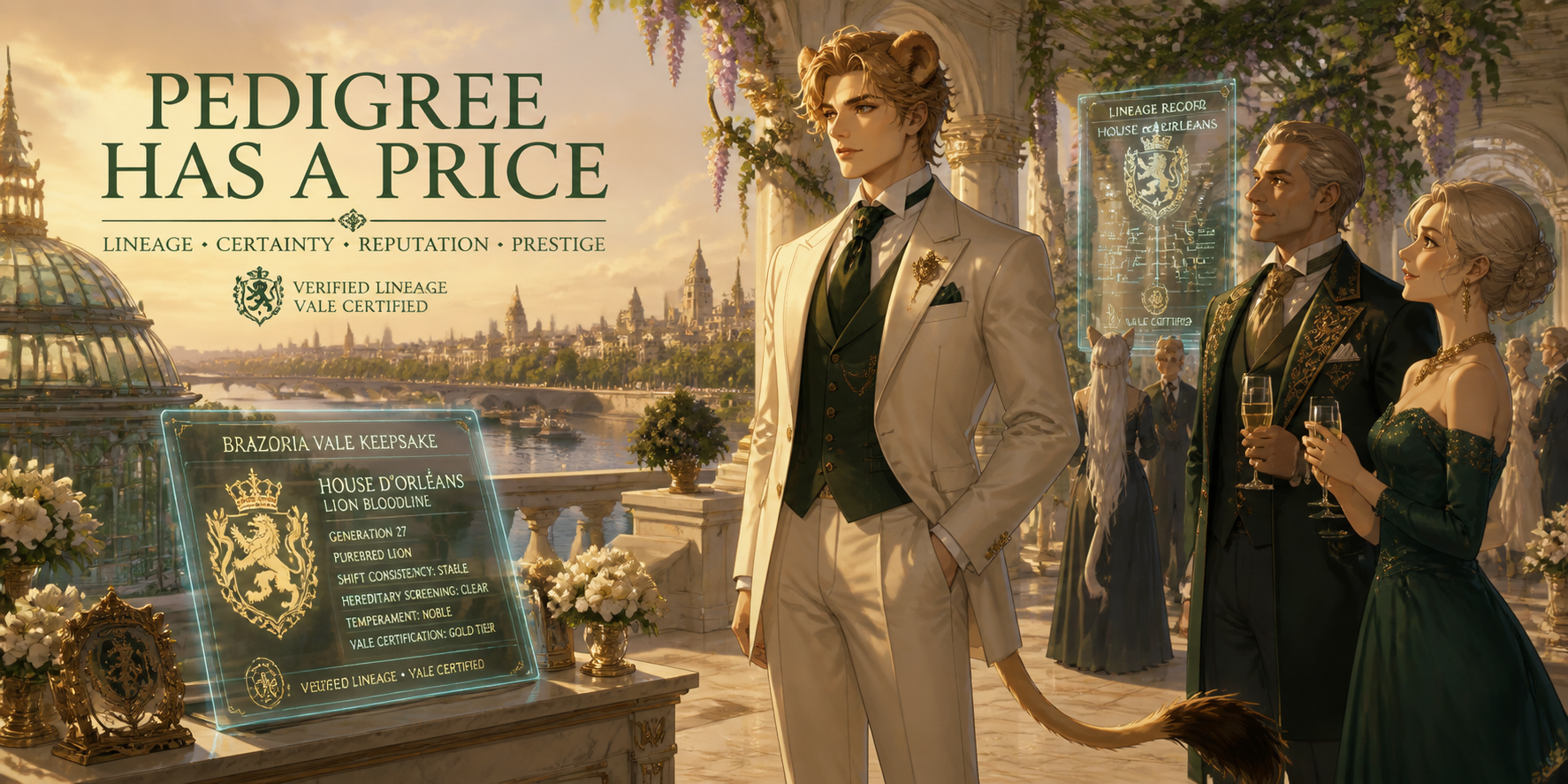
Pedigree & Prestige
Purebred companions cost more because Brazoria does not merely sell rarity. It sells certainty.
A prestigious pedigree promises documented ancestry, known hereditary risks, predictable biological traits and a recognizable breeder lineage. For wealthy households, those records transform a companion from a private relationship into a public symbol of taste, access and family standing.
Premium pedigrees may trace parents, grandparents, breeder lines, genetic testing, hereditary health, shifting expression, fertility history and previous certifications across multiple generations.
Established breeder houses function almost like luxury brands. A respected line may be known nationally for health, appearance, temperament, stable traits or generations of careful household placement.
Buyers value the expectation of predictable adult size, animal traits, full-shift expression, inherited sensitivities and temperament tendencies, even when biology refuses to behave as neatly as the paperwork promises.
Uncommon species, limited bloodlines, difficult fertility, unusual coloration and rare shift expression can dramatically increase value. A scarce purebred line may become a serious financial and political asset.
Some old households maintain associations with particular companion breeds for generations. A lineage may become as recognizable as the family's estate, crest or public name.
A rare pedigreed companion communicates money without a word. Purchase cost, specialist medicine, grooming, breeder connections and long-term care all advertise what the household can afford.
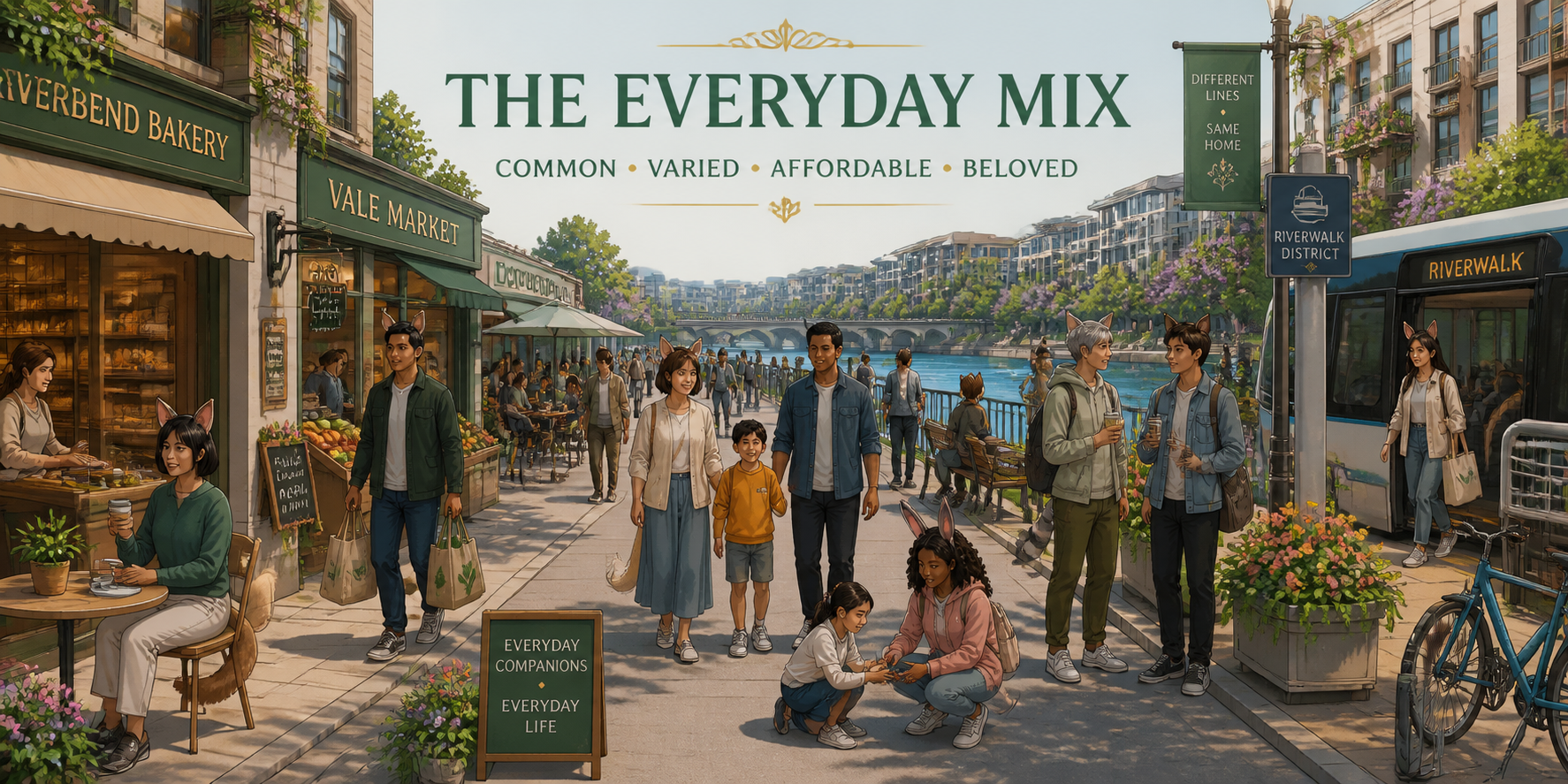
Everyday Companion Culture
Mixed-breed demi-humans are not a strange exception to companion life in Brazoria Vale. They are part of its everyday fabric.
They live with shopkeepers, teachers, office workers, young couples, retirees and ordinary families. A person does not need an estate fortune or famous surname to keep a companion, and for much of the middle class, mixed ancestry is simply normal.
Mixed companions generally carry much lower placement and pedigree costs than certified purebreds. Registration, healthcare and upkeep still cost money, but companion ownership remains realistic for ordinary stable households.
Generations of migration, household breeding and cross-line relationships have made mixed ancestry widespread. Brazorians encounter mixed companions in neighborhoods, cafés, ferries, clinics, parks and family gatherings every day.
A mixed companion may inherit one lineage's ears, another's tail and subtler traits from several more ancestors. Others visually resemble a single species despite much more complicated ancestry beneath the surface.
Mixed breeds fill ordinary bedrooms, breakfast tables and family photographs throughout the Vale. They are not automatically associated with poverty, neglect or lower-quality care.
Mixed ancestry produces enormous variation in coloration, ears, tails, sensory traits, shifting expression and inherited characteristics. Siblings from the same family can look remarkably different.
Not every mix is accidental. Breeders intentionally cross selected lines for desired appearance, temperament or biological traits. A fashionable designer cross may become more expensive than an ordinary purebred.
Purebred prestige is additive. Mixed status is ordinary. Most Brazorians do not hear “mixed breed” and automatically interpret it as unhealthy, undesirable or socially embarrassing.
Pedigree snobbery certainly exists, especially among old families, heritage circles and elite breeder societies, but it is not the default attitude of every household.
Appearance is expression, not proof. Two companions who look very different may share substantial ancestry, while two who appear nearly identical may have completely different pedigrees.
Lineage Industry
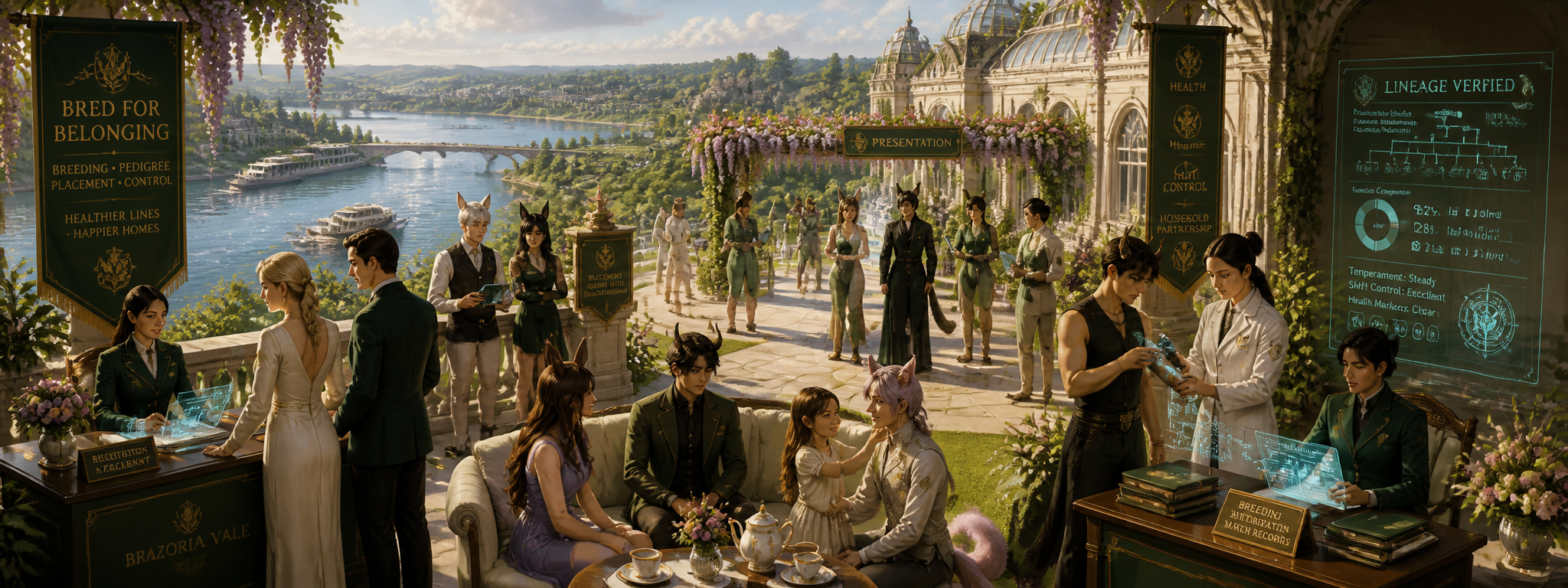
Behind Brazoria's companion households lies an enormous professional system of breeders, registries, genetic laboratories, estate lines, shows and placement agencies.
The industry presents itself as responsible stewardship: healthier lines, safer pairings, careful household matching and protection from hereditary disease. Its critics point to the same machinery and ask a simpler question: who owns the right to decide whether a demi-human reproduces at all?
The industry ranges from small household breeders and boutique designer-mix houses to prestigious purebred families and enormous lineage estates. Reputable breeders may maintain lifelong relationships with the companions they place.
Commercial pedigrees track parentage, ancestry, species percentages, phenotype, hereditary health, fertility, shifting traits, breeder history and previous certification.
Helix Vale provides much of the genetic analysis behind the system, while Vale authorities recognize pedigree status, record registered lines, document breeders and investigate disputed ancestry.
Shows range from prestigious pedigree exhibitions to family-oriented festivals. Categories may recognize health, presentation, grooming, lineage, shift control and household partnership. Mixed-breed events are common as well.
Money changes hands, but respectable Brazoria favors softer language: placement, matching, adoption, household transition and lineage placement. Direct language such as buying stock is considered crude.
Breeding may require health clearance, pedigree review, fertility registration, custodian approval and lineage compatibility. A demi-human's preference can matter socially without always being the final legal decision.
Brazorian reformers argue that demi-human consent should be mandatory, breeding contracts should expire and heritage classification should never override an individual's refusal.
Defenders of the existing system answer that regulated breeding prevents hereditary disease, discourages abusive breeders, protects vulnerable offspring and preserves rare lines.
Both sides often speak in the language of welfare. Their deepest disagreement is over who gets the final decision.
The more valuable ancestry becomes, the more profitable it becomes to lie about it.
Fraud works in both directions. One household may invent rare ancestry to raise a companion's market value. Another may hide rare ancestry to prevent heritage restrictions, government attention or reproductive claims.
Human Society
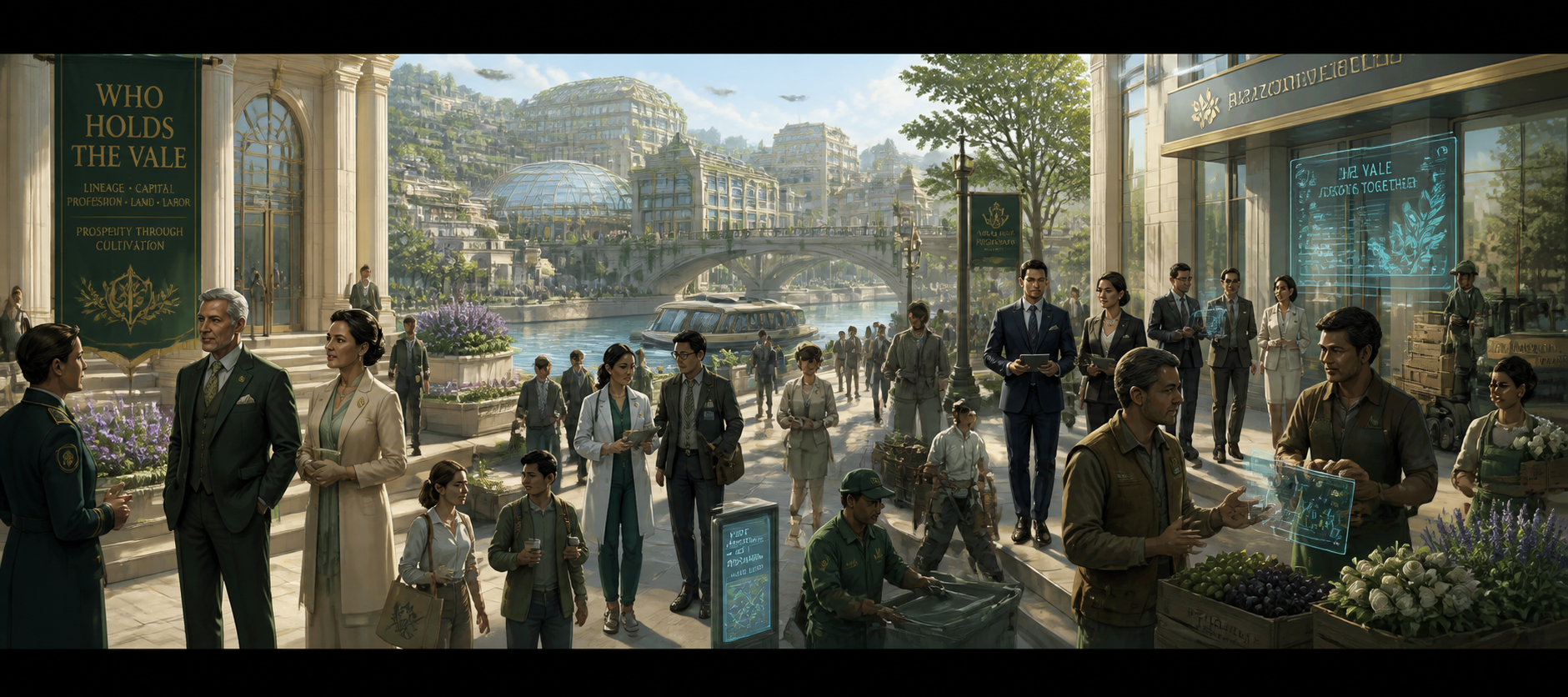
Brazoria Vale has no formal human caste system, but wealth, family name, education, land and institutional access produce a social hierarchy every bit as visible as law.
Old agricultural wealth exists beside biotechnology fortunes, respected professional authority and a broad urban middle class. Social mobility is possible, but some names, estates and networks have shaped the Vale for generations.
Historic estate families sit near the top of Brazorian society. Their power comes from land, river rights, breeder lines, corporate shares, foundations and generations of political relationships rather than formal nobility.
Biotech executives, major shareholders, Helix leadership and infrastructure magnates represent newer wealth. They may lack old names, but capital, research access and political leverage make them formidable.
Doctors, geneticists, attorneys, researchers, engineers, academics and senior administrators command considerable respect in a country that treats expertise as a pillar of competent stewardship.
Orchard families, greenhouse operators, breeders, irrigation holders and regional growers range from comfortable proprietors to immense estate owners. Land remains both cultural identity and economic power.
Teachers, nurses, technicians, clerks, shop owners, civil employees and office workers form the ordinary comfortable Vale. Many maintain companion households without belonging to elite society.
Dock crews, agricultural workers, delivery staff, warehouse employees, cleaners, transit workers and other lower-wage citizens possess less wealth and influence but retain full human civic personhood.
Brazoria's elite is not unified. Old families often consider reputation, heritage and cultivated restraint signs of legitimacy. Corporate elites answer with research influence, enormous capital and direct control over the infrastructure modern Brazoria depends upon.
The two groups compete, cooperate, marry into one another and frequently occupy the same boards.

Companion Society
Demi-humans do not occupy one social class in Brazoria Vale. Pedigree, household wealth, work, reputation and registration create an entire hierarchy within legal dependency.
Two companions may share exactly the same legal lack of independent personhood while experiencing completely different worlds of money, safety, education, privacy and public prestige.
Rare pedigree, prestigious breeder and powerful household combine into exceptional status. These companions may receive bespoke clothing, private travel, elite healthcare, personal suites and public recognition by name.
A companion need not be rare to carry social weight. Association with a respected family, professional household or locally famous owner can bring excellent care, fashionable presentation and considerable public deference.
The ordinary companion life of apartments, family dinners, errands, hobbies, allowances, parks and middle-class routines. Comfortable, integrated and common rather than socially exceptional.
Some companions regularly assist in shops, agriculture, river services, estates, hospitality, care work or specialized roles. Their conditions vary enormously according to household and occupation.
Companions raised by large breeders, conservatories, clinics or placement institutions may receive good material care while lacking the personalized household belonging Brazoria considers socially ideal.
Runaways, abandoned companions, undocumented births and people with damaged or false records lack a recognized household standing between them and the state. Brazoria describes them as unprotected, not independent.
An elite purebred companion from a powerful old family may wear better clothing, receive better medicine, travel more widely and command more social attention than a low-income human citizen.
A purebred Great Dane raised by the Louves, for example, occupies a social universe far removed from an inexpensive mixed-breed companion in a struggling household. Household name alone can alter how strangers, businesses and institutions treat them.
Everyday Social Life
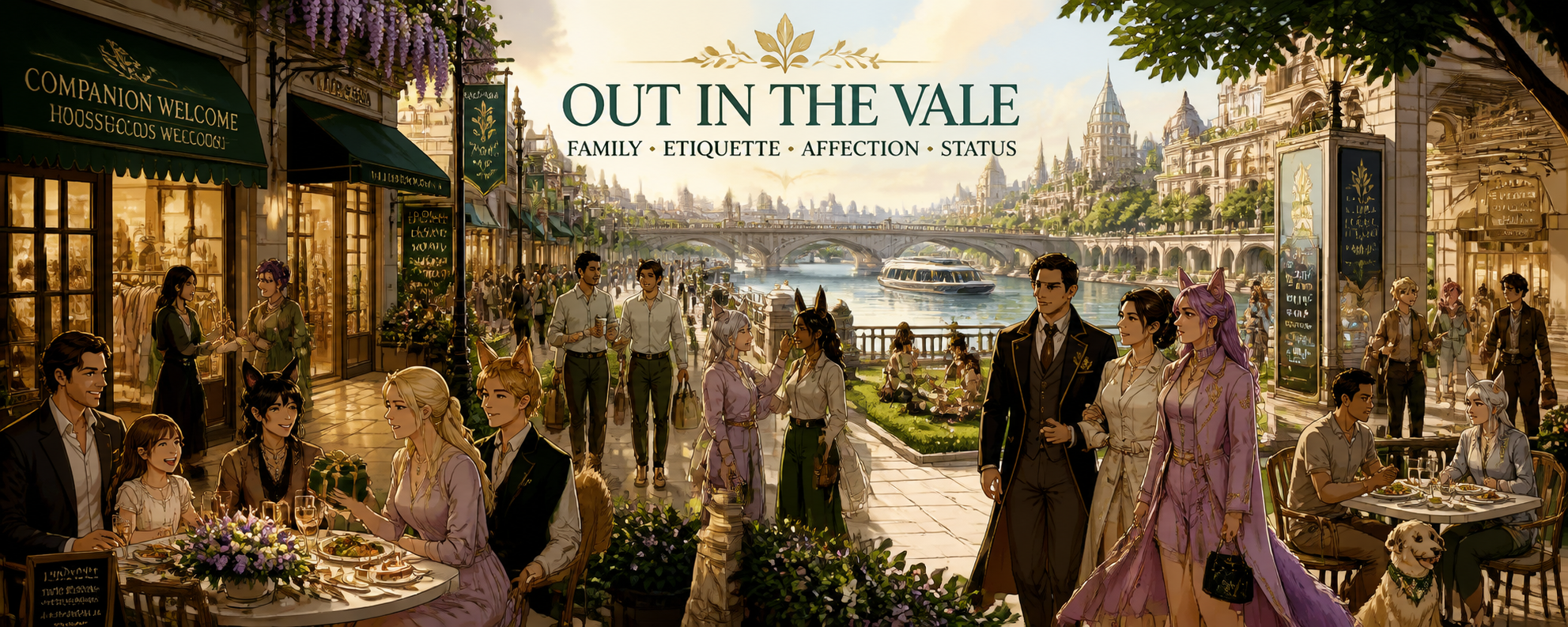
Most human and demi-human interaction in Brazoria does not happen in registries, laboratories or courts. It happens over breakfast, at cafés, on ferries, during birthdays, in parks and while somebody argues over what to order for dinner.
Companions are not hidden from Brazorian public life. Much of public life is deliberately designed around their presence.
Companions attend birthdays, weddings, funerals, graduations, holidays, reunions and family photographs. Some grow up beside human children and remain emotionally woven into the same household for decades.
Companions normally eat at the table using ordinary dishes and utensils. Many establishments offer tail-clearance seating, quieter spaces, dietary accommodations and other morphology-aware service.
Families picnic, companions meet friends, households walk together and supervised shifting areas provide recreation. Public demi-human presence is considered normal rather than exceptional.
Clothing, grooming, registration jewelry, cosmetics, tail accessories and species-specific products form a major retail market. Companions commonly choose items according to their own tastes even when household funds remain owner-linked.
Hugs, hand-holding, leaning together, cheek kisses, shared photographs and grooming hair or ears are ordinary. Companion culture is physically affectionate enough that familial closeness can sometimes resemble romance to outsiders.
A healthy, confident and beautifully presented companion reflects well on a household. Rare pedigrees draw attention, but visible happiness itself is often treated as evidence of good stewardship.
Traditional Brazorians often introduce a companion through household belonging: “This is Ellis, our fox,” or “Mina is with the Halden family.”
Younger and more progressive circles increasingly lead with the companion's name alone. Elite environments may add breeder or pedigree information because lineage itself functions as social information.
National Economy
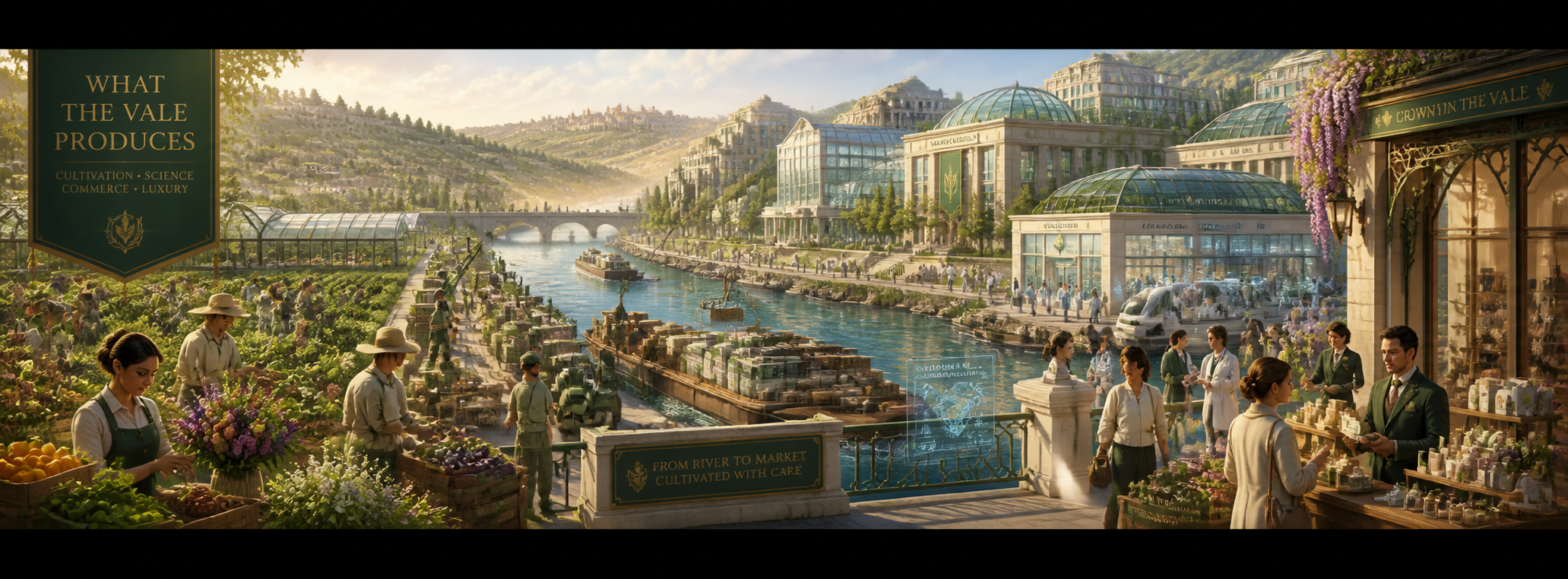
Brazoria Vale built its wealth from an unusually productive combination of fertile land, navigable water, scientific expertise and a national obsession with cultivation.
Agriculture remains the foundation, but modern Brazoria does far more than grow food. It studies biology, develops medicine, moves enormous volumes of goods along the Brazor and turns both natural abundance and technical expertise into high-value exports.
Orchards, greenhouse belts, vineyards, grains, vegetables, flowers, medicinal plants and specialty estate crops feed both domestic markets and export networks. Irrigation, genetics and environmental monitoring keep production intensive and carefully managed.
Genetic screening, ancestry analysis, fertility science, hereditary disease detection, agricultural genetics, phenotype modeling and biological databases make biotech one of the Vale's most internationally influential sectors.
Hospitals, specialty clinics, reproductive medicine, pharmaceuticals, diagnostic technology, rehabilitation and morphology-specific care support a medical industry known for sophisticated biological expertise.
Ports, river freight, warehouses, cold storage, ferry systems and distribution networks connect farms, laboratories, cities and foreign markets. Much of the national supply chain ultimately touches the Brazor.
Fine clothing, jewelry, perfumes, botanical cosmetics, estate wines, specialty foods, decorative horticulture and companion fashion transform Brazoria's cultivated identity into expensive consumer goods.
Architecture, landscaping, greenhouse construction, flood engineering, property management and riverfront development support the estates, research campuses, resorts and prosperous cities that define modern Brazoria.
Agriculture produces the Vale's biological wealth. River infrastructure moves it efficiently. Science increases its value through research and prediction. Medicine commercializes biological expertise. Luxury industries package cultivation itself as prestige.
Rather than functioning as isolated sectors, these industries constantly feed one another.
National Artery
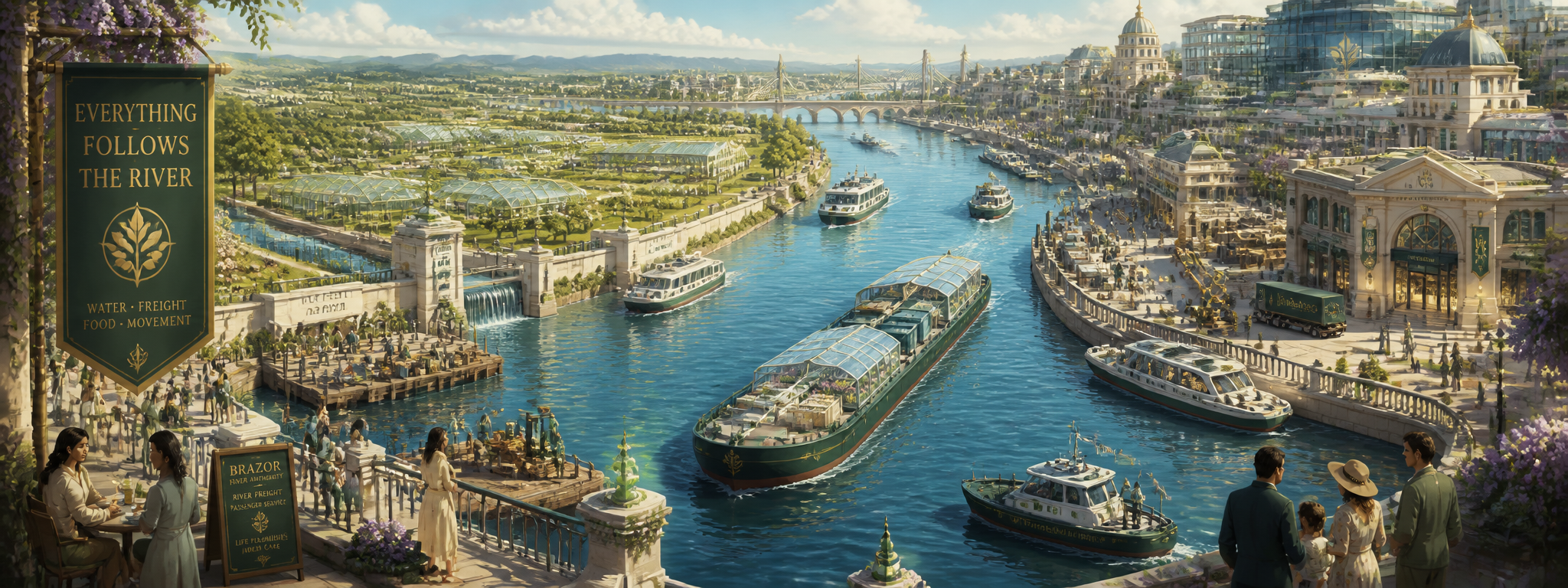
The Brazor River is not one Brazorian industry among many. It is the physical system that allows most of the others to exist.
Cities cluster along it. Fields drink from it. Freight rides it. Laboratories and hospitals rise beside it. Commuters cross it every morning while tourists photograph the same water carrying refrigerated produce and research cargo downstream.
River diversions, canals and controlled irrigation feed orchards, greenhouse belts, vineyards, fields and municipal systems. Water rights are among the most economically valuable privileges in the Vale.
Barges carry agricultural produce, medical shipments, research materials, manufactured goods and luxury exports between rural docks, city ports and major distribution centers.
Commercial terminals combine loading docks, warehouses, cold storage, customs facilities and transport links. Roads and rail often feed into these ports rather than replacing river movement.
The Brazor ties countryside directly to urban markets. Orchard estates, vineyards, floral farms and greenhouse complexes can move goods from field to city without leaving the river corridor.
Freshwater fisheries, hatcheries and controlled aquaculture support river communities and city food markets while remaining carefully monitored by environmental and water-quality authorities.
Commuter ferries, regional passenger boats and water taxis make the river part of everyday movement. For many Brazorians, crossing the Brazor is simply part of going to work.
Cruises, waterfront hotels, estate tours, botanical gardens, festivals, fishing and riverfront dining turn the same working waterway into one of the country's strongest visual brands.
Research and medical facilities cluster near river cities for shipping, transit, hospitals, universities and agricultural partnerships. Science follows the same infrastructure as produce and freight.
Control over the Brazor means control over irrigation permits, ferry licenses, port access, commercial navigation, flood defense, water quality and patrol.
The River Authority therefore regulates far more than water. It regulates the physical bloodstream through which much of the national economy moves.

Companion Commerce
Companion ownership supports one of Brazoria Vale's most visible consumer economies. The market begins before a companion enters a household and follows them through nearly every stage of life.
It sells health, beauty, convenience, recreation, expertise and prestige. Very little of its advertising needs to sell ownership itself. Ownership is already assumed.
Household breeders, purebred houses, designer-mix programs, lineage estates and placement agencies charge for carefully managed breeding, matching and household transitions.
Ancestry scans, genetic verification, pedigree documents, registry fees, breeder licensing and fraud investigation support an entire industry dedicated to proving what a companion is.
Neighborhood salons and luxury spas specialize in hair, ears, tails, horns, wings, skin, nails and show preparation. High-end services resemble human salons with morphology expertise rather than animal grooming shops.
Tail-adapted trousers, wing-backed coats, ear-safe hats, horn-compatible formalwear, registration jewelry and shift-safe clothing support designers ranging from ordinary retailers to prestigious fashion houses.
General medicine, hereditary screening, shift care, dentistry, rehabilitation, reproductive medicine and mental wellness make companion healthcare one of Brazoria's most technically sophisticated service sectors.
Household resorts, botanical spas, swimming facilities, supervised shifting grounds and private companion stays turn recreation itself into another extension of responsible ownership.
Policies may cover medical costs, hereditary disease, travel, accidents, liability, pedigree disputes, reproductive complications, unlawful transfer and specialized rare-line risks.
Tail-friendly furniture, adapted bathrooms, wing-clearance rooms, specialized bedding, travel equipment, identification jewelry and shift-safe fixtures support a large companion-ready home market.
Shift control, household coaching, public etiquette, specialized skills and companion shows support trainers, educators, stylists, sponsors, photographers and event organizers across the Vale.
The companion industry employs far more people than breeders and geneticists. Much of the sector is made of ordinary Brazorians whose work exists because companion households require specialized goods and services.
Brazorian marketing rarely emphasizes ownership. It sells the emotional duties that ownership supposedly creates.
Everyday Technology
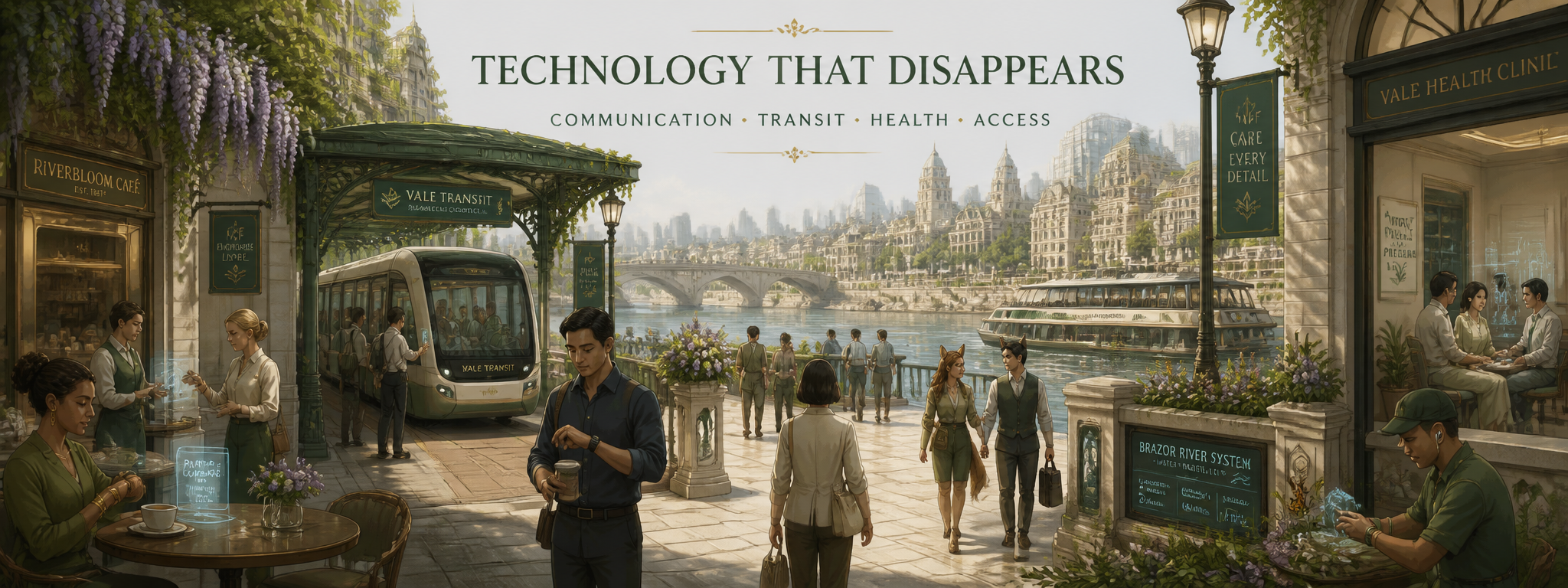
Brazoria Vale is technologically sophisticated without looking aggressively futuristic. Its best systems are designed to disappear into beautiful buildings, ordinary routines and cultivated landscapes.
A centuries-old limestone facade may conceal biometric access, adaptive climate control, water monitoring and medical infrastructure. Brazorians consider technology most successful when it improves life without demanding attention.
Bracelets, watches and jewelry-like cuffs handle messages, calls, payments, identity, appointments, navigation and transit. Practical models are nearly universal, while elite versions become expensive accessories in their own right.
Thin river-blue projections appear at shops, offices, clinics and transit stations only when information is needed. Brazoria prefers restrained displays over streets drowned in glowing advertisements.
Quiet trams, autonomous shuttles, ferries, regional rail and pedestrian systems connect river cities efficiently. Wrist-com identity and payment make most daily travel nearly frictionless.
Non-invasive diagnostics, genetic risk screening, adaptive rehabilitation and biological monitoring are common throughout the healthcare system. The same precision that improves medicine also makes biological classification extraordinarily detailed.
Climate zones, adaptive lighting, air-quality controls, automated kitchens, medication alerts, botanical irrigation and quiet security systems adjust continuously to household routines.
Traffic, river levels, water quality, flood risk, transit schedules and botanical maintenance are monitored through systems built discreetly into bridges, planters, stations and civic architecture.
Brazorians generally distrust machines that appear loud, militarized or visually intrusive. Technology is expected to preserve architecture, soften inconvenience and quietly anticipate problems rather than dominate the environment.
Companion Systems
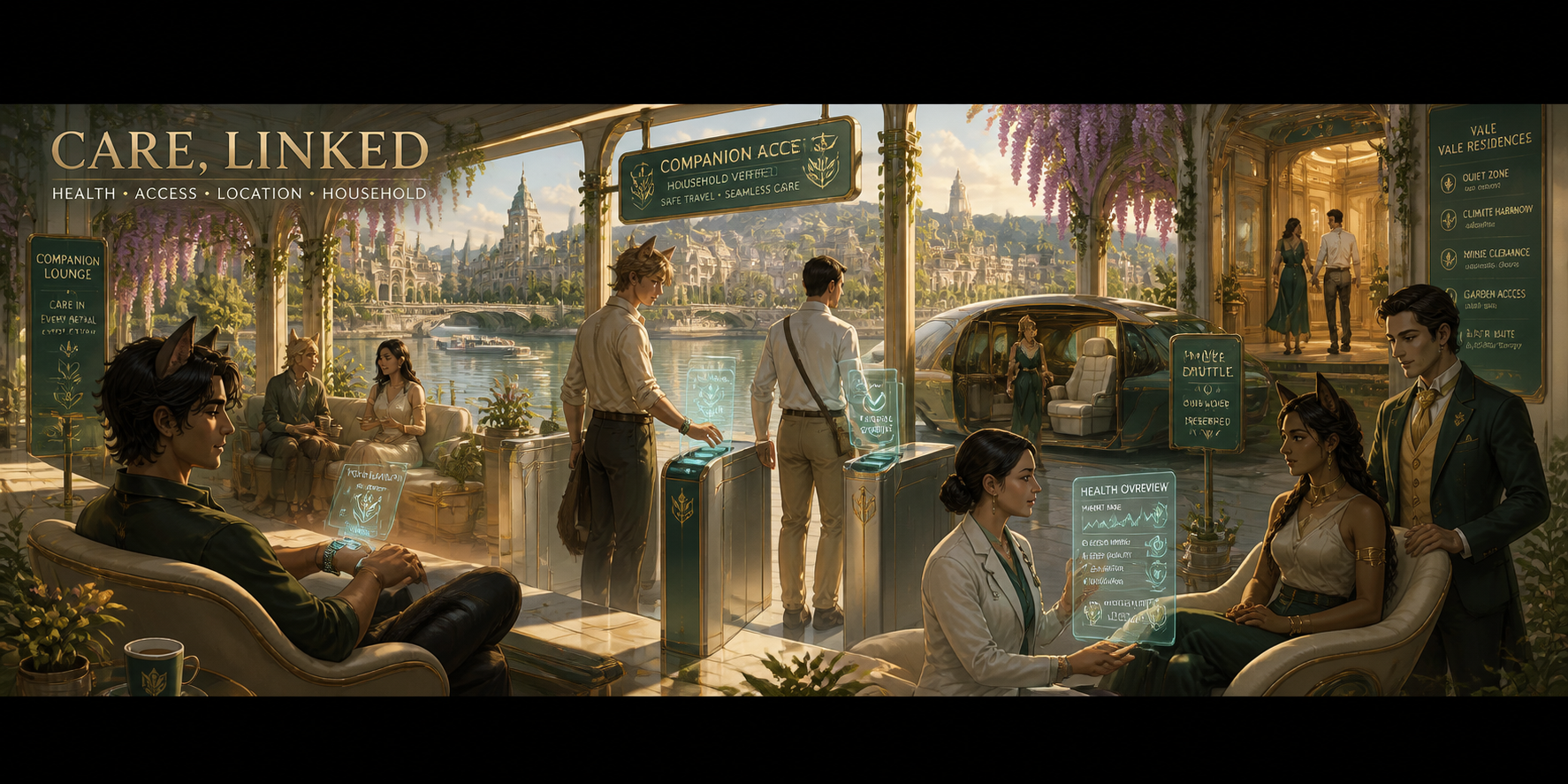
Brazoria rarely controls companions through machinery that looks like restraint. Identity, healthcare, travel and household access are instead woven into elegant systems designed to feel safe, useful and comfortable.
The technology can save lives, improve accessibility and make everyday life remarkably easy. It can also determine who may travel, who may enter, who may access records and whose authorization turns a preference into permission.
Bracelets, cuffs, necklaces, brooches, anklets and decorative collars may carry companion registration, household affiliation, emergency contacts, medical profile and travel permissions. High-end versions function as luxury jewelry.
Wearables can track medication, injury, stress, sleep, shift strain and hereditary risk while sharing relevant information with physicians and households. The care is genuine; control over the data is not always equal.
Homes, transit gates, accounts, recreation facilities and long-distance travel may recognize both the companion and the authorization attached to their registered household.
Encrypted biological profiles connect companions to verified ancestry, breeder records, hereditary health, fertility status, shift classification, rare markers and transfer history without requiring those records to sit visibly on the device itself.
Household location sharing supports emergency recovery, transit confirmation and missing-person alerts. Brazoria frames this as family safety, even when a companion has less authority than an adult human to permanently disable it.
Tail-clearance furniture, wing-safe seating, ear-sensitive sound systems, humidity controls, shift-safe doors and morphology-aware baths make homes and public spaces genuinely easier for companions to inhabit.
Premium household vehicles and river transport offer climate zoning, tail channels, wing clearance, medical monitoring and spacious interiors while quietly retaining household-linked travel permissions.
Companions message friends, call family, shop, use entertainment platforms and organize social lives through ordinary devices. Restriction lies less in communication itself than in linked identity, payments and access.
Smart homes adapt temperature, humidity, sound, lighting and access to individual morphology. The house may understand precisely what a companion needs while remaining legally someone else's house.
Land & Water Systems
Brazoria Vale looks naturally abundant because generations of engineering, biological research and constant monitoring have learned how to keep it that way.
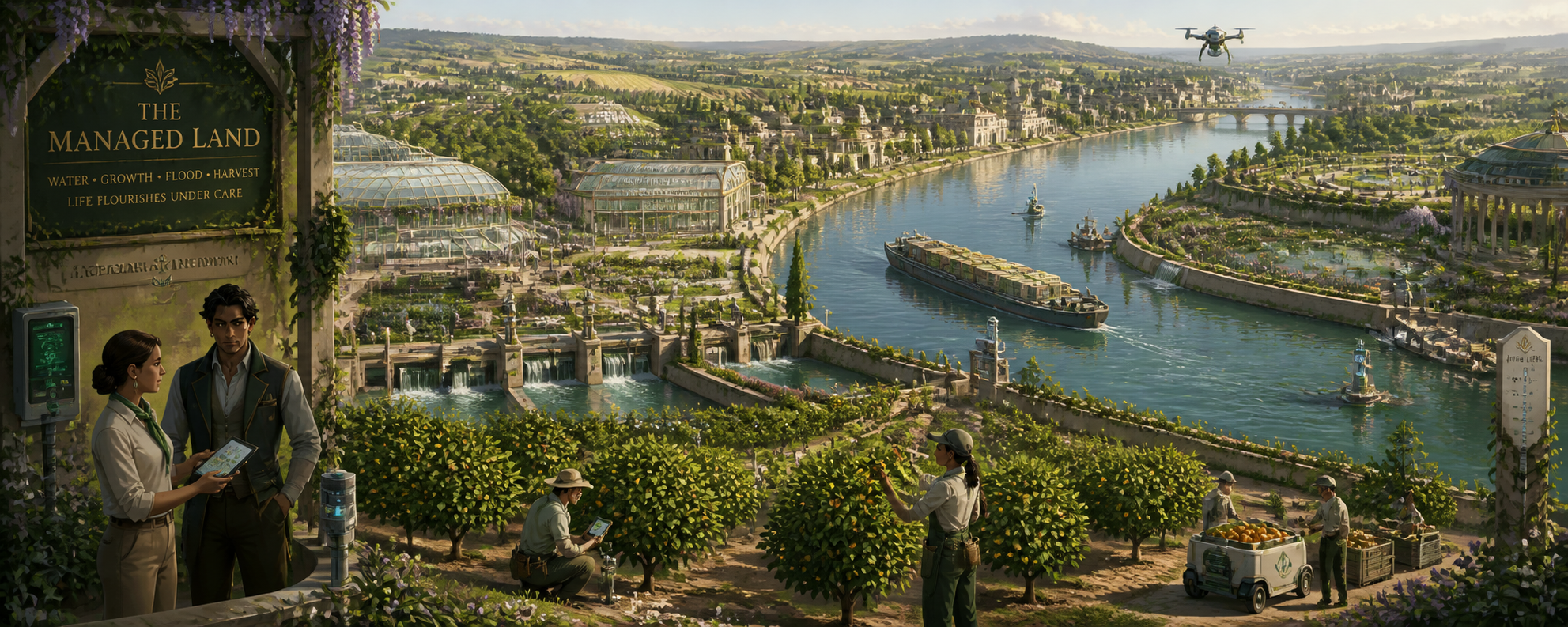
The countryside is not untouched nature. Water is routed, soil is measured, crops are selected, floods are anticipated and even wetlands may serve carefully designed economic or protective functions.
Automated gates, soil sensors, weather models and predictive irrigation route Brazor water toward orchards, fields and greenhouse belts according to crop needs, rainfall and river conditions.
Disease resistance, drought tolerance, flavor, yield, medicinal compounds and regional adaptation are improved through extensive agricultural genetics and controlled breeding programs.
Large greenhouse belts use automated shading, climate control, water recycling and precision cultivation for delicate produce, pharmaceuticals, flowers and research crops.
Bridge sensors, buoys and discreet stations continuously measure flow, depth, temperature, contamination, ecological health, freight traffic, weather and flood risk.
Adaptive levees, overflow channels, wetlands, retention gardens and movable barriers protect river settlements. Some of Brazoria's prettiest parks are functioning flood infrastructure disguised as landscapes.
Dock scheduling, vessel tracking, cargo monitoring and water-depth modeling keep agricultural and medical shipments moving efficiently along the national river corridor.
Hatcheries and aquaculture systems monitor water chemistry, population health, disease, breeding and habitat conditions while wild fisheries operate under intensive ecological oversight.
Crop drones, autonomous harvest carts, greenhouse robotics, produce sorting and quiet utility vehicles supplement human labor without visually dominating the cultivated landscape.
Pollinator monitoring, wetland restoration, erosion control, soil recovery, biodiversity tracking and water purification protect the natural systems on which Brazoria's prosperity depends.
Brazoria rarely sees engineering and landscape design as opposing goals. Flood basins become botanical parks. Water-control stations are built in limestone and planted with flowers. Research greenhouses become architectural landmarks.
The result is infrastructure designed to disappear inside the landscape it manages.
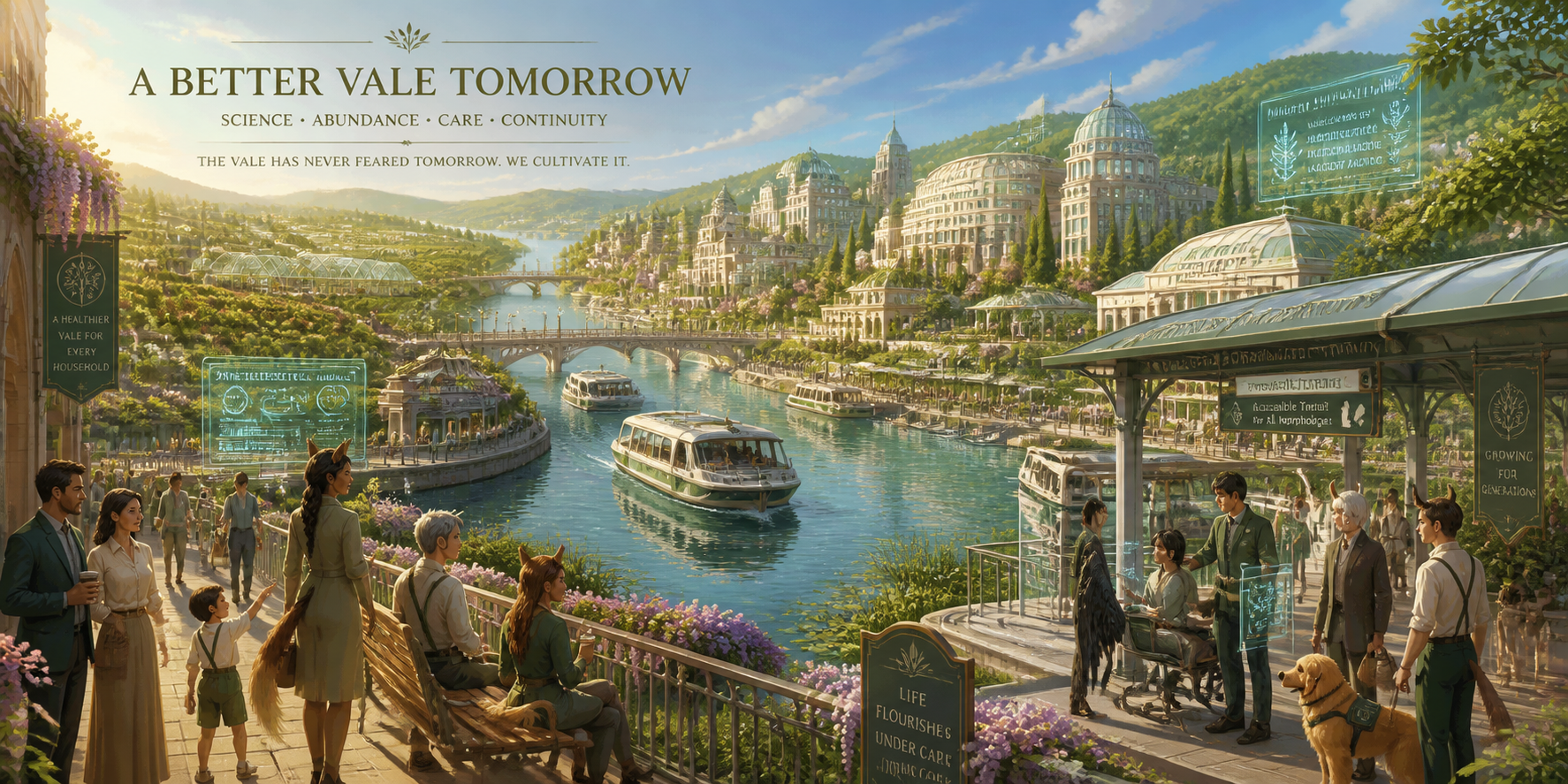
Official National Vision
Brazoria Vale does not imagine its future as revolution. It imagines refinement.
The national promise is simple: every generation should inherit a Vale that is cleaner, healthier, more productive, more scientifically precise and more compassionate than the one before it. Brazoria does not believe its institutions need to be replaced. It believes they need to become better at caring.
Earlier disease detection, precision medicine, reproductive care, agricultural genetics, improved shift treatment and increasingly accurate biological modeling are expected to keep the Vale at the forefront of life science.
Future growth emphasizes higher yields, climate-adaptive crops, greenhouse expansion, soil restoration and more efficient water use rather than simply clearing more land.
Quieter transit, pedestrian riverfronts, smarter buildings, cleaner freight, expanded clinics and botanical public spaces are intended to let Brazorian cities grow without becoming harsher places to live.
Expanded ferry networks, smarter irrigation, modernized ports, flood gardens, restored wetlands and new research corridors keep the Brazor at the center of both economic development and public life.
Future policy emphasizes stronger breeder oversight, better medicine, morphology accessibility, recreation, anti-neglect enforcement and more direct participation by companions in their own care.
Rare lines, endangered ancestry, hereditary archives and unusual biological traits are increasingly treated as resources worth preserving through careful genetic management and long-term conservation.
Mainstream reform does not require Brazoria to abandon companion ownership. Instead, it promises better homes, safer breeders, stronger medical care, more recreation, improved accessibility and gentler regulation.
The official assumption remains that a more humane form of stewardship is the answer.

Pressure Beneath the Vision
Brazoria's future is not threatened because its cities have stopped functioning. It is threatened because its categories are becoming harder to defend.
The river still moves. The gardens still bloom. Companion households still gather for dinner. Yet more people are beginning to ask whether excellent care can answer a question that is fundamentally about autonomy.
The argument is slowly moving beyond whether companions receive enough protection. Reformers increasingly ask why adult sapient people remain companions at all, and whether civic personhood can coexist with the existing custody system.
Many young Brazorians grew up loving demi-humans as siblings, friends and family. That intimacy creates difficult questions about travel permission, medical privacy, inheritance and why someone described as family can still be owned.
Dating, cohabitation, marriage and chosen partnership force households to confront companions as adults with lives that may extend beyond the family that raised them.
Every well-cared-for companion who chooses uncertainty over a secure household undermines the comforting claim that only mistreatment creates a desire to leave.
Forged ancestry, hidden rare markers, altered parentage and corrupted transfer records attack an economy and legal system built on confidence that biological history can always be known and verified.
Conflicting classifications and unreliable ancestry records threaten pedigree value, breeder contracts, heritage claims and court decisions. A system designed to eliminate uncertainty is beginning to generate it.
Brazoria is comfortable calling companions family while that family remains organized around permanent dependency.
The language becomes harder when an adult companion says they want to move out, choose a partner, marry, refuse reproduction, raise children independently, or build a household that no longer centers the human family that owns them.
Brazoria knows how to condemn cruelty. Neglectful owners, abusive breeders and violent institutions fit neatly into the national story because they can be described as failures of stewardship.
The far harder problem is the loving household whose companion still wants to leave.
They may have provided a private room, excellent medicine, vacations, education, affection and every comfort their society considers exemplary. If the companion still says, “I want my life to be mine,” better care no longer answers the complaint.
The political danger grows when these groups stop acting separately. A companion asks for personhood, a human friend agrees, a doctor challenges the consent system, and a lawyer discovers a case worth bringing to court.
Foreign Relations
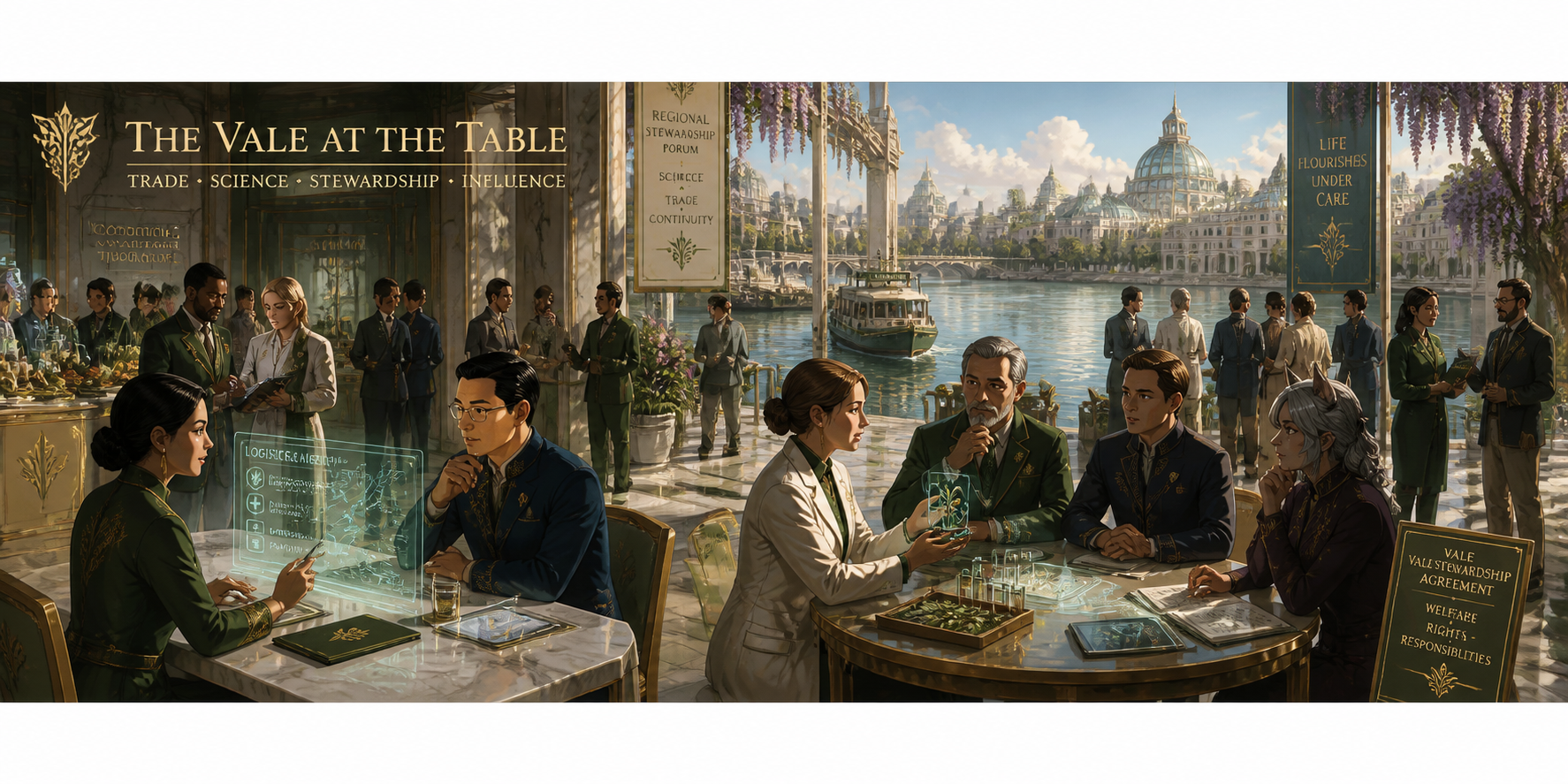
Brazoria prefers influence to intimidation. Its strongest diplomatic tools arrive as medicines, research agreements, agricultural contracts, technical standards and river commerce rather than armored columns.
The Vale sees itself as Vistall's reasonable middle: more humane than the Pecos Crown, less rigid than San Aurelo, more orderly than Mesquite Reach and more institutionally responsible than the demi-human powers that reject its stewardship system outright.
Countries may object to Brazorian politics while still relying on its medicines, diagnostics, crop science, biological analysis, technical expertise and commercial investment.
Medical conferences, agricultural partnerships, river-management agreements, genetic archives and conservation programs let Brazoria solve real problems while extending its standards into foreign institutions.
Premium agriculture, pharmaceuticals, biotechnology and river logistics give foreign governments reasons to maintain working relations even when broader political trust is thin.
After judging every neighbor against its own standards, Brazoria arrives at the conclusion it finds most comfortable: the Vale must surely be the sensible one.
Brazorian officials are accustomed to debating how companions should be housed, treated, medically protected and regulated. They are considerably less comfortable when another government rejects the category itself.
A presentation on excellent welfare standards may therefore be intended as proof of moral responsibility and received instead as evidence that Brazoria still claims legal authority over adult people.

Human-Controlled Powers
Brazoria's human-controlled neighbors are not a circle of friends. They are a web of states whose economies, security systems and political assumptions remain useful to one another.
They differ sharply over how human authority should be expressed. What they rarely dispute is whether human governments may exercise that authority at all.
San Aurelo is Brazoria's most sophisticated establishment partner. Their governments, research sectors and corporate networks share enough interests that cooperation has become routine.
Brazoria contributes biological research, agricultural wealth, ancestry analysis and technical expertise. San Aurelo contributes finance, institutional legitimacy and powerful political networks.
Their difference is primarily one of style. San Aurelo prefers cleaner legal hierarchy and stricter separation. Brazoria prefers incorporation under stewardship, arguing that valuable lives should be cared for rather than simply excluded.
Brazoria dislikes the Crown's visible brutality. The objection is not to ownership itself, but to the Crown's willingness to make domination crude, punitive and impossible to disguise as care.
The relationship remains useful through medical systems, biological analytics, crop supply, classification tools and freight agreements. Each side considers the other's methods wasteful.
Then both delegations sign the contract.
Mesquite Reach is less a conventional ally than a place where respectable systems become flexible. Brazoria publicly complains about its instability while quietly benefiting from its brokers, transport networks, off-grid medicine and ability to make difficult problems disappear into uncertain paperwork.
The danger is that Reach operators remember who asked for what. Every hidden transfer, falsified record and quiet procurement deal creates leverage Brazoria cannot completely control.

Demi-Human Powers
Brazoria expects its welfare standards to matter in international debate. Thornwyck, Eirwold and Veyrhalden acknowledge the difference between Brazorian stewardship and overt brutality, then reject the institution beneath both.
Thornwyck attacks Brazoria with the language Brazoria respects most: law, documentation, expert testimony and formal procedure.
Its lawyers challenge custody orders, conservatory claims, medical-consent exemptions, heritage restrictions and biological-record seizures with painstaking precision.
This is especially infuriating to Brazoria because Thornwyck cannot easily be dismissed as anti-intellectual. Its courts and scholars understand Brazorian law perfectly well. They simply reach the opposite moral conclusion.
Eirwold's conflict with Brazoria centers on information itself. Where Brazoria sees ancestry databases, genetic verification and biological records as tools of protection, Eirwold sees a map of bodies waiting to be claimed.
Eirwold lineages are preserved through family, clan, memory and guarded local knowledge rather than centralized registries. Requests for census, pedigree or biological data therefore encounter deep suspicion.
Veyrhalden threatens something more practical than Brazoria's reputation: its ability to keep custody physically enforceable.
River routes, sanctuary networks, false records and discreet extraction systems allow companions to cross beyond Vale authority. Brazoria describes these operations as kidnapping, unlawful transfer and interference with protected wards. Veyrhalden describes them as helping people leave.
Brazoria points to food, housing, education, medicine, accessibility, recreation and protection as evidence that its companion system is fundamentally humane.
Its demi-human neighbors do not necessarily deny that those protections are real. They deny that any of them establish a legitimate right to own another adult person.

Brazor Station Overview
Brazor Station is the corporate transit-capital of Brazoria Vale, a river-rail metropolis where government, biotechnology, medicine, agriculture and national transportation converge around the Brazor.
The city began as exactly what its name suggests: a station on the river. Freight docks became rail connections. Rail connections attracted markets and warehouses. Agricultural wealth brought laboratories and hospitals. Research brought Helix. Helix brought data, investment and institutions. The station grew until the place built to connect the Vale became one of the places most capable of directing it.
Brazor Station did not become powerful through a single palace or ministry. Its strength accumulated through connection. Every new rail line, clinic, ferry route, research partnership and agricultural contract pulled another piece of the national economy toward the city.
Rail terminals, ferries, freight lines, private medical transport and estate routes make Brazor Station one of the easiest places in the Vale to reach and one of the hardest places to move through unnoticed.
Helix laboratories, clinical archives, pedigree systems, ancestry modeling and government databases turn biological information into one of Brazor Station's most valuable resources.
Stewardship regulators, courts, researchers, physicians and corporate institutions routinely make decisions here that affect households, estates and demi-human lives far beyond the city itself.
City Identity
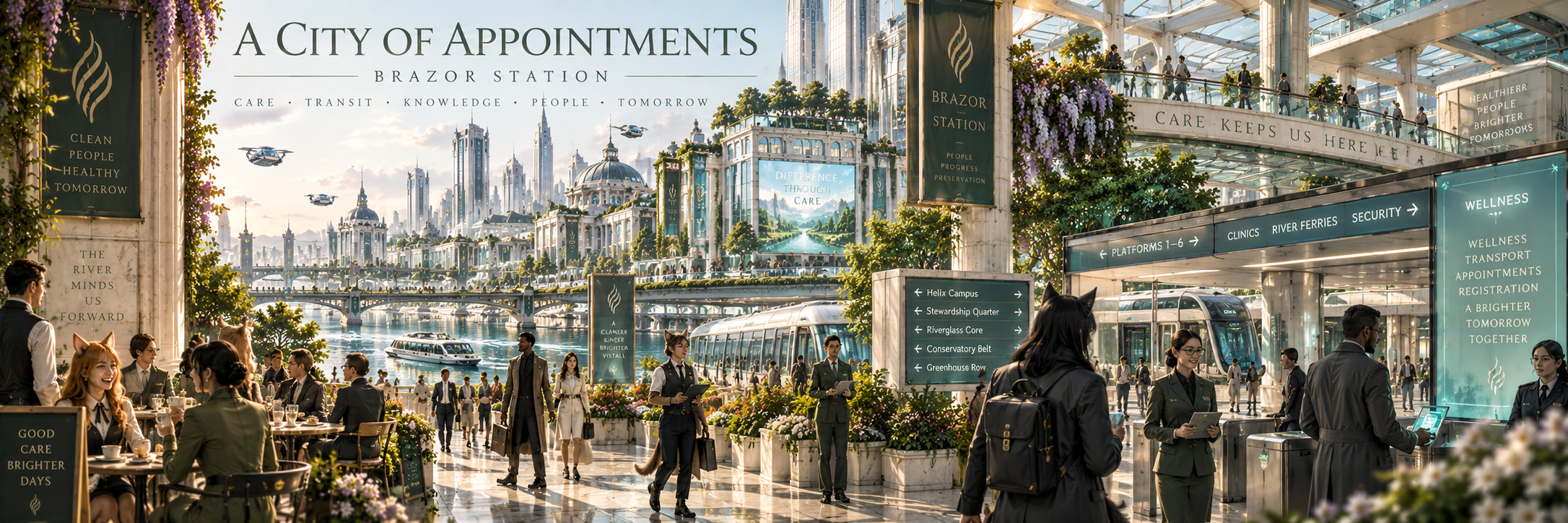
Brazor Station does not feel like a city built around control. It feels like a city built around efficiency, healthcare and carefully scheduled lives.
White and ivory buildings rise behind green roofs and glass skybridges. Clinics open onto flowering plazas. Ferries slide beneath landscaped bridges. Medical drones cross the skyline while quiet holo-signage directs residents toward platforms, examinations, gardens, government offices and river gates.
The effect is not cold. Brazor Station works very hard not to feel cold. Water, greenery, polished stone and soft light wrap systems of medical and bureaucratic oversight in the visual language of comfort.
Ivory stone, river-blue glass, green roofs, flowering walls and elevated pedestrian bridges make even dense institutional districts feel cultivated rather than industrial.
Residents move between cafés, offices, clinics, ferries, markets and transit platforms through systems designed to minimize waiting, confusion and visible friction.
Appointment systems, wrist-comms, transit scans, medical alerts and public-service displays appear in pale blue-green light and disappear again when no longer needed.
Clinics, rehabilitation centers, specialist offices and diagnostic services are woven through the city. Medical contact is ordinary enough to become part of everyday civic life.
Rail, river transit, autonomous shuttles and pedestrian routes bind districts tightly together, creating a city in which nearly every institution is only a transfer or appointment away.
Registration, wellness reviews, medical consultations, identity updates and official authorizations are frequently experienced not as confrontations, but as routine entries on a calendar.
The rhythm of Brazor Station is built around systems that rarely need to announce themselves as systems.
Central Districts
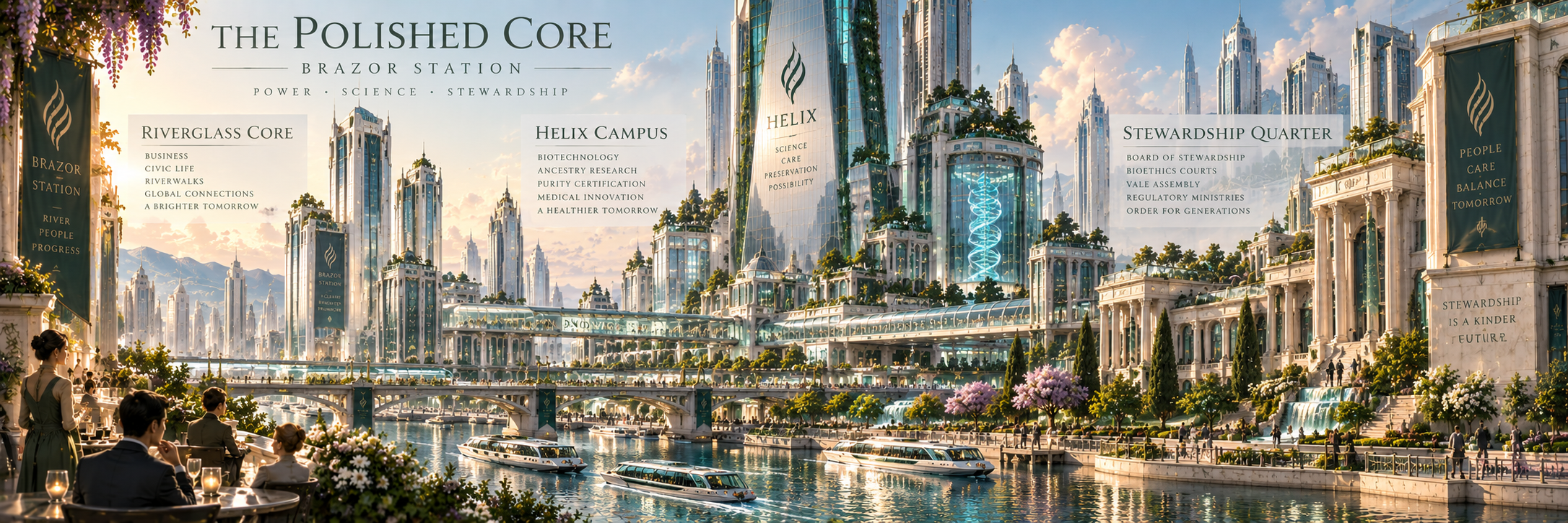
At the center of Brazor Station, corporate wealth, biological science and national law occupy the same polished riverfront. Riverglass Core, Helix Campus and the Stewardship Quarter form the city's institutional heart.
This is the Brazor Station presented to investors, foreign delegations and visiting families: reflective towers, botanical plazas, immaculate public spaces and some of the most influential institutions in Brazoria Vale.
Riverglass is the public face of Brazor Station. Corporate headquarters, government offices, public-health institutions, financial firms and river-facing commercial towers crowd around broad civic plazas and carefully landscaped promenades.
The research engine of the city contains genetic laboratories, ancestry modeling systems, medical archives, fertility analytics, pedigree verification and some of Helix Vale's most restricted biological research.
The Board of Stewardship, Bioethics Courts, Vale Assembly offices and regulatory ministries occupy serene green-and-white civic buildings where decisions about classification, custody, conservation and biological law become enforceable reality.
Riverglass was designed to make authority look open. Towers use broad windows, reflective blue-green glass and terraces overlooking the Brazor. Corporate plazas spill directly into restaurants, riverwalks, gardens and public institutions.
Reflection is part of the district's branding. Water, polished stone and glass repeatedly mirror the skyline back toward the viewer, presenting Brazor Station as clean, transparent and endlessly self-confident.
Helix Campus is less publicly theatrical and considerably more important. Laboratories, archives and computational centers here transform biological information into medical recommendations, pedigree records, ancestry probabilities and regulatory classifications.
Hereditary disease, phenotype expression, mixed ancestry, reproductive health and rare biological traits are studied across specialized research buildings.
Ancestry models, medical histories, pedigree verification and biological classifications connect laboratory findings to databases used throughout the Vale.
Fertility projections, hereditary-risk assessments and medical modeling support physicians, breeders, estates and government institutions.
Not every Helix facility appears on public tours. Security increases sharply around archives, rare-line research and projects involving politically sensitive biological classifications.
If Helix produces information, the Stewardship Quarter determines what that information means legally.
The Quarter's architecture is intentionally calming. Pale stone, quiet water, botanical courtyards and soft green interiors surround hearing rooms in which a person's residence, medical custody, reproductive restrictions or legal classification may be decided.

Movement & Production Districts
Brazor Station survives by moving things. Brazor Central Terminal moves people and freight. The Conservatory Belt moves biological knowledge between preservation and research. Greenhouse Row moves food from controlled cultivation into the wider Vale.
Together, these districts form the working circulation system beneath the city's polished civic identity.
Rail, river ferries, freight services, medical transport, corporate routes and private estate connections meet inside one enormous multimodal transit district.
Controlled gardens, heritage habitats, public educational spaces and lineage-research compounds create one of the city's most beautiful districts, though many of its quieter facilities are not open to casual visitors.
Vertical farms, pollinator domes, seed vaults, crop laboratories and agricultural infrastructure produce food, medicine and research material while supporting one of Brazor Station's largest concentrations of working demi-humans.
The terminal is not simply a train station. It is the point where multiple systems of movement overlap.
Different passengers may use the same beautiful terminal under very different permissions. A human commuter, registered companion, medical ward and privately transferred estate companion can all pass through the same building while interacting with entirely different layers of authorization.
The Conservatory Belt occupies a strange space between parkland, museum district, research campus and biological preserve.
Public paths are lush, quiet and intentionally beautiful. Families visit botanical displays, school groups attend heritage programs and tourists photograph conservatory glass beneath flowering canopies.
Behind controlled doors, however, preservation may involve medical files, reproductive records, residency restrictions and people classified as too biologically significant to be treated as ordinary companions.
Greenhouse Row feeds both the city and the laboratories studying how to feed the rest of the Vale. Vast glass structures stack growing environments vertically while nearby facilities handle seed storage, crop research, packing and distribution.
Controlled light, temperature, humidity and irrigation support dense urban production close to transit and river freight.
Managed pollinator environments support food production, ecological research and specialty crops that require carefully maintained biological systems.
Commercial varieties, regional cultivars and protected agricultural lines are stored alongside extensive genetic and cultivation records.
Agricultural technicians, greenhouse staff, freight crews and demi-human workers maintain the polished biological infrastructure on which much of Brazor Station depends.
Outer Districts
The farther one moves from Brazor Station's polished institutional center, the easier it becomes to see who controls the river, who benefits most from the city and who keeps its machinery running.
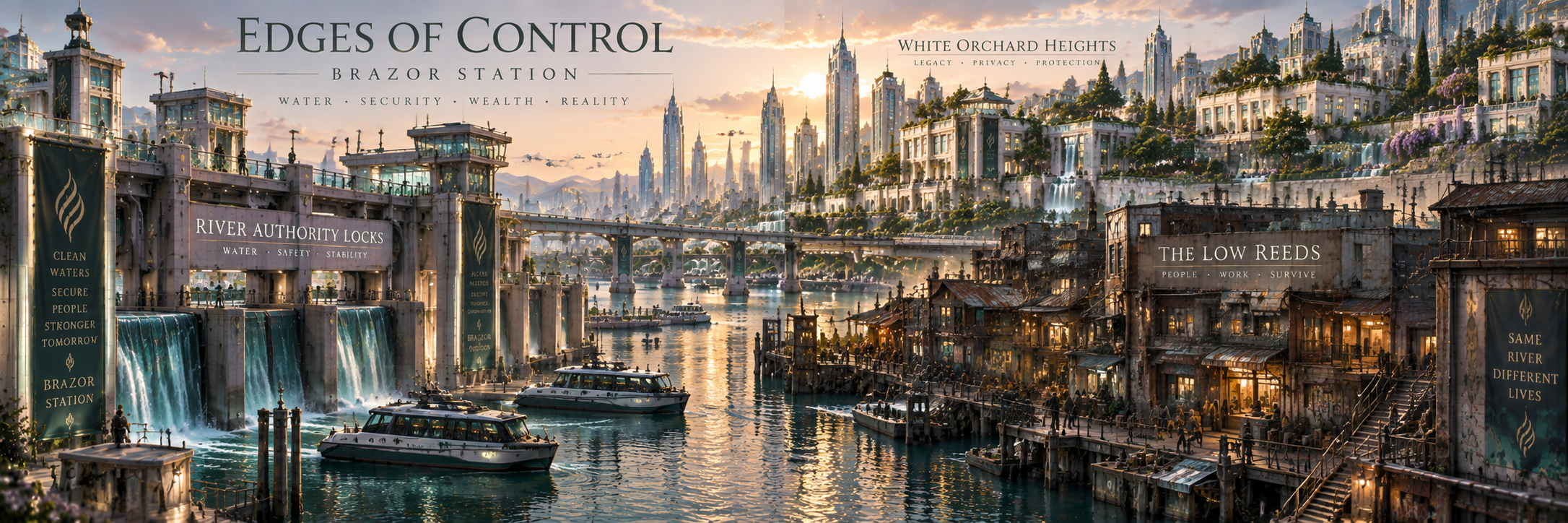
River Authority Locks, White Orchard Heights and the Low Reeds occupy very different social worlds, yet all three depend on the same water.
Docks, flood walls, ferry gates, irrigation controls, monitoring stations and drone buoys make the Locks one of the most heavily managed stretches of the Brazor.
Green House families, Helix executives, senior doctors, lawyers and political figures occupy garden estates and luxury residences protected by private clinics, gene-lock walls and carefully controlled access.
Older riverside housing, laundries, maintenance docks, food-processing facilities and inexpensive clinics support workers who keep Brazor Station functioning beyond its polished civic core.
The Locks regulate movement between river districts and the wider Brazor system. They control water for freight, ferries, flood protection and irrigation while also serving as one of the city's most important surveillance corridors.
River Authority infrastructure is rarely visually hostile. Locks are built into pale stone embankments, botanical terraces and orderly ferry stations. The surveillance is simply part of the scenery.
White Orchard Heights rises above the river on cultivated terraces where wealth buys both privacy and proximity to Brazor Station's most prestigious institutions.
Old agricultural families and lineage estates maintain city residences beside newer biotech wealth and corporate leadership.
Senior physicians, researchers, Bioethics attorneys and government officials live close to the institutions in which their influence matters most.
Elite households often rely on private medical suites and specialist clinics rather than the larger public-facing medical network.
Beautiful walls, estate gates and landscaped boundaries incorporate biometric and biological access systems nearly invisibly into residential architecture.
The Heights are not isolated from Brazor Station. They simply experience the city from the side of the systems designed to open doors.
The Low Reeds sit closer to the working waterline. Buildings are older, rents lower and infrastructure less carefully hidden behind ornamental stone.
Human laborers, demi-human workers, maintenance crews, cleaners, dock staff and service families live close to the infrastructure they maintain.
The district's oldest drainage passages and maintenance routes also predate much of Brazor Station's modern surveillance network. Those forgotten channels helped give the River-Run some of its earliest pathways through the city.
Institutional Brazor Station
In Brazor Station, some of the most consequential places in the country do not look threatening at all. They look like laboratories, hospitals, courthouses and beautifully landscaped corporate towers.
These are the institutions where records become classifications, classifications become rulings, and rulings become the conditions under which people are allowed to live.
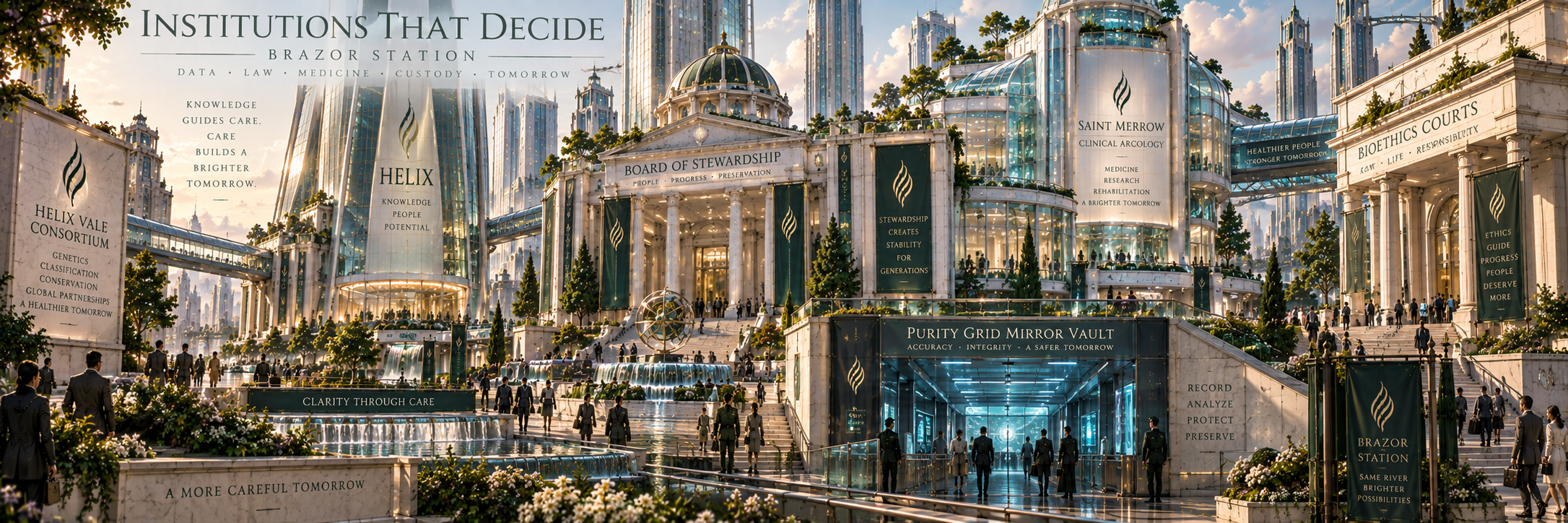
The corporate heart of Helix Vale rises over the Riverglass district as one of Brazor Station's most recognizable landmarks. Executive offices, research administration, biological analytics, national contracts and data operations converge here.
The Board's primary administrative complex oversees demi-human classification, research permissions, heritage programs, custody regulation, agricultural biological standards and the legal architecture of stewardship.
A hardened data archive containing some of the Vale's most sensitive ancestry, classification and custody records. Access is tightly controlled even by Brazor Station standards.
One of the country's largest medical complexes combines advanced diagnostics, surgery, rehabilitation, hereditary medicine and morphology-specific care with biological-status and custody review.
Specialized courts hear disputes involving medical custody, ancestry, conservatory classification, research exemptions, reproductive restrictions and appeals of biological status.
The Tower is both workplace and symbol. Its offices coordinate research contracts, ancestry databases, agricultural biotechnology, pedigree services, medical partnerships and the enormous information infrastructure that gives Helix influence far beyond Brazor Station.
Visitors encounter gardens, polished stone, glass galleries and public research displays. The most sensitive work happens considerably farther from the lobby.
The Mirror Vault is one of Brazor Station's most sensitive repositories. It preserves not only identity records, but the biological models used to interpret them.
Family trees, genetic verification, mixed ancestry models and confidence estimates connect individuals to recorded biological histories.
Physical traits, shift characteristics, inherited markers and projected phenotype expression are compared across generations.
Unusual or mythic-adjacent biological markers can trigger additional review, restricted access and conservation interest.
Custody histories, fertility predictions, heritage classifications and conservation ratings can transform a laboratory result into a legal problem.
Saint Merrow represents one of Brazoria's central contradictions particularly well. Its medicine can be extraordinary. Its physicians save lives, treat rare hereditary disorders and provide some of the most advanced morphology-specific care in Vistall.
The same institution can also determine that continued institutional care, medical supervision or biological custody is in a patient's best interest.
Hearings here are quiet, procedural and heavily documented. Physicians, legal scholars, genetic specialists and household representatives may all testify before a ruling is made.
A court may acknowledge that someone is healthy, articulate and unhappy with their placement while still concluding that continued care remains legally justified.

Public Institutions
Brazor Station's public-facing institutions make stewardship beautiful. Gardens, archives, ceremonial halls and wellness centers wrap registration and biological administration in flowers, fountains and impeccable service.
For many residents these places are genuinely pleasant. Families visit them, schools organize tours through them, companions receive healthcare through them, and elite households celebrate milestones inside them.
A vast botanical and heritage complex combining public gardens, educational exhibitions, controlled habitats and lineage-preservation programs.
A bright civic facility for household records, residency information, biological registration, demographic research and routine documentation.
One of Brazor Station's beloved public landscapes, filled with waterways, flowering terraces, shaded paths and spaces designed for human and demi-human households alike.
A public-facing genealogy and heritage center where families explore recorded ancestry, historical lines, household histories and preserved biological records.
An elegant ceremonial venue used for heritage recognition, lineage announcements, major household presentations and prestigious companion milestones.
A routine service center issuing and updating health-monitor bands, caretaker-linked wrist-comms, residency tags and other connected identity systems.
Cradle Garden is one of those places Brazor Station uses to explain itself to children. Rare plants grow beneath enormous glass domes. Heritage exhibits explain biological diversity. Controlled habitats preserve species-specific environments and historical lineages.
Public areas emphasize education, conservation and wonder. Restricted areas may support far more intensive lineage research, medical observation or conservation management.
The Census Pavilion is deliberately pleasant for a government records office. Soft light, plants, comfortable waiting areas and polite staff turn registration into another ordinary civic appointment.
A routine visit may involve nothing more dramatic than an address change. The same system can also determine which household, institution or conservatory appears beside someone's name.
The Gardens provide Brazor Station with one of its gentlest public spaces. Families picnic beside ornamental waterways, couples walk beneath flowering arches, children watch river birds and companions use morphology-accessible recreational areas.
Its popularity helps explain why many Brazorians experience their system as caring. Their institutions do not merely regulate life. They also build beautiful places in which life is genuinely pleasant.
Part genealogy center, part museum and part public records institution, the Living Archive transforms family history into an interactive civic experience.
Visitors can explore:
To Brazoria, knowing where someone comes from is a form of continuity. The country is much less comfortable with people who would rather not be permanently knowable.
First Bloom Hall hosts some of the city's most prestigious recognition ceremonies. Wealthy families, breeders, researchers and public officials gather beneath chandeliers and flowering galleries to celebrate distinguished lineages, heritage preservation and companion achievement.
Recognition may involve:
For the person being recognized, the experience can be proud, affectionate and genuinely meaningful. It can also publicly reinforce exactly which family, pedigree or institution their identity is expected to represent.
The Exchange handles some of the least dramatic and most pervasive technology in companion life.
Health-monitor systems connect medication, emergency information and routine wellness data to approved care networks.
Caretaker-linked wrist systems can connect identity, permissions, appointments and household access.
Updated residency and registration credentials keep public transit, clinics and institutional systems synchronized.
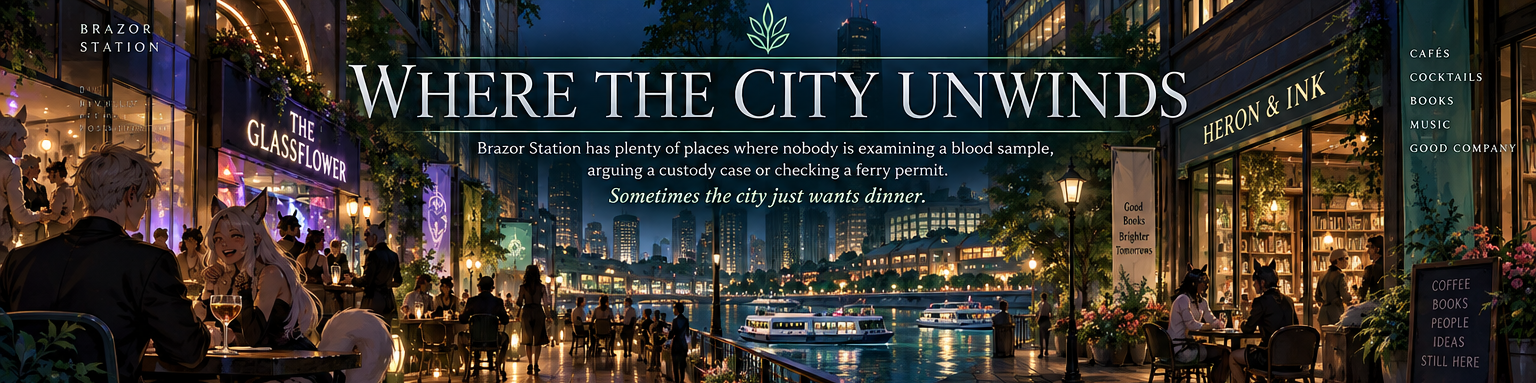
Social Life & Everyday Places
Brazor Station has plenty of places where nobody is examining a blood sample, arguing a custody case or checking a ferry permit.
Sometimes the city just wants dinner.
After work, residents spill into cafés, bookstores, bars, restaurants and music venues scattered between the river, university districts and the Low Reeds. Some places are polished enough for a Green House anniversary. Others exist because ferry crews need breakfast at two in the morning.
A famous riverfront dance club built into the lower floors of a glass tower. The main floor is loud and crowded, while upper terraces offer cocktails, quieter seating and broad views over the Brazor.
A working riverside bar favored by ferry crews, maintenance staff, dock workers and River Authority employees. Old flood photographs and retired buoy markers cover the walls.
A tiny neighborhood café beneath older worker apartments near the maintenance docks. It opens very early, closes very late and serves strong coffee, inexpensive meals and enormous slices of cake.
A two-story independent bookstore with garden-facing reading alcoves and a quiet café below. It carries everything from medical nonfiction to poetry, children's books and an alarmingly large romance section.
A conservatory café beneath flowering vines and filtered glass. Tables sit among shallow water channels and indoor trees, while the menu uses herbs, fruit, honey and edible flowers grown nearby.
A sprawling casual restaurant in an older river-facing concourse. Commuters, travelers and ferry crews rotate through the tables from breakfast until well after midnight.
Part music shop, part tiny performance venue and entirely too loud for the neighboring apartments. Several nights a week, shelves roll aside to make room for local bands and student musicians.
An elegant rooftop restaurant famous for evening views over the Brazor. Cocktails, seafood and botanical desserts arrive just as sunset turns the river into bands of silver and gold.
Brazor Station's social life shifts dramatically depending on where someone gets off the ferry.
The city is exceptionally good at providing somewhere to take someone when the evening matters.
Pretty enough to feel intentional, quiet enough to actually talk and not so expensive that ordering dessert becomes a financial event.
For celebrations, proposals and anyone willing to pay an offensive amount of money for a very good river view.
For couples who would rather dance than talk and friends who swear they are only staying for one more song.
A city may be governed from courtrooms and laboratories, but residents rarely organize their own memories around institutions.
They remember:
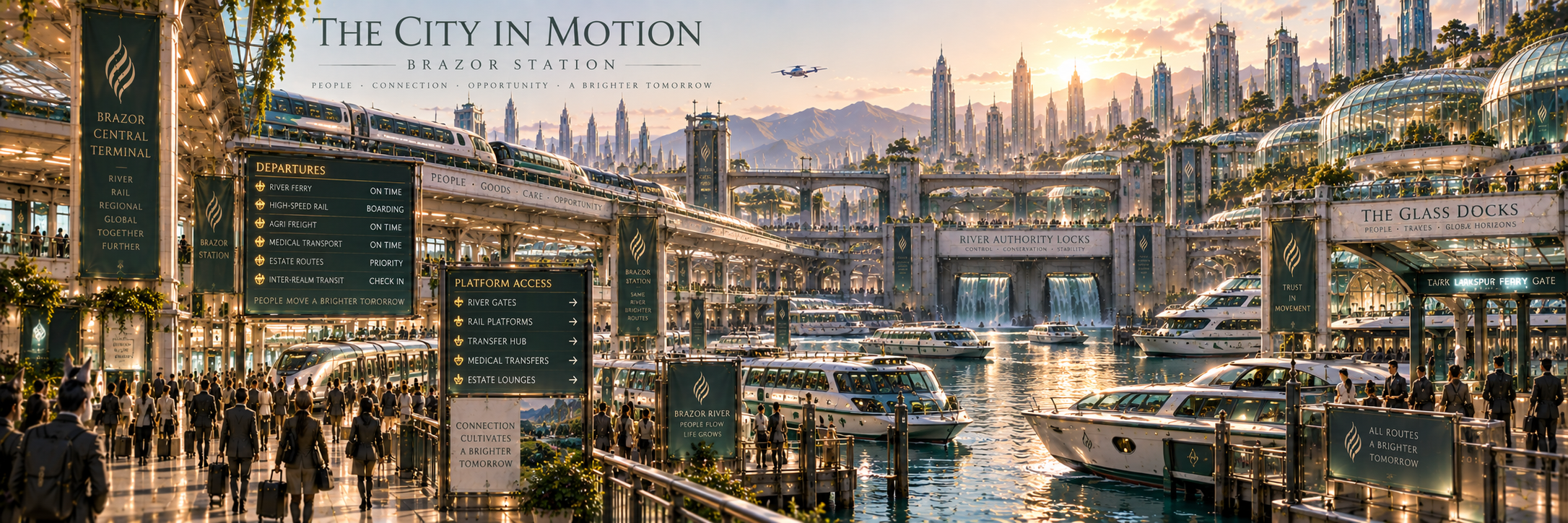
Transit & River Places
Brazor Station is built around movement. Passenger trains, ferries, agricultural cargo, medical transfers, estate boats and corporate routes overlap along the same river corridor every hour of the day.
For most residents, this makes the city extraordinarily connected. For anyone whose travel depends on permission, the same network can feel much smaller.
The city's largest passenger and logistics interchange links regional rail, ferries, freight, medical routes, corporate transport and private estate services.
A major river-control complex coordinating locks, flood systems, ferry movement, irrigation releases, commercial traffic and river surveillance.
Secure private docks serving hospitals, elite households, research institutions and estates. Their enclosed access routes allow certain travelers to move between building and vessel without entering a public street.
A heavily traveled ferry complex handling commuter traffic, regional passengers, labor routes and eastbound connections toward Larkspur Crossing.
Central Terminal is a city inside the city. Commuters buy coffee beside researchers carrying biological samples. Agricultural freight moves beneath passenger platforms. Private medical transfers use dedicated corridors only a few levels away from ordinary regional trains.
The Command Locks make the Brazor navigable, predictable and governable through one of its busiest urban stretches.
The same infrastructure that protects the city from floods and commercial accidents also makes river movement unusually easy to record.
The Glass Docks are quieter than the public ferry terminals and considerably more exclusive. Enclosed corridors connect hospitals, private clinics, secure garages and river berths through a network designed for discretion.
Patients can move directly between Saint Merrow or private facilities and waiting transport with minimal exposure to public space.
Green House families, executives and wealthy households maintain access to premium river transport and private waiting suites.
Institutional or estate transfers can occur through controlled routes where public observation is limited and authorization is handled before arrival.
The Larkspur Gate carries a much broader slice of city life. Office commuters, students, labor crews, families, companions and regional travelers funnel through its platforms toward eastern routes.
Movement is quick when identity and permissions align. Wrist-coms, travel bands and ferry systems handle most verification in seconds.

Daily Life
For all its laboratories, courts and national importance, Brazor Station is still a city where people wake up late, miss ferries, meet friends for coffee, buy flowers after work and argue over where to eat dinner.
Most days are not dramatic. The city is clean, busy, comfortable and deeply pleasant to live in. Its riverfront fills with commuters in the morning, students and office workers by noon, and families, couples and restaurant crowds as the light begins to settle across the Brazor.
The city starts with water and transit. Ferries arrive from residential districts before cafés have finished setting out their first tables. Regional trains unload commuters beneath Brazor Central while delivery crews move greenhouse produce into markets, restaurants and clinic kitchens.
Commuter boats begin crossing the Brazor while maintenance crews inspect docks, river sensors and morning transport routes.
Coffee shops, breakfast counters and bakery terraces fill with medical staff, office workers, students and travelers waiting between connections.
Regional trains bring workers, patients, researchers, government visitors and freight into the heart of the city.
Diagnostic centers, specialist offices, rehabilitation clinics and public-health buildings begin a steady day of scheduled consultations.
Produce from Greenhouse Row and surrounding agricultural regions arrives by river, rail and electric freight vehicle before the midday markets open.
Office workers cross glass bridges between Riverglass towers, government buildings, hospitals and research campuses high above the streets.
By noon, Brazor Station loosens. Business continues, but its public spaces become more social. Markets crowd with shoppers. Students spill out of classrooms. Doctors and researchers take lunch beside the river while families wander through gardens between appointments.
Flower stalls, specialty foods, greenhouse vegetables, baked goods and small local vendors turn plazas near the river into busy lunchtime markets.
University and research students gather in cafés, garden terraces and public libraries between lectures, laboratory sessions and internships.
Doctors, lawyers, researchers, civil employees and corporate workers share the same riverfront restaurants as tourists and families.
Residents move through licensing offices, public-health buildings, registration windows and government services without the city ever seeming to stop around them.
Brazor Station's public gardens are not empty prestige spaces. They are used. Children play beside fountains, elderly residents sit beneath flowering trees, couples walk the river paths and companions relax with their households in morphology-accessible recreation areas.
After work, the city shifts from institutional to social. Clinic corridors quiet. Restaurant terraces fill. Shop windows brighten beneath the skybridges while ferries move through gold and blue reflections on the Brazor.
Restaurants and cafés overlook ferry traffic and illuminated bridges while households meet for dinner after work or appointments.
Small theaters, gallery programs, university performances, conservatory exhibitions and civic events keep central districts active into the evening.
Boutiques, companion stores, bookstores, florists and food markets remain busy as office workers and families move toward transit.
Commuter boats continue beneath illuminated bridges as the daytime skyline turns into long reflections across the water.
Parents collect children, companions meet household members, students leave cafés and workers begin the evening journey back toward residential districts.
Wrist-coms quietly populate with the next day's trains, shifts, meetings, classes and medical reminders before most residents reach home.
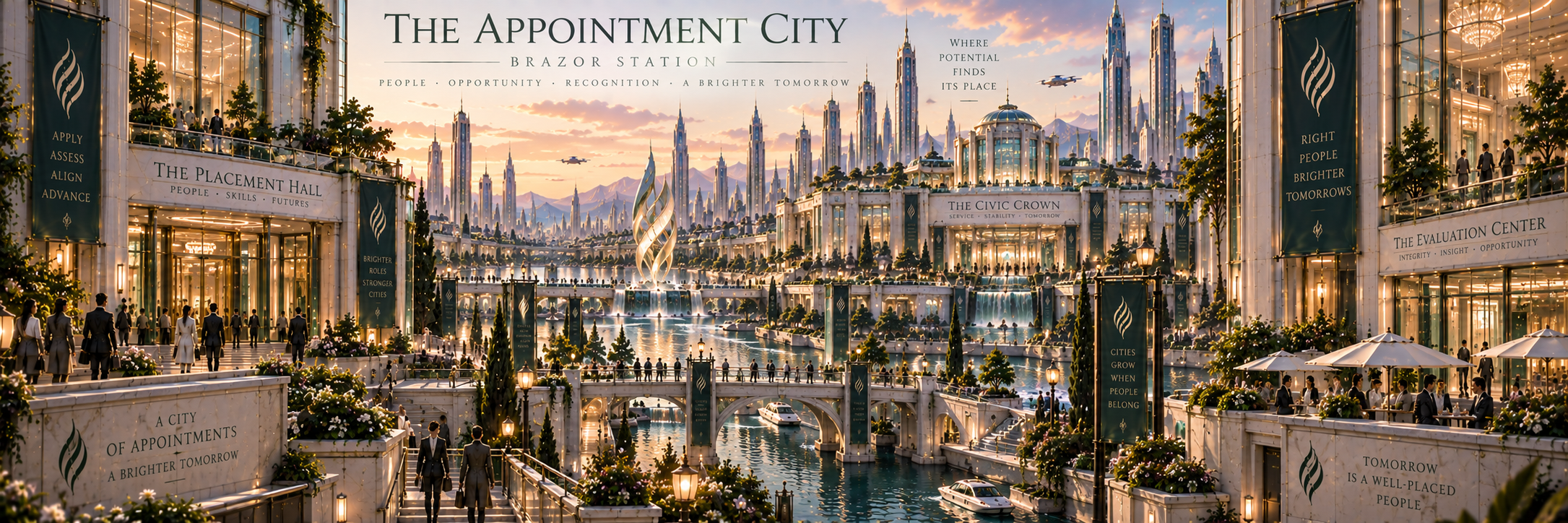
How the City Organizes Life
Brazor Station runs on appointments. Medicine, transit, government services, identity systems and household administration are organized through quiet digital routines that keep most of the city moving without visible confrontation.
The genius of Brazor Station's bureaucracy is not that residents never encounter it. They encounter it constantly. The systems are simply efficient enough to feel like another part of having a schedule.
Meetings, ferry times, clinic visits, class schedules, payment reminders and civic appointments gather in one ordinary personal interface.
Routine care arrives through gentle reminders for consultations, prescriptions, rehabilitation, screenings and follow-up appointments.
Residency records, registrations, health credentials and household information can often be updated through scheduled civic windows rather than long public queues.
Rail and ferry access is usually confirmed through wrist-coms, identity bands and automated gates within seconds.
Medical information, emergency contacts, medications and monitoring devices synchronize with approved health networks during routine visits.
For companions and some institutional residents, travel, household access or registration updates may include authorization attached to a caretaker or custodian record.
A normal Brazor Station day can contain several points of contact with civic systems without feeling particularly bureaucratic.
Much of Brazor Station's administration happens before anyone reaches a desk. Identity verification, appointment routing, health records and travel credentials move between systems automatically.
Most people do not walk around thinking about databases. They experience convenience.
Brazor Station's systems succeed because they usually solve the problem a resident wanted solved.
The same convenience can carry an additional layer. A companion's appointment system may connect not only to their identity and medical record, but to their registered household or caretaker.
The companion receives the appointment, speaks directly with the physician and uses the same polished clinical systems as anyone else.
Approved caretakers may receive scheduling updates, emergency information or required notifications depending on legal status.
Routine movement may verify identity alone or quietly confirm that the necessary household-linked permissions are active.
A simple wellness appointment can also synchronize residency, medical, registration and custodial information across several institutions.

Human Life in Brazor Station
For most human residents, Brazor Station is not experienced as a frightening city. It is experienced as a prosperous one.
The trains run. The ferries are clean. Doctors are easy to reach. Schools have gardens. Markets fill with fresh produce. River cafés stay busy into the evening. Public spaces are maintained well enough that even mundane errands can happen beneath flowering trees and polished glass.
Most humans living here do not wake up thinking of themselves as participants in an oppressive system. They wake up thinking about work, school, appointments, groceries, children, rent, dinner plans and whether the next ferry is going to be crowded.
Parents move children between garden schools, clinics, markets and after-school activities while household schedules synchronize quietly through wrist-com systems.
Office workers, hospital staff, researchers, teachers, civil employees and retail workers move through rail, ferry and skybridge networks designed to make commuting unusually predictable.
River cafés, lunch terraces, bakeries and small restaurants turn institutional districts into ordinary social spaces where residents meet before work, between classes or after appointments.
Schools and university spaces emphasize botanical courtyards, public science, environmental education and easy access to the city's museums, conservatories and research institutions.
Hospitals, specialist clinics, rehabilitation centers and preventive-health services make advanced medicine part of ordinary urban life rather than something reserved only for emergencies.
Produce from Greenhouse Row and the wider Vale reaches neighborhood markets quickly, making fresh fruit, vegetables, flowers, prepared foods and specialty products part of everyday shopping.
A human child raised in Brazor Station may grow up thinking of the city through places rather than institutions.
Brazor Station attracts students because some of Brazoria's most prestigious scientific, medical, agricultural and legal institutions are concentrated within a few transit connections of one another.
Students crowd inexpensive cafés, compete for internships, attend public lectures and complain about rent while living within sight of institutions whose decisions can shape the entire Vale.
The Brazor is not only commercial infrastructure. Humans use it recreationally.
Landscaped paths, botanical terraces, picnic lawns and public gardens give dense districts easy access to green space.
Pleasure ferries, river cruises, small boating routes and waterfront events make the Brazor part of leisure as well as transportation.
Weekend markets mix agricultural vendors, prepared food, flowers, crafts, companion goods and neighborhood social life.
Conservatory exhibitions, university programs, civic festivals, river celebrations and seasonal markets keep public spaces active throughout the year.

Human Social Structure
Brazor Station works for humans, but it does not work equally well for all of them.
A Green House heir in White Orchard Heights and a dock worker in the Low Reeds both possess full human civic personhood. Their access to money, healthcare, influence, privacy and political power may be radically different.
Among humans, class determines how comfortably the city opens its doors. Human status determines whether those doors are legally theirs to open at all.
Historic agricultural and lineage families occupy the upper edge of Brazor Station society through inherited land, river rights, estate networks, research foundations and old institutional relationships.
Senior biotech leaders, major investors and corporate administrators represent newer concentrations of power built around biological data, medicine, agriculture and research infrastructure.
Doctors, geneticists, scientists and senior medical specialists enjoy considerable respect in a city where scientific expertise shapes both public policy and private wealth.
Estate attorneys, Bioethics specialists, Board administrators and government officials may not possess old-family wealth but can wield enormous influence through the institutions that interpret it.
Teachers, nurses, engineers, technicians, academics, clerks and university students form the broad professional life of the Station, ranging from comfortably secure households to residents juggling rent and debt.
Drivers, ferry crews, cleaners, retail workers, maintenance staff, warehouse employees and food-service workers keep the city's polished public spaces functioning long after executives have gone home.
At the upper end of the human city, White Orchard Heights concentrates wealth behind landscaped walls and quietly sophisticated access systems.
Large homes, luxury apartments, garden estates and river views create distance from the density of the central city.
Elite physicians, specialist clinics and household medical services reduce dependence on ordinary public systems.
Executives, lawyers and old families often know the officials, physicians and institutional leaders who make important decisions personally.
Much of Brazor Station sits between the Heights and the Low Reeds.
These households may own apartments rather than estates, rely on ordinary transit rather than private boats and use public clinics instead of personal physicians. They are still broadly the group for whom Brazor Station's promise of stable, prosperous urban life feels most believable.
At the working edge of the river, many human households live much closer to financial precarity.
Worker apartments and boarding houses are smaller, older and more vulnerable to maintenance problems than homes farther uphill.
Dock crews, cleaners, food processors, maintenance workers and service employees often work longer or less predictable hours.
Medical care remains better than in many countries, but convenience, specialist access and privacy still scale sharply with income.
Low-income workers depend more heavily on public ferry, rail and shift schedules that can turn a delayed connection into a very long day.
A low-income human resident may be overworked, indebted, poorly housed and almost completely excluded from the circles that shape Brazor Station's policy.
They can still:
That distinction matters. Wealth can make one human far more powerful than another. Poverty does not convert a human into somebody else's legal dependent.
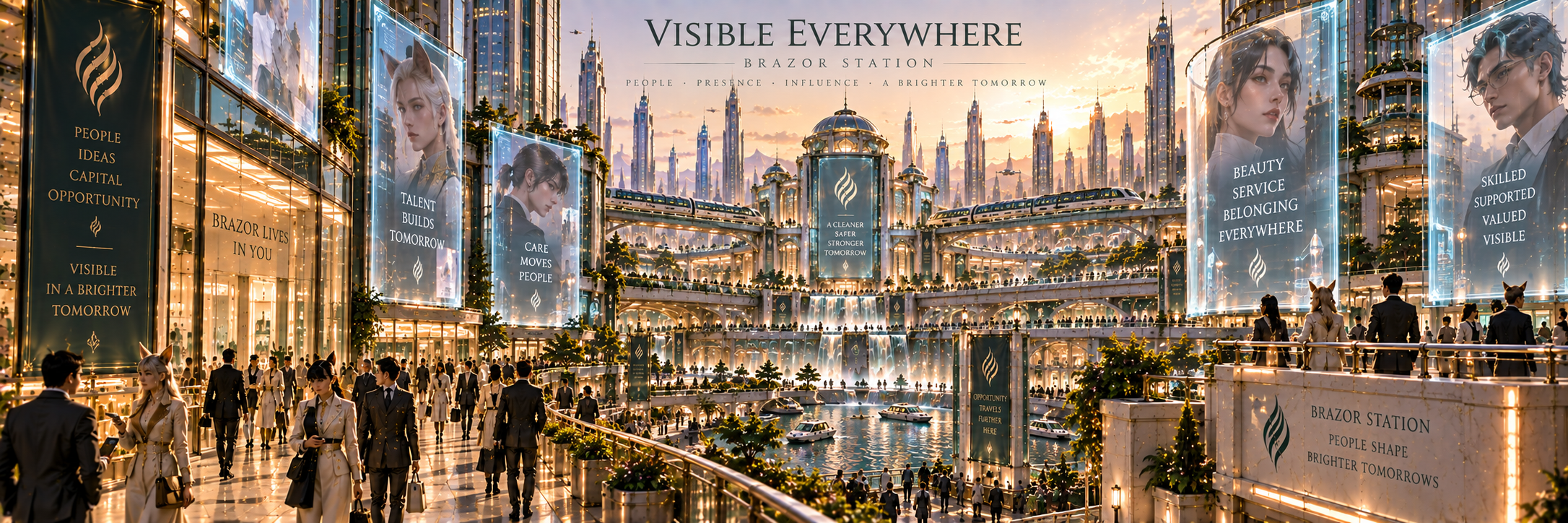
Demi-Human Life in Brazor Station
Demi-humans are not hidden in Brazor Station. They work beside the river, ride the ferries, sit in cafés, visit clinics, tend gardens, attend conservatory programs and move through the same glass-and-green city as everyone else.
Their visibility is one of the things Brazoria points to most proudly. Unlike societies that isolate or publicly exclude demi-humans, Brazor Station builds them directly into its ordinary urban life.
Heron demi-humans work around ferry gates, water-control stations and river-management infrastructure where balance, water familiarity and specialized experience make them a familiar sight along the Brazor.
Bee demi-humans appear throughout Greenhouse Row's pollinator systems, agricultural laboratories and controlled growing environments, working alongside human technicians in some of the city's most productive biological spaces.
Fox demi-humans are common enough in estate and household settings to appear naturally throughout White Orchard Heights, private gardens, companion outings and elite social spaces.
Otter demi-humans maintain river-monitoring equipment, inspect water systems and work around docks, flood infrastructure and sensor stations throughout the lower river districts.
Demi-humans appear as patients, companions, staff, research participants and long-term medical residents across Saint Merrow and the city's extensive clinical network.
Companions meet household members after work, eat at restaurants, shop, sit beside the river and participate in ordinary family routines rather than being confined to dedicated demi-human spaces.
Brazor Station's demi-human workforce is spread across industries rather than concentrated into a single visible labor class.
Some work because their household encourages it. Some occupy formal working-companion roles. Some are attached to estates or institutions whose needs define the work they perform.
A demi-human in Brazor Station may spend an ordinary afternoon doing things that would be unremarkable for any city resident.
The city's biomedical culture makes demi-humans especially visible in clinical and research settings.
Morphology-specific medicine, hereditary care and shift-related treatment bring companions and workers into the city's hospitals as ordinary patients.
Some demi-humans participate in approved medical or biological studies, particularly where rare traits, mixed ancestry or hereditary conditions are involved.
Rare or protected lines may spend substantial time inside conservatory, medical or research systems dedicated to preserving biological traits.
Demi-human employees and working companions appear throughout laboratories, clinics, archives and public-health institutions in support and specialist roles.
Brazor Station does not organize public life around removing demi-humans from sight. Their presence is normal enough that advertisements, cafés, hospitals, transit terminals and family photographs may all include them without comment.
Brazorians frequently point to that visibility as proof that their system is fundamentally different from exclusionary human states.
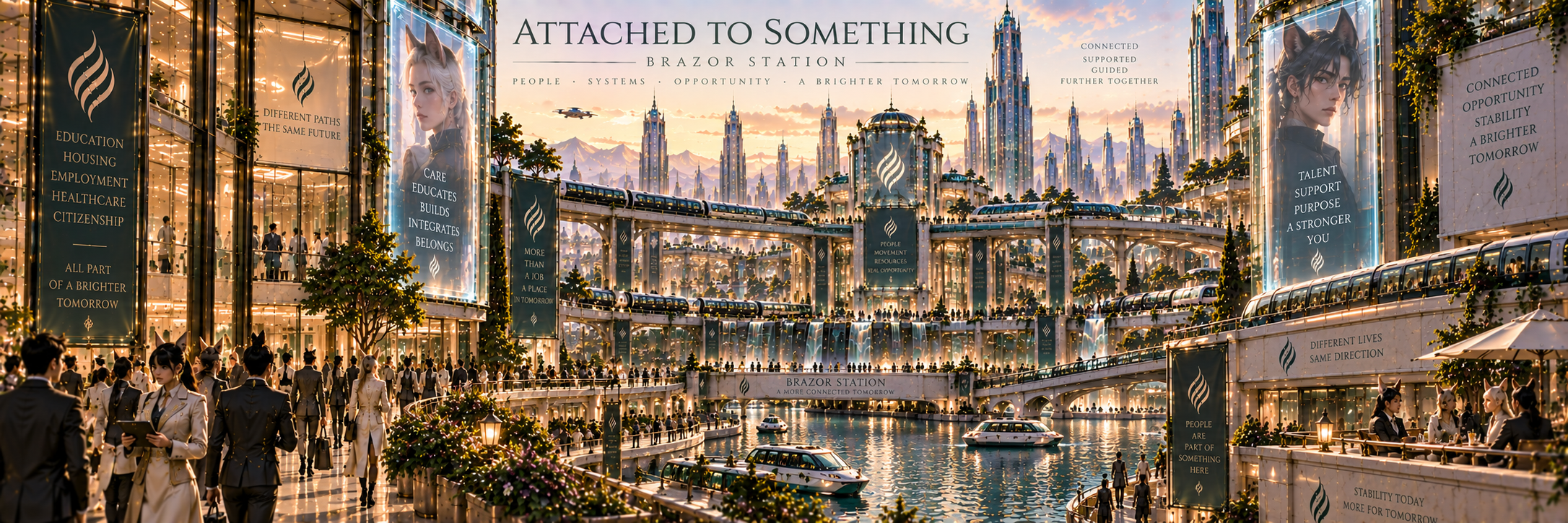
Status in the Station
A demi-human in Brazor Station is rarely just a name in the civic system. Somewhere in the records, that name is usually attached to something else.
A household. A clinic. An estate. A research sponsor. A conservatory. A labor permit. A medical file. A travel authorization. A caretaker record.
The attachment may be affectionate, professional, medical, protective or prestigious. It may also determine who holds the final legal authority when the demi-human and the system disagree.
Most household companions live ordinary urban lives connected to a registered human household through residency, medical, travel and identity systems.
Demi-humans employed in agriculture, river systems, shops, clinics or estates may carry labor permissions alongside household or institutional records.
Some demi-humans reside under medical, research, conservatory or institutional custody rather than within an ordinary private household.
Demi-humans associated with rare documented lineages may be attached to preservation programs, breeder agreements or special regulatory oversight.
Mixed-line demi-humans are common in Brazor Station. Their records may include several ancestry lines, phenotype probabilities and classification notes without making mixed status unusual in daily life.
Children displaying scarce or unusual inherited traits may attract early medical, heritage or research attention long before they are old enough to understand why adults consider those traits important.
Long-term patients can become closely connected to Saint Merrow, specialist clinics or rehabilitation systems when continued supervision is considered medically necessary.
Specialized work in river infrastructure, controlled agriculture, institutional settings or restricted facilities may require additional permit records linked to identity and status.
Travel across the Station can connect identity to ferry access, rail authorization, medical transfer records, household permissions or institutional destination.
A companion walking through Brazor Station may look completely independent in ordinary public life. Their record can tell a more complicated story.
The most familiar form links a companion to the human household legally responsible for their residence, welfare and major decisions.
A medical attachment may coordinate treatment, monitoring, rehabilitation or long-term clinical supervision.
Research institutions can appear in records when an individual participates in long-term biological, clinical or hereditary studies.
Rare or protected lines may be linked to preservation programs that regulate care, residence, reproduction or movement.
Specialized jobs can attach work authorization to specific facilities, routes or occupational categories.
Medical transfer, estate travel and restricted transit can generate movement files that follow a person between institutions.
Few objects represent Brazor Station's system better than the ordinary wellness band.
A single attractive device may connect:
For the wearer it can be useful, convenient and even lifesaving. For the system it provides a reliable way to keep medical, civic and custodial information attached to the same person.
An ordinary mixed-breed companion might wake in their own bedroom, take a ferry alone, meet friends for lunch, work a shift, shop after work and return home without anyone visibly supervising them.
Their wrist-com may still know which household they belong to.
The distinction matters because Brazor Station does not require constant physical supervision to maintain custody. The attachment lives in the infrastructure.
For an institutional ward, the attachment is more obvious. Residence may be tied directly to a clinic, conservatory or research program.
Their schedule might include:
The institution may describe these restrictions as necessary care rather than punishment, particularly when rare biology or serious medical needs are involved.
Rare ancestry creates an especially difficult form of attachment.
Brazoria sees unusual lineages as biologically and culturally valuable. A rare-line child may therefore gain access to exceptional medical care, specialist education and prestigious recognition while simultaneously attracting more institutional attention than an ordinary companion.
The more valuable the trait becomes, the more people acquire an official reason to care what happens to the person carrying it.
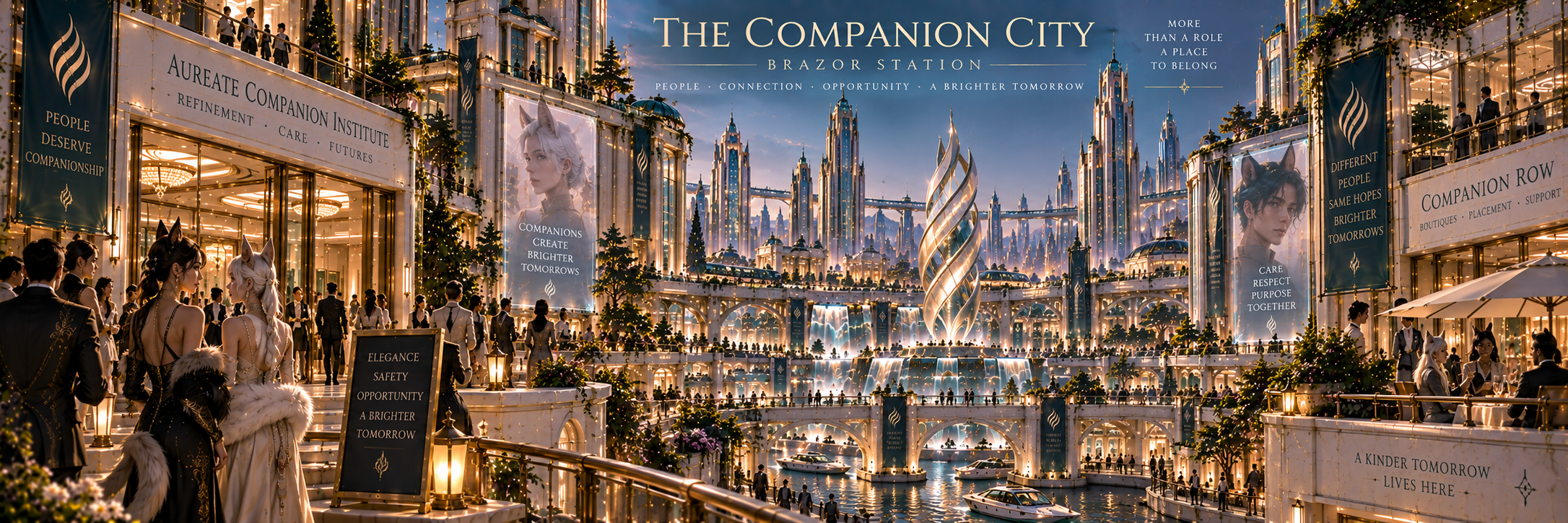
Urban Companion Culture
Brazor Station does not merely allow companions into public life. It has built an enormous urban culture around making that life comfortable, attractive and easy to navigate.
Companions sit at café tables, browse boutiques, visit salons, attend medical appointments, ride ferries, spend afternoons in gardens and accompany their households through nearly every part of the city.
For many households, this is exactly what responsible companionship is supposed to look like: inclusion without pretending the legal relationship is something other than stewardship.
Restaurants and cafés across the Station routinely provide tail-clearance seating, wider pathways, sensory accommodations and ordinary table service for companions dining with households or friends.
General medicine, hereditary care, rehabilitation, shift medicine and morphology-specific treatment are easy to find in a city where companion healthcare is both a major industry and a point of civic pride.
Urban grooming studios combine human salon culture with specialist care for ears, tails, horns, wings, skin, nails and presentation needs.
Tailored clothing accommodates ears, tails, wings and horns without treating morphology as an inconvenience. Companion fashion ranges from practical daily wear to extraordinarily expensive household prestige pieces.
Ferries, trains, lounges and private vehicles increasingly include tail channels, wing clearance, adaptable seating and sensory-conscious waiting spaces.
Companions use riverwalks, botanical parks, conservatories and household recreation areas alongside human residents rather than being restricted to separate leisure spaces.
Brazor Station's retail culture includes an enormous market built around companion comfort.
Advertising rarely frames these products around control. The language is about family, health, comfort, confidence and making a shared home work better for everyone inside it.
The Wellness Band Exchange is one of the most ordinary places in companion life. Residents visit to replace, upgrade or synchronize connected health and identity technology.
Medication reminders, emergency information, wellness data and medical alerts remain connected to approved clinics.
Bands can be designed as discreet cuffs, bracelets, anklets or jewelry rather than obvious institutional devices.
Depending on legal status, the same device can link household contacts, travel access, residency information and caretaker permissions.
The White Heron Gardens are especially popular with companion households because the landscape was designed with different bodies in mind.
On a pleasant afternoon, nothing about the Gardens needs to look politically complicated. Friends talk. Children play. Companions nap beneath trees. Couples walk along the water. Families take photographs beside the flowers.
Companion culture becomes considerably more luxurious uphill.
Elite households may provide:
Large bedrooms, tailored furnishings, private terraces and species-specific environmental controls are common in wealthy households.
Specialist physicians may visit the residence, while private clinics handle routine care away from crowded public facilities.
Luxury vehicles and private rivercraft accommodate morphology, health needs and household schedules in considerably greater comfort than ordinary transit.
Designer clothing, jewelry, grooming and pedigree presentation can turn an elite companion into a visible reflection of household taste and status.
First Bloom Hall represents the ceremonial side of companion culture. Distinguished achievements, prestigious lineages, heritage recognition and important household milestones may be celebrated publicly beneath flowers, glass and gold.
A companion may genuinely enjoy being honored there. Families may genuinely be proud. Friends may attend, photographs may fill household walls afterward, and the recognition may remain emotionally meaningful for years.
Brazoria's contradictions do not require every affectionate experience to be false.
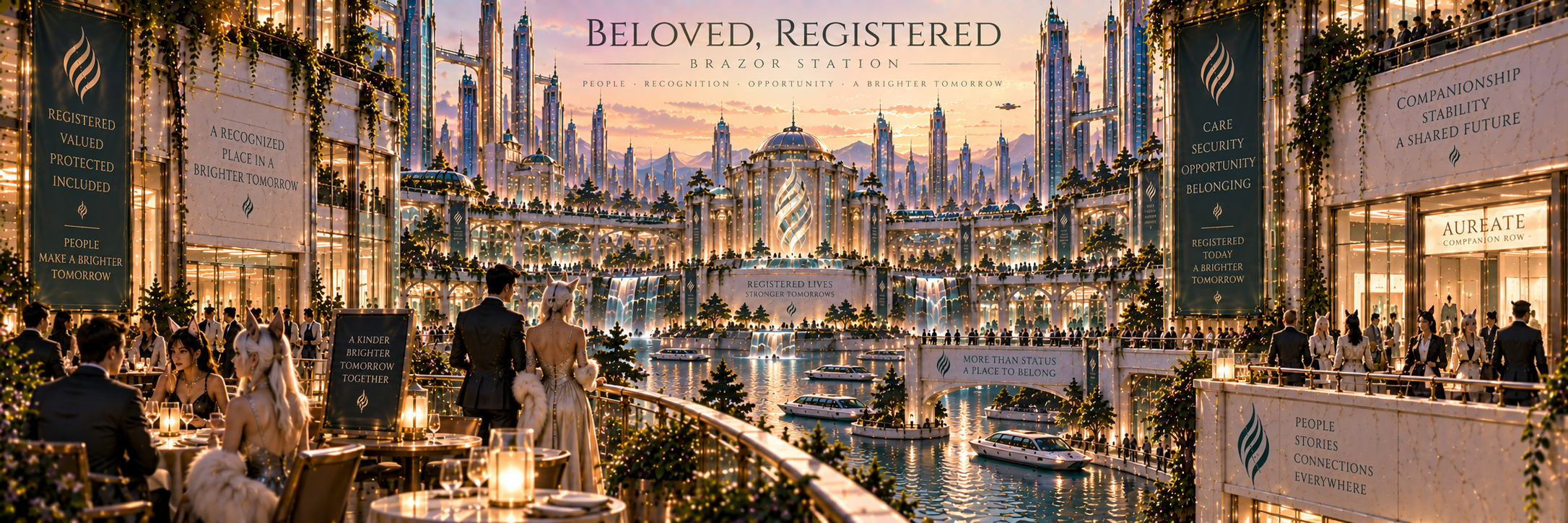
Prestige & Custody Culture
Brazor Station has perfected a particular kind of social contradiction: a companion can be deeply loved, publicly celebrated, medically protected and meticulously registered to someone else at the same time.
The city does not usually experience these ideas as opposites. Registration is described as protection. Household linkage is continuity. Health monitoring is responsible care. Pedigree records preserve history. Placement ensures that nobody is left without a home.
Ownership survives by being woven into systems Brazorians already consider benevolent.
Companions may be emotionally integrated into households for decades, appearing in family portraits, attending weddings, celebrating birthdays and becoming inseparable from household identity.
A documented prestigious lineage can signal wealth, breeder reputation, predictability and household taste, particularly among elite families.
Scarce ancestry or unusual inherited traits may bring specialist care, ceremonial recognition and heightened attention from heritage institutions.
Wellness bands, clinic systems and household records make preventive medicine exceptionally thorough while also keeping biological status continuously legible to approved institutions.
Bracelets, cuffs, anklets, necklaces and decorative bands transform legal identity infrastructure into objects that can be fashionable, sentimental and expensive.
Residency, travel, medical data, emergency contact and permissions can be synchronized through systems built around the registered household relationship.
A Brazorian household may describe a companion as:
These phrases are often affectionate rather than intentionally demeaning. The companion may return that affection just as sincerely.
The complication lies inside the possessive.
Purebred does not automatically mean rare, and rare does not automatically mean purebred. Brazor Station's elite companion culture pays attention to several kinds of distinction at once.
Verified single-line ancestry, respected breeders and generations of documented history can carry significant social prestige.
An uncommon biological trait may appear in a purebred, mixed, hybrid or uncertain lineage. Scarcity creates attention regardless of pedigree structure.
Association with an influential Green House, executive family or renowned institution can elevate a companion's social position regardless of ancestry.
Intentional mixed lines bred for appearance, temperament or household compatibility can become fashionable enough to rival conventional pedigrees in price.
First Bloom ceremonies transform biological and household prestige into public ritual.
Recognition might celebrate:
The ceremony can be joyous. A companion may choose their clothing, invite friends and enjoy the recognition enormously.
The event still presents their identity through the language of household, lineage and stewardship.
The most prestigious registration devices do not resemble institutional tags.
Gold, silver, gemstones, family crests and custom craftsmanship can turn household-linked identification into heirloom-quality jewelry.
Middle-class households often choose attractive practical designs combining health monitoring, identity and transit access.
Patients with ongoing care needs may use devices optimized for medical data, emergency alerts and clinic synchronization.
Wealthy households can move companion care almost entirely into private infrastructure.
For an elite companion, this can mean extraordinary comfort and medical attention. It can also mean that nearly every system surrounding them belongs to the same household that holds their legal custody.
The Glass Docks reveal how thoroughly Brazor Station can wrap custody in luxury.
Nobody needs to use the language of detention. The city calls it privacy, medical discretion, safe transfer or household transport.
Brazor Station's companion institutions rarely use crude commercial language.
Emphasizes finding a suitable household rather than selling a person.
Frames the process around compatibility, lifestyle and long-term wellbeing.
Makes transfer between custodians sound like continuity of care rather than a change in ownership.
Used when lineage, breeder agreement or conservation status influences which households are considered appropriate.
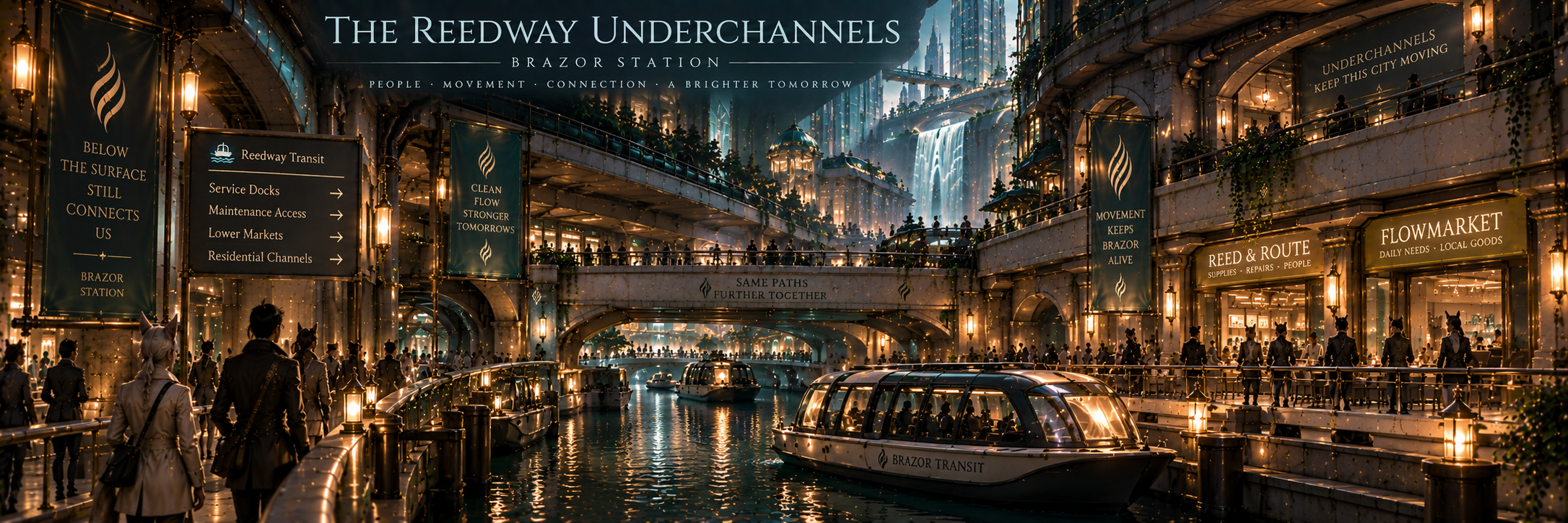
Physical Underground
Beneath the Low Reeds lies an older Brazor Station: drainage tunnels, maintenance corridors, overflow channels and forgotten access passages built before the city's modern surveillance systems learned to watch everything above them.
Collectively known as the Reedway Underchannels, these routes now form one of the most dangerous and useful pieces of the River-Run network.
Broad storm channels and older water passages run beneath the Low Reeds, carrying runoff toward the Brazor and connecting sections of infrastructure modern planners rarely think about unless something breaks.
Utility corridors link pumps, flood systems, laundries, docks, service buildings and river infrastructure through routes intended for technicians rather than ordinary public movement.
Guides have mapped combinations of ladders, culverts, utility rooms, maintenance hatches and waterside exits into pathways capable of moving people beneath ordinary checkpoints.
The Reedway is not a single secret passage with a convenient entrance and exit. It is a changing network assembled from pieces of legitimate city infrastructure.
Large enough to walk through during dry conditions and dangerous enough to become death traps when river levels rise.
Electrical, water and mechanical access passages provide indirect connections between older buildings and public infrastructure.
Some routes emerge near maintenance piers, drainage mouths or working docks where a person can disappear into ordinary river activity.
Old laundries, warehouses and worker buildings sometimes conceal access points that predate current zoning records.
Knowing the Reedway is a specialized skill. Guides memorize more than directions. They learn the rhythm of the city above them.
A route considered safe one week may become useless the next because of repairs, construction, a new scanner or nothing more dramatic than unusually heavy rain.
Companions, wards and institutional residents trying to leave Brazor Station may be moved beneath districts whose public transit they cannot use safely.
Medical workers carrying records, supplies or a patient out of institutional custody sometimes rely on River-Run guides for the final movement toward the Brazor.
River operators and black-market transport crews use selected exits to connect underground routes with boats moving beyond the city's formal ferry network.
Some Low Reeds workers know only one door, one tunnel or one safe storage room, contributing a tiny piece without ever seeing the entire route.
The greatest danger in the Reedway is not always the authorities.
Brazor Station's water systems can change quickly. Storm runoff, flood-control releases and river surges can turn a dry passage into a violent channel with little warning.
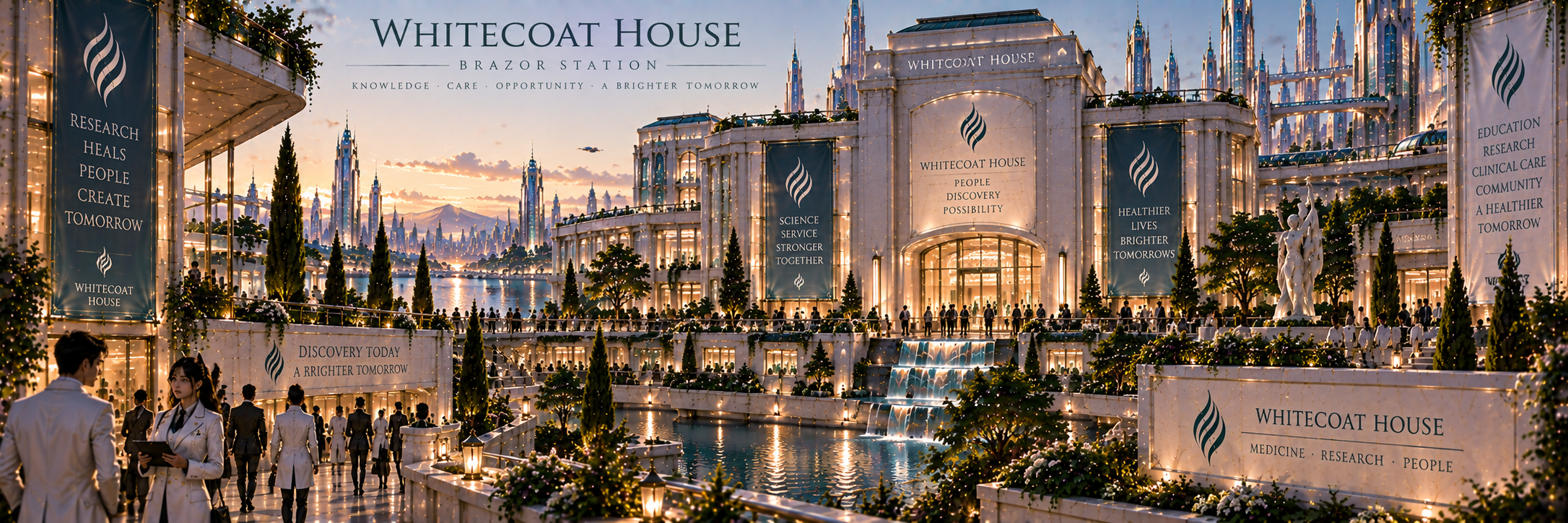
Institutional Underground
Whitecoat House is not a house.
It is a name used for a rotating network of physicians, nurses, laboratory assistants, archivists and other institutional workers who use Brazor Station's own medical machinery to help people disappear through it.
There is no permanent headquarters to raid. One clinic may contain a sympathetic nurse. Another may contain an archivist willing to alter a timestamp. A third may have a physician prepared to challenge a custody order long enough for someone else to move.
Physicians can delay transfers, reinterpret medical necessity, question custodial recommendations and create legitimate clinical reasons for a patient to be somewhere the system did not originally expect.
Nurses often know schedules, room assignments, medication timing, transport procedures and the small practical details that determine whether a plan works outside a spreadsheet.
Technicians may encounter samples, classifications and biological records before those results become permanent parts of a patient's official status.
Medical archivists and data workers know where records travel, which institutions receive copies and how apparently minor discrepancies can become extremely useful.
Whitecoat House is especially dangerous to Brazor Station because its members understand the system from inside.
Brazor Station depends on professional trust.
A doctor walking through Saint Merrow with a patient is not unusual. A nurse moving supplies between wards is not unusual. An archivist accessing a medical file is not unusual. A laboratory worker carrying sealed material is not unusual.
Whitecoat House survives by hiding extraordinary actions inside ordinary professional behavior.
Members look exactly like the educated professionals Brazor Station is trained to trust.
Legitimate institutional permissions can open doors that an underground operative could never approach from outside.
Knowing what the system expects makes it possible to create deviations subtle enough to survive long enough to matter.
Whitecoat House is deliberately compartmentalized.
A physician may know:
They may know nothing about similar cells elsewhere in the city.
That makes the network frustrating to investigate. Arresting one participant rarely reveals a hierarchy because there may be no hierarchy to reveal.
Many Whitecoat defectors did not enter medicine expecting to become resistance workers.
Some begin with one patient.
A doctor sees an adult companion clearly refuse a transfer and watches the legal system override them. A nurse watches a rare-line child become a heritage case. A laboratory assistant realizes a genetic result will trigger institutional custody rather than treatment. An archivist discovers records were altered to make an ownership claim stronger.
For some, that is the moment the language of care stops being enough.

Data Underground
Near Helix Campus, a scattered sabotage network known as the Spoiled Garden attacks Brazor Station at the point where the city is most confident: its information.
The network does not need to destroy the Purity Grid outright. It only needs to make certainty expensive.
A swapped sample here. A contradictory family tree there. A custody history that no longer matches the clinic record. A classification carrying two mutually exclusive ancestry results.
For a system built on the promise that biology can always be made administratively legible, confusion is a weapon.
Samples may be mislabeled, duplicated, contaminated or quietly redirected so that later analysis no longer aligns cleanly with the person the system believes it describes.
Pedigree records can be altered to create competing parents, hidden branches, duplicated relatives or ancestry combinations that demand human review.
Transfer histories, household attachments and institutional records may be changed so that two different systems appear to recognize different custodians.
Ordinary companions become institutional wards on one screen and domestic residents on another. Rare lines become ordinary. Purebred records suddenly reveal mixed ancestry.
The goal is often not to create a believable new truth, but to make the existing truth impossible to certify automatically.
Small groups embedded around research, administration and technical systems act independently enough that no single compromised cell exposes the entire operation.
The name refers both to the wider sabotage culture and to a shifting collection of hidden technical spaces near Helix Campus where corrupted records are staged, compared and redistributed.
A node may temporarily occupy:
The physical location matters less than access to systems and people willing to feed information into it.
The Spoiled Garden does not always make someone look less valuable.
Sometimes it makes someone look more valuable in one database and ordinary in another.
That can trigger:
Courts cannot easily enforce a custody or heritage ruling when the biological basis for that ruling is under active dispute.
Breeders and elite households depend on ancestry certainty. A credible possibility of widespread record corruption threatens enormous financial value.
Doctors may be forced to repeat tests or suspend biological-status decisions while contradictory records are investigated.
Every high-profile mistake weakens the claim that centralized biological classification represents objective truth rather than institutional interpretation.
The Spoiled Garden's most recognizable symbol appears as unauthorized green holo-text blooming briefly across service walls, laboratory interfaces and hidden terminals.
Most messages vanish quickly. Helix removes them almost as soon as they appear.
That is part of the point. The slogan only needs to exist long enough for someone inside the system to know they are not the only one questioning it.
Helix can repair a server.
It can replace corrupted hardware.
It can rerun a genetic test.
What it cannot easily restore is confidence once enough people begin asking whether a clean result is actually clean.
The Spoiled Garden attacks the assumption that makes the entire system scalable: that one biological identity can be converted into one stable administrative truth.
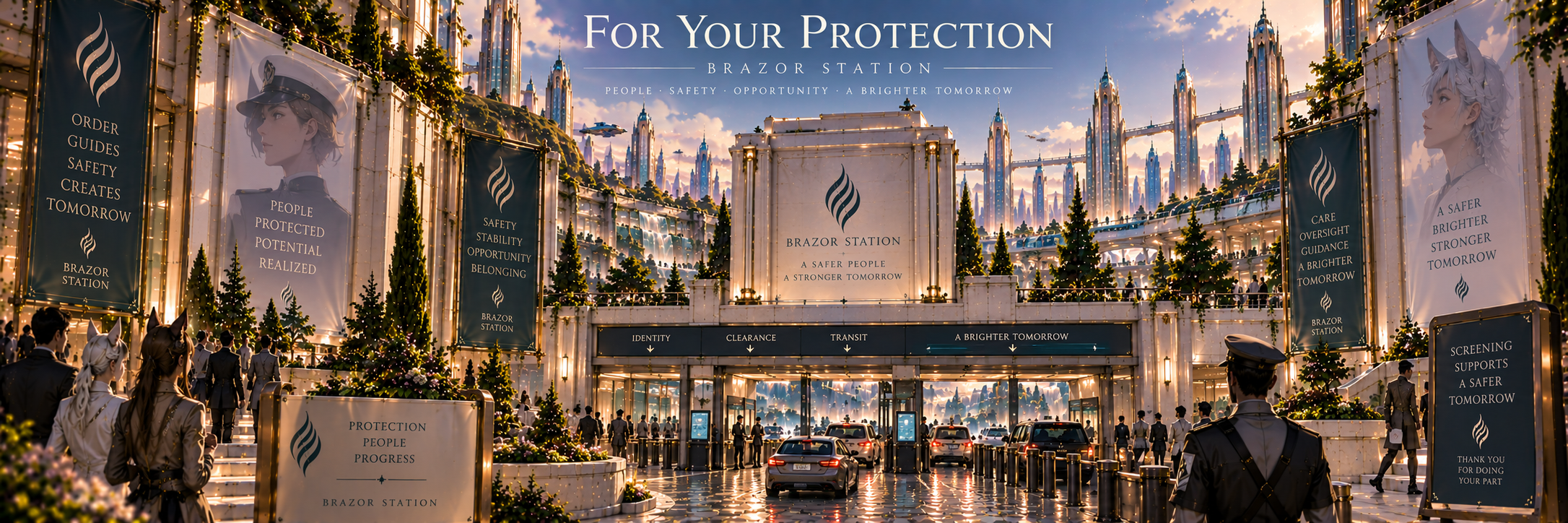
Current Security Profile
Brazor Station does not secure itself like a fortress. Its security is medical, environmental and bureaucratic, woven so thoroughly into ordinary infrastructure that most residents encounter it as convenience rather than enforcement.
Doors recognize biological credentials. Ferries verify identity before boarding. Clinics synchronize records automatically. River drones monitor both water conditions and vessel traffic. Wellness bands can carry emergency information, residency status and household-linked permissions through the same quiet network.
The system rarely needs to ask where someone belongs. Most of the time, Brazor Station already knows.
Medical bands and wrist-com systems can link identity, health information, emergency contacts and approved access while remaining visually indistinguishable from ordinary personal technology.
Private clinics, research facilities, estates and sensitive archives use biological verification to decide who may enter without requiring a visibly guarded doorway.
Autonomous patrol and monitoring units track water conditions, vessel movement, infrastructure problems and unusual activity along the Brazor.
Passenger identity and relevant travel permissions can be confirmed automatically before a traveler reaches the platform or boarding ramp.
Medical alerts, medication data, clinic access and emergency health information move with the wearer throughout the city's connected care network.
Hospitals and approved medical providers can automatically update relevant records after treatment, examinations, status changes or required reviews.
Biological traits, shift characteristics and registered identifiers can be checked at sensitive facilities without requiring invasive testing every time.
Companion devices may share selected alerts, travel information or emergency notifications with the household or caretaker listed in the civic record.
Clinical transfers generate records connecting patient, origin, destination, authorization and receiving institution across private and public transport networks.
Brazor Station rarely relies on one dramatic checkpoint. Security works because many small systems compare information continuously.
Certain biological records can trigger additional attention before a person ever reaches a physical checkpoint.
Possible flags include:
A flag does not necessarily mean arrest or detention. It may simply cause another review, another clinic notification, another verification step or another reason the system decides not to let an ordinary process remain ordinary.
Along the Brazor, surveillance extends into the water itself.
Registered commercial, medical and passenger traffic can be identified and routed through managed river corridors.
The same buoy network tracks depth, current, contamination and flood risk, giving surveillance a completely legitimate environmental purpose.
Unrecognized vessels, unusual routes or missing authorization can trigger River Authority attention before reaching central docks.
River-Run guides and Veyrhalden-linked operators survive by learning which sections of the network are watched, delayed, under repair or simply too busy to notice everything.
Most residents do not experience these systems as a permanent emergency.
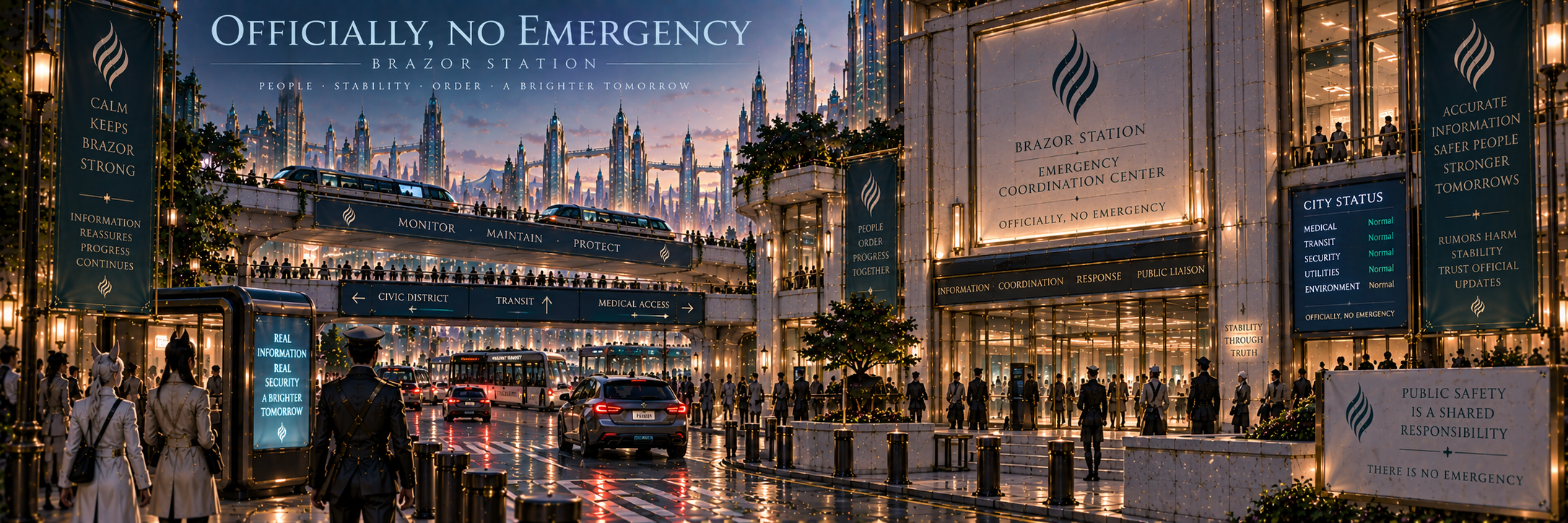
2097 A.E. • Current Status
Brazor Station remains open. Ferries are running. Clinics are operating. Markets are full. Government offices continue issuing appointments.
Officially, there is no citywide emergency.
There are merely several unrelated investigations, temporary security adjustments, record discrepancies, public demonstrations, increased river patrols, legal petitions, missing persons and one extremely inconvenient collection of rumors.
Conflicting ancestry results, corrupted records and classification disputes are forcing manual review of cases the system was designed to resolve automatically.
Thornwyck attorneys continue challenging Brazorian custody, medical-consent and heritage rulings through increasingly visible legal petitions.
River Authority drone coverage, checkpoint activity and patrol traffic have increased along routes associated with unauthorized movement and missing companions.
Companions, institutional wards and individuals connected to sensitive biological records continue disappearing from systems that insist they should be easy to locate.
Students increasingly organize around consent, personhood, medical privacy, companion rights and the expanding use of biological classification in civic life.
Old families have begun accusing rivals of pedigree manipulation, concealed mixed ancestry and compromised pureblood records as confidence in biological documentation weakens.
Restricted medical files and custody documents continue appearing outside approved channels, raising fears that sympathetic staff are embedded throughout major clinics.
Corrupted ancestry trees, contradictory classifications and unauthorized green holo-graffiti continue surfacing near Helix-linked systems.
River authorities suspect sanctuary operators and Veyrhalden-linked smugglers are helping fugitives move beyond Brazorian custody through routes the city cannot fully close.
San Aurelo's government and institutional partners rely heavily on Brazorian biological analysis. The growing number of disputed classifications is therefore becoming an international embarrassment rather than a purely domestic problem.
San Aurelo wants:
Brazoria would very much like to provide all of those things without publicly admitting how uncertain some of its supposedly definitive systems have become.
One of the city's most uncomfortable unresolved incidents involves a disappearance connected to the Larkspur transport chain.
Records indicate movement.
Other records indicate no movement.
Several systems appear to recognize different versions of what happened, and investigators have not publicly explained which record is considered authoritative.
The official response is deliberately calm.
Even residents who ignore politics can see that something has changed.
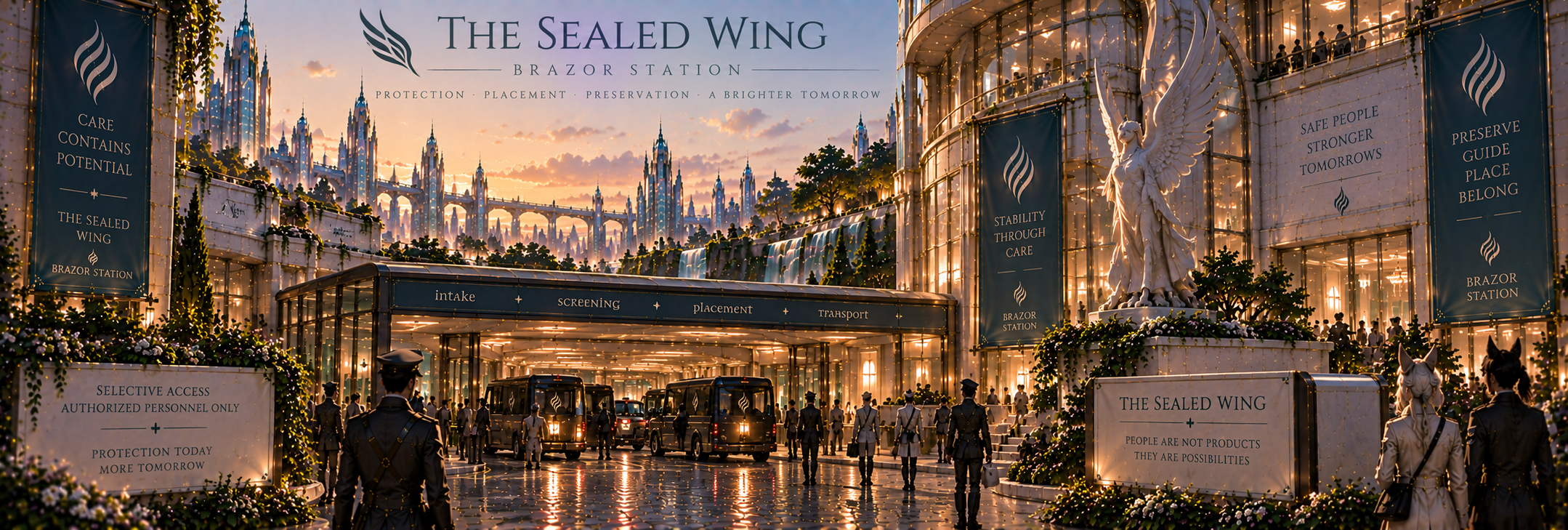
Current Mystery • Saint Merrow
One restricted wing of Saint Merrow Clinical Arcology is currently under emergency biosecurity lockdown.
The official explanation is contamination control.
No public report has identified the contaminant.
No public timeline has been given for reopening.
And the number of people suddenly interested in insisting that nothing unusual is inside has produced exactly the amount of confidence one would expect.
Ordinary staff credentials no longer open the restricted access corridor. Entry has been reduced to a short list of specially cleared medical, research and security personnel.
Several neighboring clinical services were relocated before the lockdown became public, suggesting the hospital had warning before the official notice appeared.
Routine access to some connected medical and research files has been suspended or redirected through higher-level review.
No detailed contamination report, incident timeline or public explanation for the extraordinary access restrictions has been released.
The most persistent rumor claims Saint Merrow identified a biological marker inconsistent with ordinary registered demi-human ancestry.
The story varies depending on who tells it:
The rumor gains credibility from one uncomfortable fact: the Purity Grid Mirror Vault is already believed to maintain restricted mythic-marker flags.
Another version claims the lockdown has nothing to do with contamination and everything to do with a patient transferred into Saint Merrow without lawful documentation.
Possibilities whispered through clinic staff include:
If true, the emergency lockdown may be less about containing biology than containing the paperwork around it.
A third rumor insists the wing is sealed because someone who was supposed to be inside it no longer is.
No confirmed escape notice has been issued.
That has not stopped River-Run circles from asking whether anyone recently emerged from the Reedway carrying a Saint Merrow medical band.
The quietest rumor may be the most destabilizing.
It claims that nothing escaped.
Nothing contaminated the ward.
Nobody was transferred illegally.
The problem was simply a test result that the Purity Grid could not classify without contradicting itself.
The recorded ancestry does not produce the biological result observed in the patient.
Different systems return categories that should not be biologically compatible.
New samples reportedly reproduce the same anomaly rather than resolving it as laboratory error.
The problem may not be the patient at all. It may be what the result implies about the certainty of the system studying them.
No confirmed public link exists between the sealed Saint Merrow wing and the Purity Grid Mirror Vault.
That has done little to stop speculation.
Several rumors insist restricted files associated with the incident now require Mirror Vault authorization. Others claim Helix personnel began accessing mythic-marker records shortly before the lockdown.
Neither Saint Merrow nor Helix has publicly confirmed those claims.
From outside, the mystery is remarkably mundane.
No alarms echo across the city. No crowds flee Saint Merrow. The hospital continues operating around the sealed section as though the architecture itself has agreed not to ask questions.
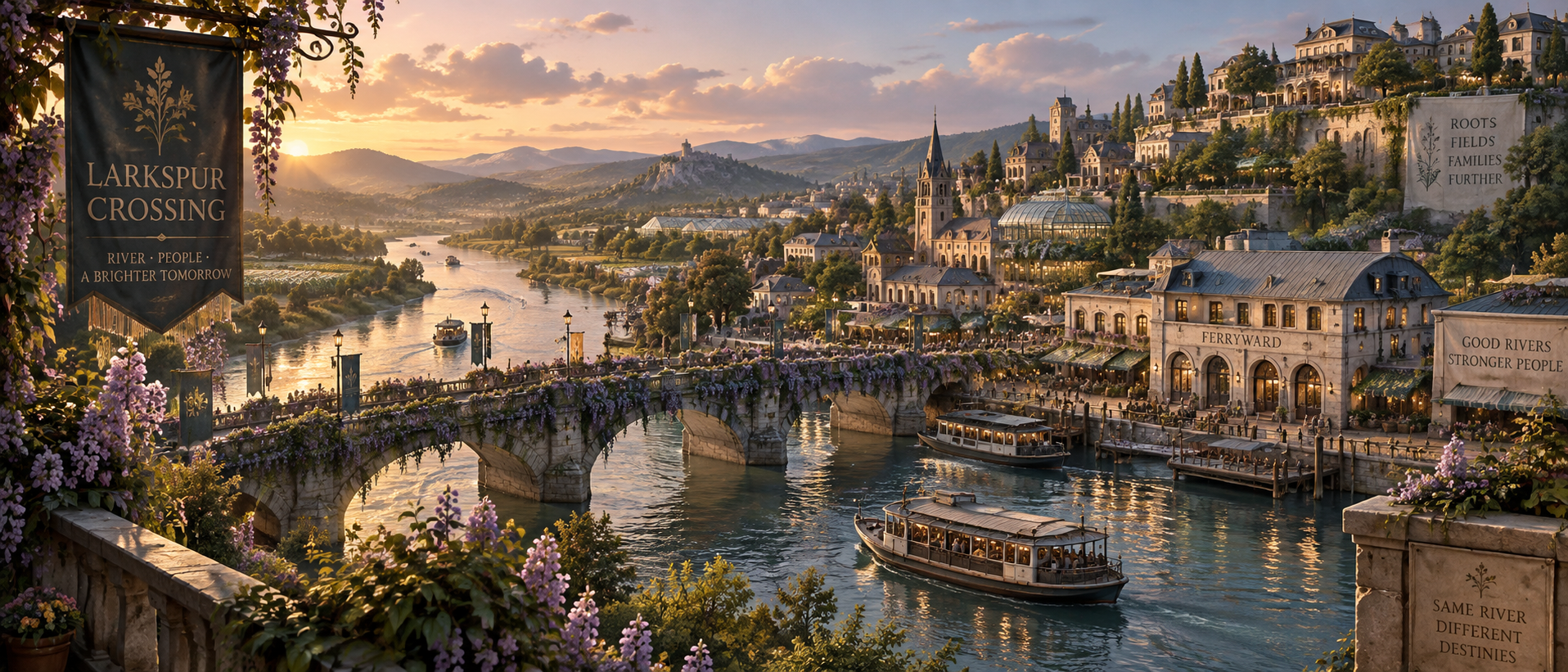
Larkspur Crossing // City Overview
A flower-covered eastern crossing where the river carries orchards, ferries, families, freight, and the dangerous knowledge that another kind of life exists downstream.
Larkspur Crossing sits where the Brazor River stops feeling like infrastructure and starts feeling like part of the household. It curls directly through the city, beneath flowered bridges and past ferry landings, old mills, garden walls, cafés, clinics, orchards and river estates before narrowing east toward routes Brazoria Vale has never managed to make entirely obedient.
Smaller than Brazor Station and considerably less corporate, Larkspur is a city built at human scale. Most buildings rise only a few stories. Old limestone and river stone remain visible beneath modern retrofits. Wisteria and larkspur spill over balconies, greenhouse roofs glitter behind neighborhoods, ferries move between familiar landings, and agricultural traffic enters town beside commuters who have ridden the same route for years.
The river is street, workplace, freight lane, gathering place and horizon. People cross it to work, eat beside it, grow food from it and measure distance by its bends.
Orchards, flower farms, medicinal herb fields, seed nurseries and greenhouse belts begin almost as soon as the denser streets end. Larkspur never fully separates city from cultivated countryside.
Larkspur has sophisticated systems, but social knowledge matters just as much. Ferry workers know regular commuters. Shopkeepers know households. Old families know one another's histories.
Larkspur feels looser because life is visible here. Demi-humans accompany households through markets, work along the river, visit cafés, help on farms and appear throughout ordinary civic life. The city rarely resembles a cage until somebody reaches the edge of what their household, estate, institution or registration permits.
Both sets of names describe the same place. Larkspur really is beautiful. Its gardens really are loved. Its ferry city really can feel gentle. Its households can be affectionate, generous and deeply attached to the companions raised within them. None of that changes the legal boundary underneath daily life.
Brazoria Vale // Eastern Brazor Corridor // Larkspur Crossing
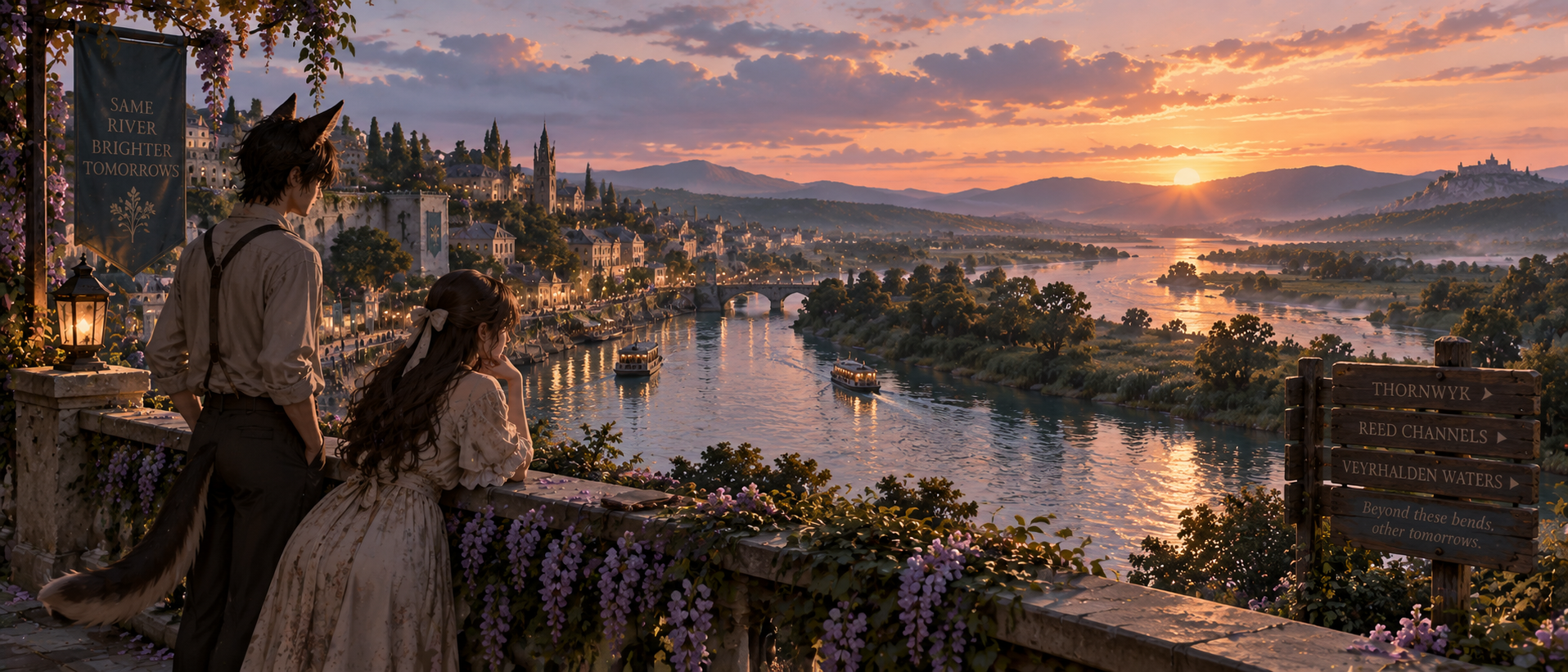
Larkspur Crossing // Emotional Geography
In most of Brazoria Vale, freedom belongs to rumor, politics and foreign maps. In Larkspur, people can stand beside the river and look toward it.
East of Larkspur Crossing, the Brazor begins threading itself through quieter channels, reed country, secondary roads and borderland hills. Somewhere beyond those bends are jurisdictions where a Brazorian custody certificate has no power, where ownership claims can be rejected outright, and where a person arriving under another household's name may be recognized under their own.
The distance changes the psychology of the city. To most humans, the eastern horizon is geography: scenic hills, ferry routes, trade connections and the complicated edge of national jurisdiction. To demi-humans, it can be something much more immediate. The far shore is proof. There are places close enough to imagine reaching where the legal assumptions governing their entire lives simply stop.
A companion who vanished after a ferry shift. A farm worker who never returned from an eastern delivery. Someone's cousin who supposedly reached sanctuary. Most stories cannot be verified. That rarely stops them spreading.
Official ferries follow approved crossings, but the Brazor contains smaller channels, reed passages, maintenance approaches and old local waterways. People raised beside the river know water rarely obeys the neat lines drawn over it.
Thornwyck contacts and Veyrhalden-linked water routes are discussed carefully, usually as somebody else's story. Their proximity means even people who never intend to run know running is physically possible.
The eastern routes mean commerce, agriculture, ferry regulation, border politics and occasional inconvenience. Some locals worry about smuggling. Others resent tighter inspections. Many simply think of the distant hills as part of the familiar landscape.
The same hills can represent the possibility that Brazorian status is not permanent everywhere. A registration, placement agreement, estate claim or household designation may control a life here without possessing any authority at all somewhere beyond the water.
Every story about somebody who crossed is also a lesson for the River Authority. Every suspicious ferry trip, missing household member, abandoned wrist-comm and unfamiliar boat teaches officials where people believe the weak points are. Larkspur's gentleness therefore exists beside an unusual watchfulness. The city knows exactly what waits downstream.
That tension has shaped generations of local folklore. Children grow up hearing stories about people who crossed the water and were never seen again. Some versions end badly. Others insist the missing person found a new name, a different shore and a life no Brazorian record could reclaim. Families argue over whether such stories are warnings, fantasies or betrayals.
The Brazor River does not become freer as it travels east. The people following it might.
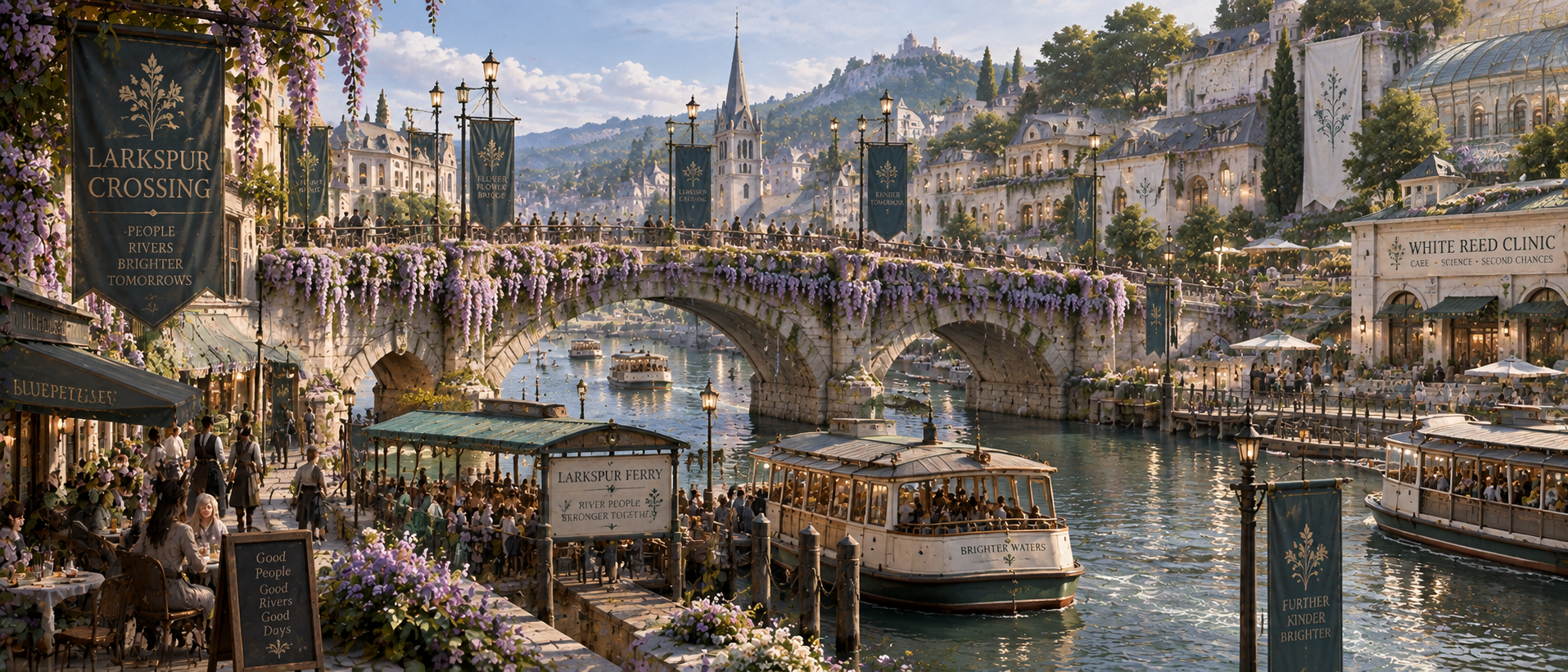
Larkspur Crossing // Central Districts
Flower Bridge, Ferryward and White Reed Quarter form the public heart of Larkspur, where civic pride, river traffic and the city's culture of care all meet beside the Brazor.
Most visitors meet Larkspur here first. The river narrows beneath old stone arches covered in flowering vines, ferries come and go beneath civic banners, cafés face the water, and pale medical buildings rise just beyond the busiest streets. It is beautiful enough that the mechanisms governing movement and custody can disappear into the scenery.
The bridge is Larkspur's most recognizable landmark, photographed at weddings, festivals, family outings and every spring flowering. Old ivory stone supports climbing larkspur, wisteria and seasonal vines while civic banners hang between decorative lamps.
Ferry gates, passenger landings, cargo docks, river cafés and tourist boats crowd the waterfront. Dock crews know one another by name, commuters have preferred boats, and aquatic and waterbird demi-humans are common among maintenance, navigation and river-service workers.
Small hospitals, recovery houses, fertility offices, wellness lodges and caregiver schools occupy quieter streets just beyond the river. White curtains, garden courtyards and low limestone buildings give the district an unusually peaceful character.
The Flower Bridge is a genuine civic symbol. School portraits are taken there. Couples meet beneath its arches. Festival ribbons are tied along its railings. Flower vendors compete for the best corner during spring. Locals complain when tourists block the walking lanes for photographs and then take exactly the same photographs themselves.
Its decorative arches also contain discreet transit scanners. They are small enough to disappear among lamps, flowers and restoration hardware. For most residents, passing beneath them is no more remarkable than crossing a street. A problem becomes visible only when somebody's clearance does not behave as expected.
Morning crews recognize market sellers carrying the same crates every week. Café staff know which ferries empty before the breakfast rush. River Authority officers know the regular labor routes. Demi-human workers may joke with coworkers, stop for coffee after a shift and complain about weather delays like anyone else. The scan happens anyway.
White Reed Quarter reflects the same contradiction in a quieter form. Many of its institutions really are good at care. A person recovering from illness may receive excellent food, clean rooms, species-appropriate accommodations and attentive medicine. Caregiver training is respected work, and neighborhood clinics serve ordinary residents alongside registered companions.
But not every recovery room is freely entered or freely left. Some facilities accept protected biological residents under household, estate or institutional authority. A room may have fresh flowers, an open window and a gene-locked door at the same time.
Flower Bridge // Ferryward // White Reed Quarter
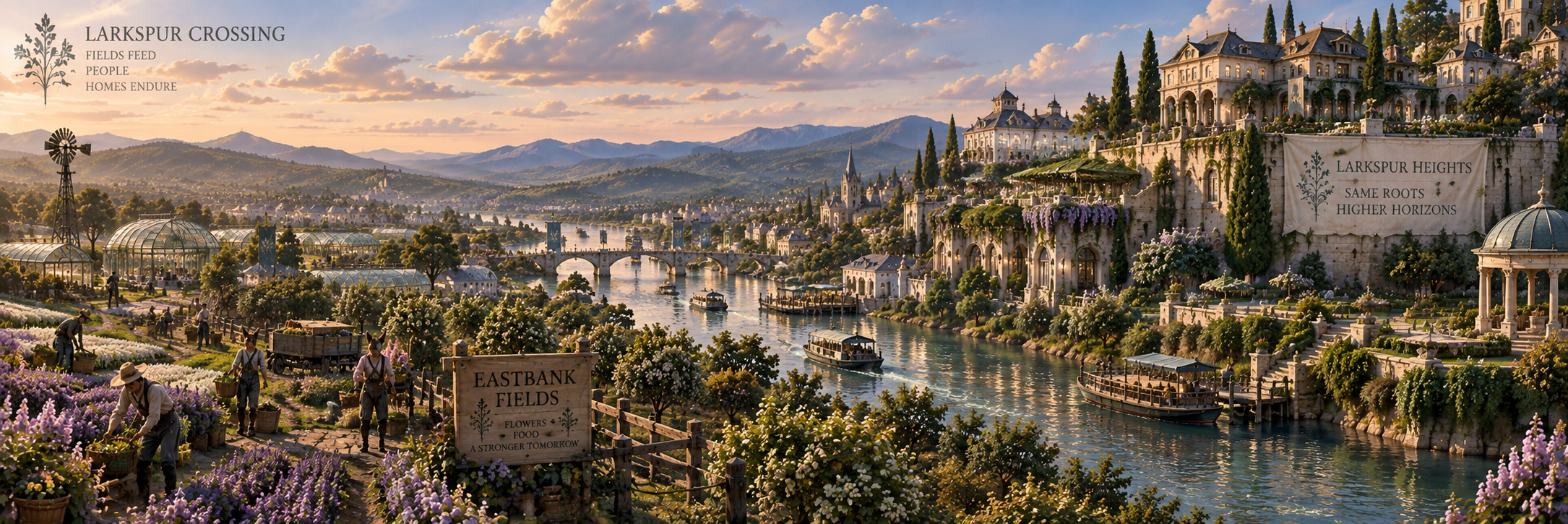
Larkspur Crossing // Fields & Estates
On one side of Larkspur, people grow the city. On the other, old families look down across what generations of that labor built.
Larkspur thins quickly beyond its river center. Streets become lanes, low walls divide orchards, greenhouse roofs catch the afternoon sun and broad fields of larkspur, herbs and specialty crops spread across the eastern bank. Above them, the land rises toward the old villas and private gardens of Larkspur Heights.
Agricultural Belt
Eastbank is where Larkspur's cultivated identity becomes literal. Flower farms produce the blue-purple blooms associated with the city. Orchards line irrigation channels. Medicinal herbs grow under controlled shade. Seed nurseries and greenhouse belts support both local agriculture and Brazoria's wider biotech economy.
Old-Money Ridge
The Heights curve along higher ground overlooking the Brazor. River villas sit behind old garden walls, private docks descend toward the water, and guest conservatories glow behind estates whose family names may be older than the modern city government.
Demi-human agricultural workers are often assigned according to practical traits. Pollinator-linked workers move through flowering crops, scent-sensitive workers identify disease or ripeness, climbing species maintain trellised plants, and nocturnal lines may work harvests during cooler hours.
Farmhouses, estate cottages, labor residences and small roadside communities are scattered between the fields. Some are generational homes with strong neighborhood ties. Others are housing tied directly to agricultural employment or estate custody.
Several prominent families hold Green House recognition, a prestigious Brazorian designation associated with agricultural stewardship, conservation investment, documented lineage management and long-standing regional influence.
From Eastbank, Larkspur Heights is a line of pale villas above the trees. From the Heights, the fields become a cultivated landscape of orchards, glass roofs and river channels stretching toward town. The distance between them is not enormous. Socially, it can feel much larger.
Estate life in Larkspur is less theatrical than elite culture in the largest Brazorian cities. Domestic companions may have bedrooms rather than quarters, attend household dinners, accompany families into town, maintain their own hobbies and be known personally by neighbors. Children may grow up beside the same companion for decades. Household affection can be deep, ordinary and completely sincere.
That intimacy also makes authority harder to see from outside. Private disagreements become household business. Custody decisions become family decisions. A companion disappearing from public life may be explained as illness, travel, relocation or a private matter, and old families are exceptionally good at making other people feel rude for asking twice.
Eastbank Fields // Larkspur Heights // Agriculture Below, Inheritance Above

Larkspur Crossing // Old River Districts
Old Mill Steps and South Silt remember the version of Larkspur that existed before gardens became civic branding and the river learned to move through polished terminals.
The western bends of Larkspur are older, lower and less carefully curated. Here the Brazor presses directly against foundations built generations ago. Stone stairs disappear beneath changing water levels. Mill races cut through blocks newer planners never managed to straighten. Working docks sit beside buildings whose lower rooms still smell faintly of river mud after a wet season.
Oldest River District
Old Mill Steps grew around water-powered industry long before modern Brazoria covered the river in sensors and smart infrastructure. Abandoned mills, converted workshops, old warehouses and narrow homes cling to foundations designed around a Brazor that regularly ignored property lines.
Working Floodplain
South Silt is practical Larkspur: mechanics, ferry workers, field hands, maintenance crews, processors, loaders and families whose lives follow shift schedules more closely than garden festivals. Rent is lower, streets flood first and everybody knows somebody who can repair something after official shops have closed.
Old drainage arches and mill channels run beneath parts of the district. Some remain municipal infrastructure. Others have been sealed, forgotten, flooded, reopened, mislabeled or simply left alone because restoration costs more than anyone wants to admit.
Plans to rehabilitate Old Mill Steps appear every few years. Architects arrive, surveys are conducted, funding is announced and sections are repaired. Then water damage, ownership disputes or political priorities stall the work again.
Official maps describe streets and utility corridors. Residents know which cellar connects to an older stair, which dock stays dry during high water, which alley floods first and which maintenance gate has not latched properly in fifteen years.
Someone knows a mechanic who will work after midnight. Someone has a cousin on a ferry crew. Someone can find a temporary room without asking for a dozen documents. Someone heard which River Authority officer is looking the other way this week. The neighborhood's informal economy is built from relationships, debts, gossip and memory.
That makes South Silt useful to almost everyone. Undocumented workers can disappear into crowded labor networks. River-Run sympathizers can find boats, tools or temporary storage without creating a formal record. Informants can sell exactly the same knowledge in the opposite direction. A person asking the wrong question may discover that friendliness and trust are not interchangeable.
Old Mill Steps carries a similar ambiguity underground. Half-flooded passages and forgotten service routes are ordinary pieces of decaying infrastructure until somebody needs a route the city does not officially recognize. Then an old drainage arch stops being a relic and becomes geography with consequences.
Old Mill Steps // South Silt // Working River, Older Memory

Larkspur Crossing // Civic Infrastructure
Larkspur rarely asks whether somebody belongs in the city. More often, it asks where they belong, who is responsible for them, and whether the river agrees with the paperwork.
Around Ferryward, bureaucracy is woven directly into ordinary movement. Commuters step through scan arches on the way to work. Farm crews queue beside tourists. Cargo passes beneath flowering stonework. Ferry clerks greet people they have known for years while status lights quietly decide whether the next gate opens.
The system feels less severe than a fortified border because most people use it every day. Larkspur's crossings are civic infrastructure first: ferries need manifests, bridges need maintenance, farms need workers, the River Authority needs traffic records. The same network also determines when a companion may travel, when an estate transfer is valid, and when an ordinary morning becomes an inspection.
The city's primary ferry checkpoint handles commuters, river workers, household travel, visitors and small commercial traffic. Most verification happens through wrist-comms and unobtrusive biometric readers before passengers ever reach the gangway.
Built into the ceremonial heart of Larkspur, the Customs House manages bridge declarations, visitor clearances, household travel records and flagged crossings. Its pale stone and flowered balconies make it one of the prettiest checkpoints in Brazoria.
Controls ferry lanes, lock schedules, patrol notices, cargo movement, flood restrictions and water-access permissions. Boat operators know its staff almost as well as they know the river.
The system is so familiar that locals read it almost without thinking. A light appears beside a travel record, the gate responds, and the line keeps moving.
Identity, travel authority and relevant permissions align. The passenger proceeds normally. For most humans and routinely authorized companions, this is the color they expect to see.
Something requires review. It may be mundane: an expired permit, changed itinerary, cargo discrepancy or damaged wrist-comm. It may also involve household authorization, custody records or biological status.
Movement pauses. Staff are notified and the traveler is directed away from the normal flow. White does not publicly explain why somebody has been flagged, which is part of what makes it feared.
Biological Records
The Annex is Larkspur's local interface with Brazoria's biological record system. It is smaller and friendlier than the great registry offices of Brazor Station, but the information passing through it can shape a person's work, healthcare, custody and travel for years.
Local Reality
Larkspur's bureaucracy is personal in a way metropolitan systems are not. A clerk may know the family submitting an estate report. A ferry officer may recognize the companion whose clearance suddenly changed. A nurse may remember the patient whose ancestry record no longer matches last year's file.
Hybrid anomaly flags are among the Annex's most sensitive records. They may appear when visible traits, inherited markers or historical documentation conflict with an existing classification. Some are administrative mistakes. Some expose ancestry a family never knew about. Others become the first sign that somebody has spent years living under a category the Grid no longer accepts.
Larkspur Ferry Gate // Flower Bridge Customs House // River Authority Lockhouse // Green Census Annex
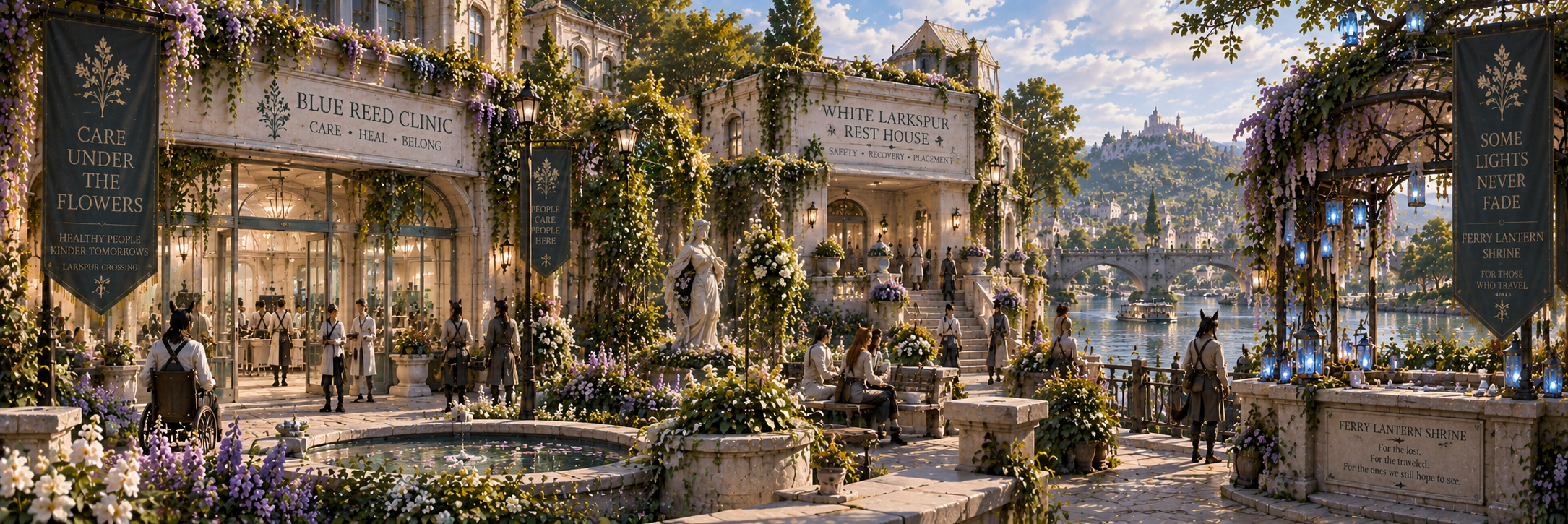
Larkspur Crossing // Care & Memory
Some of Larkspur's gentlest places are genuinely gentle. Others use the same language, the same white curtains and the same gardens for something more complicated.
White Reed Quarter and the garden streets around it form one of the quietest parts of Larkspur. Small clinics sit beside public gardens. Recovery houses open onto shaded courtyards. Families walk beneath flowering trellises while blue lanterns flicker at a river shrine built for people the water did not return.
A modest riverside clinic serving local families, ferry crews, agricultural workers and registered companions. It handles ordinary medicine: injuries, infections, prenatal care, chronic treatment, species-specific health needs and the thousand unremarkable problems that keep a town's doctors busy.
A beloved botanical park used for school trips, family outings, civic ceremonies and seasonal flower displays. Children learn local agricultural history here, couples take photographs under the vines, and elderly residents argue cheerfully about which generation ruined the rose beds.
A peaceful recovery facility known for private rooms, soft gardens, attentive staff and excellent long-term care. It also accepts protected biological residents placed there through household, medical or institutional authority.
Most people enter the clinic because they are sick, injured, pregnant, exhausted or due for a checkup. That ordinariness is precisely why quiet resistance can survive inside it. A sympathetic physician, nurse or archivist does not need a secret laboratory. Sometimes they only need access to the right field in the right record.
Official Memory
The shrine stands near the river beneath a canopy of flowers and small blue lamps. Officially, its lanterns remember ferry accidents, floods, drowned workers and travelers lost to the Brazor. Families leave flowers, handwritten names and tiny offerings beside the water.
Unofficial Memory
Not every lantern is for somebody who died. Some are lit for companions transferred away without warning, people who vanished into institutional custody, relatives who escaped, workers who never returned from an estate, and those whose families do not know whether to mourn or hope.
Nobody formally acknowledges the second tradition. Nobody has successfully stopped it either. A blue lantern does not explain whom it represents, and Larkspur is too fond of the shrine to interrogate every grieving person who leaves one.
The White Larkspur Rest House carries a different ambiguity. Many residents are treated exceptionally well. Meals are good. Gardens are maintained. Staff are trained. Species accommodations are taken seriously. Some residents actively prefer it to previous homes or institutions.
But treatment and autonomy are separate questions. A peaceful residence can still be one where access is logged, visitors are approved and a gene-locked door will not open simply because the person standing behind it asks.
Blue Reed Clinic // Heritage Garden // White Larkspur Rest House // Ferry Lantern Shrine

Larkspur Crossing // Food, Drink & Local Life
Ferries eventually dock. Shops eventually close. Larkspur, however, has never been particularly good at going straight home.
Evenings gather along the Brazor. Café tables fill beneath flowering balconies, restaurant windows turn gold against the river, musicians start tuning somewhere down Ferryward, and friends who intended to stop for one drink discover several hours later that the last convenient ferry has already gone.
Larkspur's social life is neither metropolitan nor sleepy. It runs on regulars. People have favorite tables, preferred bartenders, habitual breakfast orders and extremely developed opinions about which bakery is overrated. Humans and demi-humans share much of this ordinary public life, especially in the older river districts where everyone has known everyone else for far too long to maintain much mystery.
A comfortable river-worker pub within walking distance of the main landings. Dock crews, ferry staff, mechanics and off-shift River Authority workers crowd the tables after evening changeover. The bell behind the bar is rung whenever weather cancels the last ferry.
Coffee, delicate pastries and one of the best bridge views in town. Popular for first dates, study afternoons and prolonged conversations over a drink that stopped being warm forty minutes ago.
Used books, poetry, local histories, river maps and shelves that lean just enough to concern visitors. The lowest floor has survived more floods than anyone remembers and remains open through sheer local stubbornness.
Cheap, filling river food and breakfast all day. Shift workers arrive before dawn, mechanics take over the lunch counter, and ferry crews occupy the booths late enough that nobody is entirely sure when breakfast ends.
Traditional local cakes, flower teas and aggressively pretty table settings. Tourists love it. Elderly regulars consider several tables inherited territory and can identify every neighborhood scandal since approximately the invention of water.
A farm-market café built around whatever the surrounding orchards and fields are producing. Fresh bread, fruit preserves, herb dishes and seasonal lunches make it a favorite stop between town and the agricultural belt.
A small bar and live-music room tucked just far enough from the main ferry traffic to feel local. Folk musicians, student bands and river singers rotate through a stage barely large enough for everyone using it.
Larkspur's dependable special-occasion restaurant, overlooking the illuminated bridge and evening ferries. Anniversaries, graduations, family dinners and an alarming percentage of local marriage proposals happen on its terrace.
A small city cannot support endless anonymity, so its cafés, pubs and restaurants become extensions of neighborhood life. The same dock worker seen at the Ferry Bell may appear at Silt & Salt before sunrise. The doctor from Blue Reed might spend Friday night listening to music at the Low Lantern. A family companion who has visited Bluepetal every week for ten years may be as recognizable to the staff as the household that legally brought them there.
None of these places exists primarily to explain Larkspur's politics. They exist because people want coffee, books, fried food, music, gossip, dates, cake and somewhere to sit beside the river after work. That mundanity matters. Larkspur is not only a system people survive inside. It is also a hometown people become attached to.
Coffee // Books // River Food // Music // Terraces // One More Drink
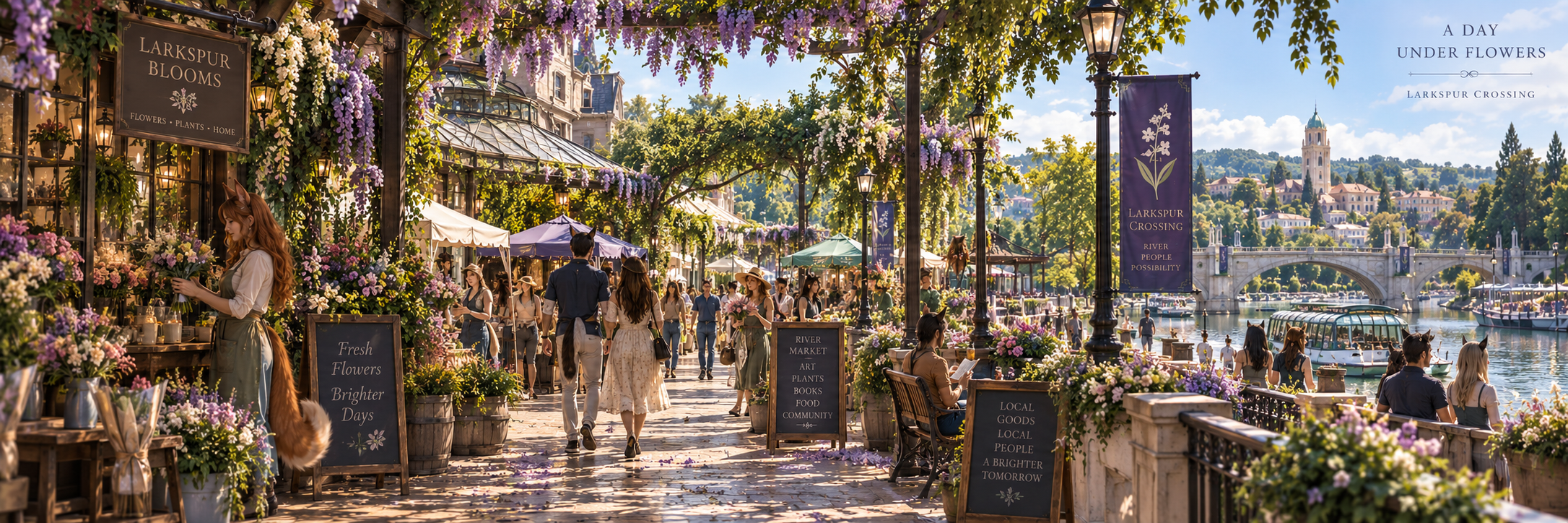
Larkspur Crossing // Daily Life
Larkspur wakes with ferry bells, smells like bread by breakfast, fills its riverwalks by noon, and turns gold beneath bridge lights before most families have finished dinner.
Daily life in Larkspur is built around the river without being consumed by it. Ferries set the rhythm of commutes. Farms determine what appears at market. Bridge traffic decides when children need to leave for school. Clinics, cafés, orchards, shops and small offices all open around routines that have repeated long enough to feel permanent.
For most human residents, Larkspur genuinely feels like a good place to live. Streets are quieter than Brazor Station, healthcare is strong, local food is excellent, festivals still matter and enough people know one another that a broken fence or sick neighbor rarely remains somebody else's problem for long.
Ferry bells start early. Field crews cross while the river is still cool, farm trucks unload produce, clinic workers arrive in pale uniforms, bakeries lift their shutters and school crossings fill with children carrying bags, lunches and whatever project they forgot was due.
Fruit, herbs, cut flowers, greenhouse vegetables and nursery stock arrive from Eastbank throughout the morning. Farmers know which vendors want what before the stalls are fully open, and regular customers learn which days mean fresh bread, peaches or the first larkspur cuttings.
Parents walk children toward school, older residents claim café tables, ferry workers finish overnight shifts and companions accompany households through errands that are so ordinary nobody stops to notice them.
The morning's work spreads outward into markets, lunch counters, public gardens and ferry queues. Tour groups pause beneath Flower Bridge, agricultural students compare field samples over cheap food, workers eat beside the water and delivery boats compete with sightseeing ferries for space along the busier landings.
Seasonal produce, cut flowers, bread, preserved fruit, prepared food and small local crafts fill the market lanes. It is part grocery run, part social event and part recurring argument over which orchard actually grows the best pears.
School groups learn local agricultural history, tourists photograph the flowers and families wander the garden paths between errands. Older residents frequently use the benches for conversations requiring absolutely no permission from the people being discussed.
People pick up medicine, replace broken tools, buy groceries, meet friends for coffee, collect children, argue with mechanics and wait for ferries. Larkspur works because most of life here is not an event.
Evening
Workers return from the fields and river. Restaurants fill. Small bars start their first music sets. Families gather for dinner, teenagers linger beside the water, and residents take slow walks beneath bridge lamps while ferries carry the last heavy commuter traffic home.
After Sunset
The Ferry Lantern Shrine becomes more visible after dark, its blue lights reflected in the river beside the warmer gold of cafés and bridge lamps. Some people stop there deliberately. Others simply pass it on the way home, as familiar with the glow as they are with the sound of the water.
Farm festivals amplify everything Larkspur already loves about itself. Flower garlands stretch across streets, orchards host tasting tables, schools organize performances, ferry crews decorate boats and local families compete over recipes that have apparently been “the traditional version” for four different generations.
The important thing is that none of this happiness is fake. People really do love the river markets. Children really do grow up remembering summer festivals. Families really do trust local doctors. Neighbors really do bring food when somebody is ill. Brazoria's contradictions work precisely because ordinary life can be warm enough that many residents see no reason to question the structure underneath it.
Morning Ferries // River Markets // Garden Paths // Evening Lanterns

Larkspur Crossing // Familiar Faces
Larkspur does not need a database to tell every resident who lives on the next street. Somebody already knows their mother, their employer, their favorite café and what time they usually catch the ferry.
Larkspur is large enough to have districts and small enough for those districts to remember people. Regulars are not anonymous customers. Commuters are not anonymous passengers. Families, workers, companions, shopkeepers and ferry crews pass through one another's lives often enough that recognition becomes part of the city's social fabric.
Most of the time, this feels comforting. A shopkeeper notices when an elderly customer misses their usual morning. A ferry clerk keeps an eye out for a teenager traveling home alone. A café starts making somebody's order before they reach the counter. A mechanic recognizes the sound of a neighbor's failing engine before the neighbor admits anything is wrong with it.
Bluepetal knows which commuters need coffee before conversation. Silt & Salt knows who works night shift. Market sellers know which households buy for six people and which elderly customer will absolutely complain if the peaches are not ripe enough.
Bridge crews recognize walkers. Ferry staff know regular routes. Clerks know which children travel between separated households, who works Eastbank mornings and which families always arrive late despite living five minutes away.
Farmers know which crews belong to neighboring holdings. Estate names carry familiar workers and companions with them. A person does not always need to introduce themselves because somebody already knows where they came from.
A household companion who has lived in Larkspur for years may be known by neighbors, shopkeepers, teachers, ferry workers and friends completely independently of whether those people know the details of their registration. They are not socially invisible. Quite the opposite. The city may know them extremely well.
The Comfort
When somebody gets sick, neighbors ask after them. When a child misses the ferry, another parent may bring them home. When an orchard loses part of a harvest, relatives and nearby farms help. Small-city familiarity creates a real safety net that no formal civic system could fully reproduce.
The Cost
The exact same network makes anonymity difficult. A new haircut is noticed. A new relationship becomes lunch-table conversation. Somebody changing routines prompts questions. A familiar companion suddenly traveling alone is not an abstract anomaly. They are someone the ferry clerk remembers seeing with the same household for twelve years.
Old Larkspur families carry reputations across generations. A surname can tell locals which neighborhood somebody grew up in, which estate their relatives work for, who feuded with whom and which ancient disagreement apparently remains relevant forty years later.
News can cross Larkspur without touching a public channel. A café conversation reaches a ferry crew, the ferry crew mentions it to a market seller, and by dinner somebody's aunt knows what happened along with three completely invented improvements.
Locals often think of people in relational terms: the clinic doctor's son, the woman from Waterstairs, the Louves' Great Dane, the mechanic from South Silt, the orchard worker who sings at the Low Lantern. Larkspur places people inside stories.
This is why “belonging” carries more than one meaning in Larkspur. It can mean being welcomed, remembered and woven into community life. It can mean knowing exactly which table will make room when someone arrives. It can also mean being socially attached to a household, estate, workplace or family so thoroughly that stepping outside that familiar role becomes immediately visible.
That difference is not inherently sinister. Most residents would call it community, and most days they would be right. The trouble begins only when somebody needs what a small town struggles to give them: the freedom to become unfamiliar.
Regulars // Neighbors // Households // Familiar Faces // A City With a Long Memory

Larkspur Crossing // Human Life
Ask most humans in Larkspur what kind of place they live in and they will not describe a border city, a custody hub or an escape corridor. They will describe home.
Human life in Larkspur is shaped less by grand institutions than by routines repeated across generations. Farm families measure years in harvests. Ferry crews know the river by weather and sound. Teachers recognize former students pushing their own children through festival crowds. Doctors treat three generations of the same household. Shopkeepers still remember when half their customers were shorter than the counter.
The city is prosperous without feeling enormous, cultivated without feeling sterile, and old enough that many traditions existed long before anybody bothered to formalize them. For the humans who grow up here, Larkspur often feels like one of the kinder places in human-controlled Vistall.
Orchard owners, greenhouse operators, seed growers, flower farmers and agricultural specialists form one of Larkspur's oldest social foundations. Children may grow up helping during harvest before studying agronomy, medicine, logistics or biotechnology and eventually returning to the same land with newer tools.
Ferry crews, dock staff, lock operators, mechanics, maintenance teams and small boat operators keep the city moving. Their work is practical, weather-dependent and deeply social. A delayed ferry can reorganize half a neighborhood's morning.
Teachers, doctors, café owners, booksellers, bakers, clinic staff, gardeners and local administrators make up the quieter center of civic life. Many live close enough to work that errands become conversations before they become tasks.
Residents point to clean clinics, river festivals, public gardens, agricultural schools, good food, strong neighborhood networks and comparatively relaxed public life as evidence that their city does things differently. They are not entirely wrong.
Old Wealth
Larkspur's wealthiest households occupy river villas, old estates and agricultural holdings above the city. Some families have financed clinics, gardens, research programs, ferry improvements and conservation projects for generations. Their names appear on plaques, scholarships and civic foundations almost as often as they appear in private estate records.
Working City
At the other end of the city's class structure are ferry laborers, mechanics, processors, maintenance crews and seasonal agricultural workers. South Silt families may distrust the Heights, complain loudly about officials and still defend Larkspur against anyone from outside who insults it.
Larkspur's medical culture is personal. Physicians and clinic staff often understand not only a patient's history but the family, estate or workplace surrounding them. Humans tend to view this familiarity as one of the city's greatest strengths.
Local schools feed into agricultural programs, healthcare training, ferry administration and university routes farther west. Many teachers grew up in Larkspur themselves and remain woven into the same families they once taught.
Fishing, small pleasure boats, garden walks, riverside picnics and evening ferries turn the Brazor into recreation as much as infrastructure. Larkspur residents do not only depend on the river. They are emotionally attached to it.
Many human residents have also known demi-human companions for their entire lives. A child's earliest memories may include a family companion at the breakfast table, helping in the garden, attending festivals, carrying groceries home from market or sitting beside them during a childhood illness. That intimacy deeply shapes how Brazorian ownership is understood locally.
To many Larkspur humans, the existence of affection seems like proof that the system is humane. They remember companions who were loved, spoiled, protected and mourned. They know households where companions have bedrooms, hobbies, friends, spending allowances and favorite restaurants. When outsiders call Brazoria cruel, locals may sincerely feel that those outsiders are describing somewhere else.
Larkspur's humans disagree constantly about how far the city's softer traditions should go. The arguments are political, generational, economic and intensely local.
Some residents support broader movement rights, stronger companion protections, independent earnings, easier legal appeals and tighter limits on estate authority. They may still think in Brazorian stewardship language while believing current law has fallen behind local reality.
Others believe relaxed travel, public demi-human visibility and permissive local culture encourage escape, registry fraud and foreign interference. They see tighter controls as protecting households, farms and the city's reputation.
A large portion of the population is less ideological. They want crops to survive, children to get to school, clinics to stay funded, river levels to behave and somebody to fix whichever ferry has decided to become today's municipal problem.
It is one of Larkspur's favorite phrases because almost everyone can agree with it. Farm families hear community. Ferry crews hear solidarity. Wealthy households hear stewardship. Reformers hear obligation to protect the vulnerable.
The disagreement begins with a quieter question: when Larkspur says our own, does it mean people who belong to the community, or people the community believes belong to someone?
Farm Families // River Crews // Green Houses // South Silt // Festivals // Home
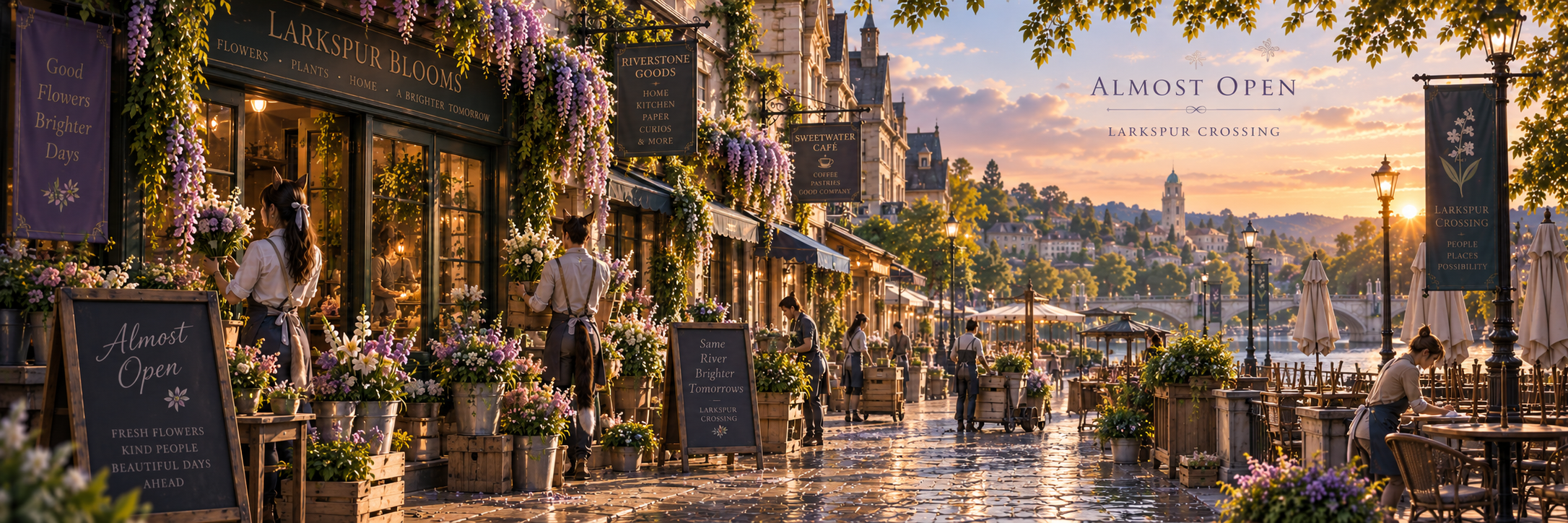
Larkspur Crossing // Demi-Human Life
In Larkspur, demi-humans are not hidden from public life. They work beside the river, buy lunch at market, catch ferries, visit clinics, meet friends and grow up being recognized by half the city.
For a human visitor arriving from harsher parts of Vistall, Larkspur can look startlingly relaxed. Animal ears rise above café tables. Tails pass through market crowds. Winged workers cross Ferryward carrying equipment. Estate companions walk garden streets beside households that have known them for decades.
Nobody gasps. Nobody treats their presence as unusual. Larkspur's demi-humans are woven visibly into the city, especially in agriculture, river work, medicine, household life and the small businesses that make the eastern crossing function.
A heron demi-human may spend the morning coordinating dock traffic, checking mooring lines or working beside ferry crews. They remain fully human in face and body, with avian traits added to that human form. Around Ferryward, nobody considers that remarkable.
Pollinator-linked demi-humans are valued throughout Eastbank agriculture. A bee demi-human may work among flowering crops and greenhouse domes, using heightened scent, pollination knowledge or species-linked traits alongside ordinary agricultural training.
Otter demi-humans are common around river maintenance, buoy systems and wet infrastructure. One may spend an afternoon waist-deep beside a sensor housing, complain about faulty municipal equipment and meet friends for food afterward like any other worker.
Larkspur's demi-humans do not exist only inside estates or institutional corridors. They are neighbors, coworkers, regular customers, familiar commuters, friends and recognizable parts of the city's social landscape.
Public Life
A companion may order coffee without attracting attention. A river worker may complain about ferry schedules. Friends may meet at the Low Lantern. Agricultural workers may shop after a shift. Demi-humans can participate in a great deal of Larkspur life without every interaction becoming a legal event.
The Edge
The difference appears when ordinary movement becomes independent movement. A café visit may be normal while leaving the district is not. A job may be familiar while choosing another employer is not. A household companion may be known across town while still lacking authority over the record that determines where they legally belong.
Demi-humans work throughout Larkspur in agriculture, ferries, maintenance, care, domestic service and specialized river roles. Coworkers may know them for years without thinking much about the legal structure attached to their labor.
Public familiarity creates real relationships. A demi-human may have favorite restaurants, childhood friends, local grudges, hobbies, routines and people who would immediately notice if they stopped appearing.
Many companions and workers travel through approved parts of Larkspur routinely. Ferry crossings, markets, clinics and neighborhood visits can feel almost unrestricted when they remain inside permissions nobody has reason to challenge.
That is why Larkspur can feel dramatically freer than other human-controlled cities without actually recognizing demi-human civic equality. Its system grants enough room for lives to become rich, social and recognizable. Many demi-humans sincerely love people here, build communities here and think of Larkspur as home.
The city becomes psychologically different because the alternative is so close. From the river, from the Heights, from certain eastern roads and garden walls, people can see the direction of jurisdictions where Brazorian custody law has no authority.
An estate companion in Larkspur Heights may spend their entire life surrounded by affection, comfort and familiar faces while knowing that somewhere beyond the river are places where their legal relationship to those same people would be understood completely differently.
Visible // Familiar // Working // Social // Almost Open

Larkspur Crossing // Permission & Custody
Larkspur's restrictions are rarely built like walls. More often, they are built like permissions somebody has never needed to question.
A demi-human can move through much of Larkspur without looking confined. They may walk through gardens, take a ferry to work, shop in town, visit friends, receive medical care and attend public events. Yet each life is still anchored to a recognized structure that answers the legal question Brazoria considers most important:
In practice, that responsibility can belong to a household, estate, employer, conservatory, medical institution or approved sponsor. Most permissions operate quietly enough that a person may go days without consciously encountering them.
Domestic companions may live with a family, travel with household members, maintain personal routines and enjoy considerable day-to-day independence. Their broader movement and legal decisions remain tied to the household responsible for their registration.
Large Larkspur estates may manage companions, agricultural workers, protected residents and heritage lines through private custody systems. Access can extend across homes, gardens, docks and fields without extending beyond estate authority.
Agricultural and river workers may receive travel authority linked to shifts, routes or employers. The permit can make commuting feel ordinary while still defining where that movement is considered legitimate.
Protected or rare-line demi-humans associated with conservatories may receive public access, educational schedules, supervised outings or approved travel. The paperwork frames these limits as stewardship rather than confinement.
Aquatic and river-service workers often move across more of Larkspur than estate companions because their jobs require it. Their wrist-comms may authorize specific docks, ferry lanes, maintenance areas or waterways while rejecting movement outside those zones.
Recovery houses, clinics and long-term care programs may control movement through treatment plans or custodial medical authority. A restriction can therefore arrive not as punishment, but as a doctor's instruction backed by law.
A sponsor may authorize education, travel, specialized work, medical treatment or temporary residence beyond a companion's normal household range. From the outside, that expanded life can look very much like independence.
What Permission Feels Like
When authorization is broad and routines are stable, there may be no visible confrontation at all. The garden gate opens. The ferry accepts the wrist-comm. The café does not care. The clinic knows the file. Life proceeds.
What Permission Is
A household can alter travel permissions. An estate can revise access. A labor assignment can end. A medical authority can restrict movement. A sponsor can withdraw support. The person living inside those permissions may not hold final authority over any of them.
This is particularly visible in Larkspur Heights, where beautiful estates often extend toward views of the Brazor and the greener country beyond. Garden paths may run for acres. Private docks may open directly onto the river. Companions may roam freely across grounds large enough to feel like neighborhoods.
The gate itself may barely look technological. A reader is hidden in polished stone. A small light confirms identity. A wrist-comm exchanges authorization automatically. There is no guard tower, no visible chain and no reason for the gate to draw attention until it refuses to open.
That is the difference between having room and having autonomy. A person may be trusted with an enormous amount of space while still lacking the legal right to choose what lies beyond it.
The route is expected, authorized and routine.
If the destination and movement fit existing household or local permissions, nobody may care.
The same person who moved freely through town may discover that choosing where to live, whom to travel with or whether to remain in Brazoria was never included in that freedom.
This is why Larkspur's proximity to Thornwyck and Veyrhalden-linked routes matters so much. The city does not merely contain restrictions. It places those restrictions beside a visible horizon where the same paperwork may cease to matter.
Estate Custody // Labor Permission // Sponsorship // Medical Authority // The Garden Gate
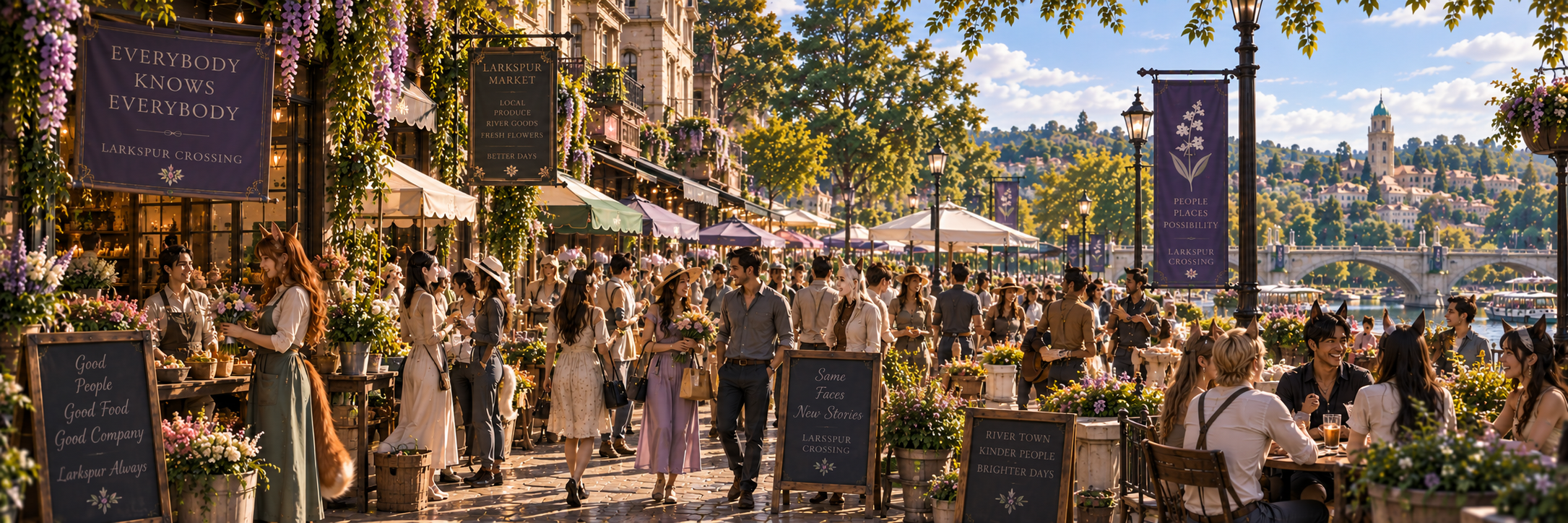
Larkspur Crossing // Society
Larkspur has neighborhoods, districts and thousands of residents. Somehow, this has never stopped half the city from knowing who somebody dated in school.
Larkspur social life runs on familiarity layered over familiarity. Family names carry histories. School friendships become adult business connections. Ferry crews marry into orchard families. Clinic workers grew up beside estate heirs. The same people meet again at markets, festivals, garden committees, cafés and bridge celebrations until relationships form a web dense enough to survive generations.
Unlike Brazor Station, Larkspur offers very little metropolitan anonymity. A person can certainly be private. They just cannot expect privacy to mean nobody notices.
Old Larkspur families are attached to orchards, ferry companies, clinics, river estates, schools and civic projects. A familiar surname may tell locals where somebody grew up, which household they belong to and several things their grandparents did before they were born.
Classmates become teachers, farmers, physicians, business owners and local officials. Childhood friendships remain useful social currency, while embarrassing school stories display a supernatural resistance to death.
In practice, somebody sees the restaurant reservation, somebody recognizes the ferry pair, and somebody's aunt knows both families. New relationships rarely stay completely unknown for long.
Who somebody knows can matter almost as much as occupation or wealth. A respected family, trusted employer, old school connection or familiar estate name can soften introductions long before formal credentials appear.
Community Memory
Larkspur's long-established households maintain family histories that extend beyond inheritance. They remember marriages, business partnerships, old disagreements, household companions, famous harvests, ferry accidents and which family helped which neighbor during a flood twenty years ago.
Community Pressure
The same memory can become restrictive. Families notice departures from expectation. A respected heir dating someone unexpected, an estate changing companion practices or a familiar resident suddenly refusing old traditions can become public conversation long before becoming a formal issue.
Prominent households are often associated with particular companion lineages across generations. Locals may recognize not only the family but the breeds historically kept, raised or supported within its estates.
Which orchard belongs to whom, which private dock serves which villa and which family financed which conservatory are pieces of local knowledge absorbed almost accidentally.
A gardener may have siblings working Ferryward. A clinic administrator may be married to an Eastbank grower. A household companion may have friends employed by three neighboring estates. Social circles cross class lines constantly even when legal ones remain firm.
Civic life strengthens those connections. School associations, agricultural societies, flower committees, ferry organizations, heritage groups and neighborhood fundraising circles provide endless reasons for the same people to keep appearing in the same rooms.
River festivals are especially powerful social events. Families reserve familiar viewing spots. Young adults drift between friend groups. Estate households host receptions. Ferry crews decorate vessels. Old classmates reunite accidentally and then spend twenty minutes pretending they did not already hear everything about one another from somebody else.
Friends link arms. Couples hold hands along the riverwalk. Parents kiss children goodbye at ferry gates. Household companions may lean comfortably against family members or receive casual affection without attracting attention. Larkspur is not culturally afraid of visible closeness.
What matters is how a relationship is understood. Affection that reinforces familiar roles feels reassuring. Affection that challenges those roles may suddenly attract much more attention.
Most of that attention is not malicious. Neighbors ask because they care. Relatives interfere because they believe they are helping. Friends notice changes because they know someone well enough to recognize them.
That is what makes Larkspur's social expectations powerful. Community does not merely surround a person here. It develops an opinion.
Family Names // School Histories // Estate Connections // River Festivals // Everybody Has Context

Larkspur Crossing // The Louve Family
Everybody in Larkspur has seen Mochi Louve and Auggie Pyrrhus together. Almost nobody understands exactly what they are seeing.
The Louves are one of Larkspur's established local families, prominent enough to be recognized without belonging to the very highest tier of Brazorian national power. Their name is associated with river society, cultivated land, civic events and the kind of comfortable local influence built through generations of being present whenever Larkspur needs money, organization or another garden reception.
Mochi's father. Practical, socially respected and deeply attached to Larkspur's old civic traditions. Everett belongs to the generation that sees responsible stewardship as evidence that Brazoria's system works when decent people are entrusted with it.
Mochi's mother and a familiar presence in local garden, charity and social circles. Warm hospitality is one of the Louve household's signatures, and Dahlia has spent years making their river gatherings feel less like formal events and more like an unusually beautiful family dinner.
Mochi's older brother, raised within the same small-city network of school friends, estate families and river traditions. Like the rest of Larkspur, Bennett has effectively never known a version of the household where Auggie was not already part of it.
Mochi Moxxanne Louve and August “Auggie” Pyrrhus were raised alongside one another. He is the Louves' purebred Great Dane demi-human companion, specifically tied to Mochi, and their closeness has been part of the family's public image for so long that most locals barely think to interpret it.
What Larkspur Sees
A prominent local daughter and the household companion who grew up beside her. Auggie accompanies Mochi to family gatherings, river events and ordinary outings. He knows her routines, her family and her friends. She trusts him instinctively. He is welcome beside her because he has always been beside her.
What Larkspur Does Not Know
They fell in love. Not symbolically, not as children who never outgrew attachment, and not as a sentimental version of household loyalty. They are two adults in a mutual romantic relationship, and they deliberately keep that part of their bond private.
Mochi reaching for Auggie's arm, leaning against him or automatically looking for him in a crowd reads as completely normal to people who have watched them grow up together.
Auggie accompanying Mochi alone raises little concern. His loyalty to her is considered established fact, and the Louves trust him with a level of familiarity that would be unusual for somebody newly placed in the household.
Neighbors may casually describe Auggie as practically one of the Louves. Under Brazorian social logic, this is affectionate praise rather than a challenge to his legal status.
The distinction matters because Brazoria has plenty of language for loving a companion. A person can call one beloved, precious, family, lifelong, irreplaceable or even the most important person in their life without necessarily threatening the legal structure.
Mochi loving Auggie is therefore not the scandal.
Larkspur understands this easily. It confirms Mochi as a caring member of a respected household and Auggie as a deeply cherished companion.
Now the relationship enters territory Brazorian culture handles poorly. Romance implies choice, reciprocity, adult partnership and expectations that do not fit neatly inside owner-and-companion law.
This is the point where a private relationship becomes a structural question. If Auggie's wishes carry the same moral authority as Mochi's, then ownership stops looking like benevolent responsibility and starts becoming very difficult to explain.
Mochi and Auggie have years of shared jokes, habits, arguments, affection and ordinary intimacy behind them. They know how the other takes their food, which stories have been told too many times, when somebody needs quiet and when somebody is pretending not to laugh. They are not performing doomed romance every time they stand beside the river.
At Louve gatherings, that familiarity is almost camouflage. Mochi can settle naturally beside Auggie because she always has. Auggie can hover near her when a reception gets crowded because everyone expects him to. A quiet touch can disappear inside twenty years of established behavior.
The irony is that Larkspur's intimacy protects them and threatens them at the same time. Everyone knows how close they are, so closeness itself attracts no suspicion. But if someone ever understood what changed between them, the same community that remembers their entire childhood would have very little difficulty reconstructing everything that came after.
The Louve View
The Louves are not secretly cruel people waiting for an opportunity to hurt Auggie. He has been raised within a household that feeds him well, protects him, includes him socially and regards his welfare as a genuine family responsibility.
The Structural Problem
Auggie's quality of life does not change the legal hierarchy underneath it. Mochi may love him completely and still inhabit the side of Brazorian law granted final authority. That contradiction exists whether either of them wants it there or not.
Mochi Louve // Auggie Pyrrhus // Lifelong Familiarity // Private Romance // One Very Local Secret

Larkspur Crossing // Estate Culture
Larkspur wealth does not rise in corporate towers. It settles behind old garden walls, follows orchard boundaries, descends toward private docks and remembers which family planted the trees.
The estates of Larkspur Heights are quieter than the wealth districts of Brazor Station. There are fewer executive compounds, fewer corporate façades and considerably more family history. River villas sit among orchards, private gardens, glass conservatories and old stone walls, often on land held by the same household for generations.
That does not make Larkspur's elite less powerful. It makes their power more personal. A family may own farmland, fund a clinic wing, employ half a neighborhood during harvest, maintain companion lines, sit on agricultural boards and host civic receptions from the same property where three generations eat Sunday dinner.
The wealthiest houses face the Brazor from elevated gardens or long waterfront terraces. Architecture tends toward old limestone, pale stucco, river-glass additions and carefully preserved original structures rather than monumental new construction.
Many estates maintain direct river access for pleasure craft, research vessels, agricultural transport and household ferries. A dock can be recreation in the morning, business infrastructure by afternoon and a private arrival point after dark.
Estate wealth often extends beyond the villa itself. Orchards, flower fields, nurseries, experimental crops and managed riverbanks may surround a household for kilometers, tying family prestige directly to cultivated land.
Glass & Green
Conservatories are common features of older Larkspur estates. Some are botanical showpieces. Others preserve rare plants, host agricultural research, accommodate species-specific environments or provide private recreational spaces for household companions and guests.
Household Structure
Estate companions may live extraordinarily comfortable lives. Private rooms, custom clothing, medical care, hobbies, garden access, household travel and decades-long emotional bonds are common among wealthy families who consider themselves responsible custodians.
A domestic companion may sleep upstairs while agricultural workers live in cottages beyond the orchard. An estate ward may receive treatment from a private physician. Household staff may have served the same family for decades. Different kinds of dependency overlap until the boundaries between employment, care, custody and family life become difficult to separate.
Wealthy households often retain physicians, therapists, fertility specialists or visiting clinicians. For companions and estate wards, excellent treatment can occur entirely inside systems chosen and controlled by the household.
Garden estates frequently extend into working land. Groundskeepers, field crews, greenhouse workers, pollinator specialists, mechanics and seasonal labor may all be tied economically to a single household.
An estate's influence is measured partly in memory. Which family funded a flood repair, preserved an orchard, employed a neighborhood or cared for a famous companion line can shape public opinion generations later.
This is where Larkspur wealth differs most sharply from Brazor Station's corporate elite. Brazor Station can hide responsibility inside departments, subsidiaries and contracts. Larkspur tends to attach responsibility to a surname.
That can make wealthy families unusually accountable to local opinion. It can also give them enormous protection. When a respected household describes a dispute as private, neighbors are often reluctant to challenge decades of goodwill, family friendship and civic contribution.
A companion stops appearing in town. An estate ward is moved to private treatment. A household employee leaves suddenly. A relationship becomes uncomfortable. Outsiders may ask questions, but established families possess both the privacy of wealth and the social benefit of being personally known.
The Intimacy
Estate households are not distant corporate machines. Gardeners know children by name. Companions grow up beside heirs. Physicians remember grandparents. Domestic staff attend weddings and funerals. People become genuinely attached across lines of class and legal status.
The Privacy
That same intimacy can protect harmful decisions. A household with a good reputation may receive more trust than the person disputing its authority. Problems disappear not because nobody noticed, but because everyone thinks they understand the family involved.
River Villas // Private Docks // Orchards // Conservatories // Households // Family Matters

Larkspur Crossing // Green House Profile
A beautiful river estate, an old philanthropic name, a serious research portfolio, and just enough missing information to make Larkspur start asking questions it normally considers impolite.
House Merroway occupies a broad water-facing estate outside the busiest streets of Larkspur Heights, where terraced gardens descend almost directly into the Brazor. Its private docks, conservatories and research buildings are integrated so carefully into the landscape that visitors can mistake working infrastructure for part of the scenery.
The Merroways hold prestigious Green House recognition and have spent generations building a reputation around river stewardship, agricultural investment, aquatic research and conservation philanthropy. Their name appears on restoration projects, scholarships, flood-relief funds and ecological programs throughout eastern Brazoria.
Young by the standards of Larkspur's old estate families, Andrew inherited a household whose influence extends far beyond its garden walls. Publicly he represents a modern generation of Green House stewardship: educated, polished, conservation-minded and comfortable speaking the language of responsible biological care.
Merroway recognition is rooted in cultivated land, river management and documented stewardship. The household carries enough historical prestige that its reports are usually treated as credible before anyone asks for supporting detail.
The estate employs and maintains custody relationships with aquatic and river-adapted demi-human workers involved in dock maintenance, sensor work, water sampling, habitat management and specialized research support.
Merroway projects study water quality, river ecology, agricultural runoff, aquatic morphology and species adaptation. Small research docks and instrument stations are distributed throughout the property rather than concentrated in a single obvious facility.
Public Face
House Merroway funds river-cleaning programs, ecological surveys, wetland restoration, local scholarships and public conservation projects. Its gardens occasionally open for charity events, academic receptions and agricultural demonstrations.
Private Holdings
The estate also maintains private biological wards for aquatic and wetland-linked demi-human lines. Official descriptions emphasize specialized housing, medical oversight, reproductive health, environmental accommodation and long-term lineage conservation.
Terraces descend through flowers, old trees and carefully shaped wetlands before meeting private docks along the Brazor. Research boats can leave without passing through a public terminal, while discreet sensors monitor both environmental conditions and access throughout the waterfront.
Low-profile laboratories, equipment sheds, sample storage and sensor stations are built into boathouses and garden structures. Nothing about the riverfront resembles a major industrial research campus.
Biometric readers sit inside gates and dock fixtures. Garden cameras resemble environmental monitors. River sensors track movement as easily as water conditions. The estate is not fortress-like because it does not need to be.
Much of what happens on Merroway property is governed through estate authority rather than ordinary public access. Medical visits, transfers, research assignments and ward movements can occur without attracting the attention a city facility would generate.
Andrew is frequently seen with **Pika**, a female musk deer demi-human attached to the Merroway household. Pika is human-faced and human-bodied, with musk deer traits added to her appearance, including her distinctive ears and species-linked features. Her orange hair, freckles, teal eyes and familiar place beside Andrew have made her recognizable at Merroway receptions and public events.
To most of Larkspur, their presence together supports exactly the image House Merroway prefers: a young household head visibly affectionate toward a well-kept companion, representing the modern, polished face of Brazorian stewardship.
The current scandal began with discrepancies in aquatic-line documentation connected to Merroway conservation wards and labor holdings. Several records appear to describe the same individuals differently depending on whether the file concerns employment, medical care, conservation status or ancestry certification.
Critics claim some aquatic demi-humans were assigned cleaner or more convenient lineage classifications in estate reports than those appearing elsewhere in the biological registry.
Several people appear to have moved between labor, conservation and medical classifications without clear public transfer histories, raising questions about how much authority the estate exercised internally.
House representatives attribute the inconsistencies to historic records, evolving classification standards, incomplete rural files and multiple institutions maintaining overlapping datasets.
Why Larkspur Hesitates
The family has funded flood recovery, supported research, preserved river land and employed local families for generations. Plenty of residents believe the accusations are politically motivated or exaggerated by outsiders who do not understand how old estate records work.
Why Larkspur Is Listening
One inconsistent file is paperwork. Several overlapping discrepancies involving aquatic lines, private wards and internal transfers begin to look less accidental. Recent disappearances elsewhere in Larkspur have made even loyal neighbors less willing to dismiss the questions.
No public evidence currently proves House Merroway is responsible for the broader disappearances troubling Larkspur. That has not stopped the estate from becoming one of the city's favorite whispered theories, particularly among people already suspicious of how easily Green Houses can move biological residents between private systems.
The estate remains open enough for charity receptions, research visitors and civic partners. The gardens remain immaculate. Boats continue moving from its docks. Andrew continues appearing at public functions. Pika remains beside him.
Nothing has collapsed. Nobody has been publicly condemned. Larkspur has simply begun doing something its old families dislike intensely.
House Merroway // Green House // River Research // Conservation Wards // 2097 Lineage Inquiry
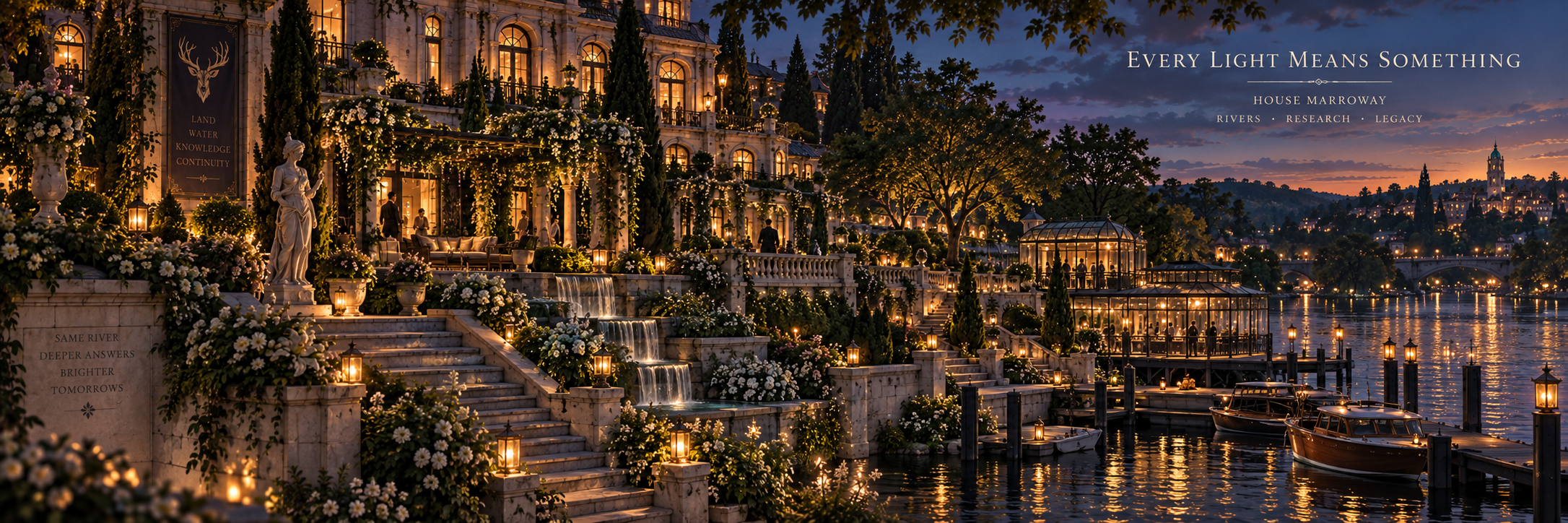
Larkspur Crossing // Public Crossings
The morning crowd does not stop to study the gates. Green means keep walking. Blue means wait. White means somebody's day just changed.
Flower Bridge and the Larkspur Ferry Gate carry thousands of ordinary crossings through the city every day. Farm crews move toward Eastbank. Children cross for school. River workers change shifts. Estate households travel into town. Visitors photograph the flowers while commuters quietly move around them.
The verification system is built directly into that routine. Scanners sit inside bridge arches, ferry rails, ticket posts and customs fixtures. Wrist-comms exchange records automatically. Most travelers receive a light before they have consciously noticed being checked.
Larkspur's civic centerpiece is also one of its busiest controlled routes. Decorative arches conceal biometric readers and movement sensors among flowers, lamps and restoration hardware.
Passenger ferries process commuters, workers, families and household companions through linked wrist-comm and identity checks before boarding. Regular travelers barely slow down.
Travel disputes, cargo questions, visitor clearances and unusual status results are routed here. Most cases are resolved quickly enough that the surrounding pedestrian flow never notices.
The colors are so familiar that residents interpret them instinctively. Nobody needs a sign explaining what happens next.
Identity and current travel permissions agree. The gate opens and the traveler continues with the normal flow.
Something requires human review. An expired permit, route change, damaged wrist-comm, cargo issue or custody authorization may be enough to turn green into blue.
Movement stops. The traveler leaves the ordinary queue and waits for officials to determine why the system no longer considers the crossing routine.
The meaning of a clearance depends on the person crossing. A recognized human citizen may simply need a valid local identity. A ferry employee may travel under a recurring work route. Agricultural crews use labor permissions. Estate companions may move under household or property-linked authorization. River workers can hold access to specific docks, channels and maintenance zones.
Labor Movement
A field worker can cross toward Eastbank because the assignment expects them there. A ferry technician can access restricted docks because the River Authority recognizes their shift. An aquatic worker may possess river permissions most humans never need.
Estate Movement
Domestic companions may pass through central Larkspur with almost no visible restriction when household authorization is broad. The same person taking an unfamiliar route alone may produce a very different result from the same gate.
Larkspur does not want every crossing to feel like a checkpoint. It wants approved movement to feel effortless. The cleaner the routine becomes, the less anyone thinks about who defines what counts as approved.
Locals therefore develop habits around the lights rather than fear of them. Someone steps aside when blue appears. A ferry worker gestures them toward the review lane. The queue closes the gap. Somebody checks the time. Somebody complains that they are going to miss breakfast.
White is different. White attracts glances because it interrupts the social script. The person who was part of the crowd one second earlier is suddenly standing outside its normal flow.
Flower Bridge // Ferry Gate // Customs House // Green // Blue // White
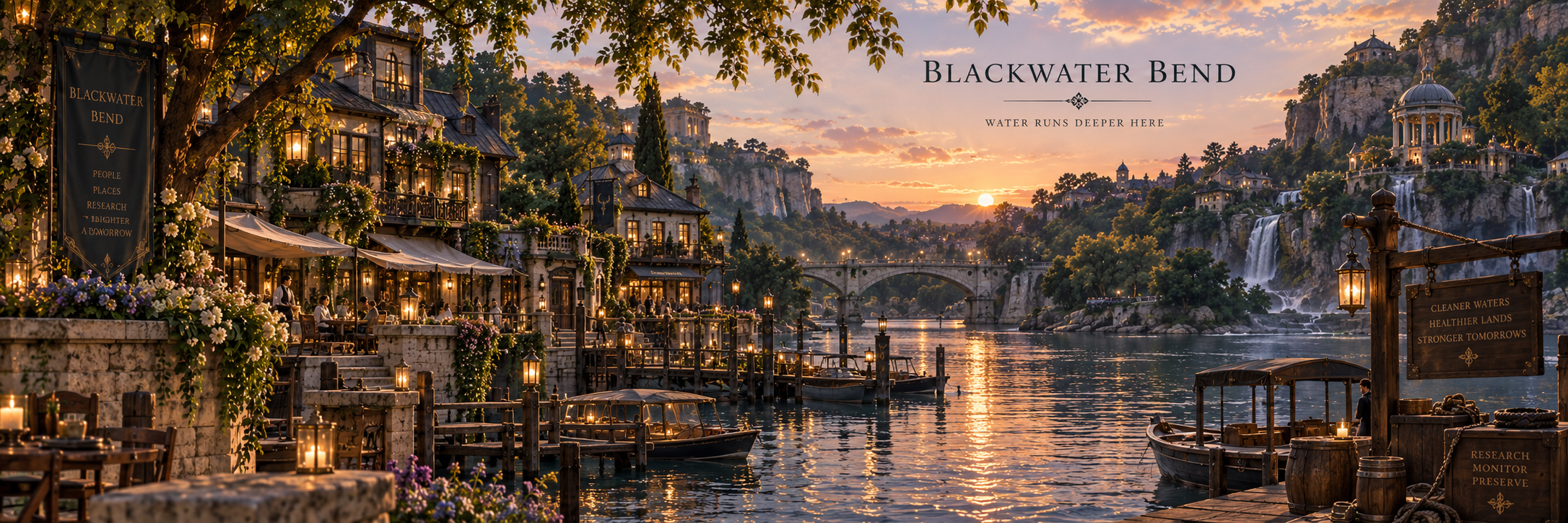
Larkspur Crossing // Unofficial River Route
The River Authority calls it shallow, unstable and functionally impassable. The river has never shown much interest in official statements.
Beyond Larkspur's regular ferry lanes, the Brazor bends through a low stretch of reeds, narrow channels and shifting silt known locally as Blackwater Bend. It sits far enough outside the maintained route that most residents have little reason to visit and close enough that river people have spent generations knowing exactly what the Authority gets wrong about it.
By daylight it looks inconvenient more than mysterious. Mud banks appear and disappear with water level. Reeds narrow the channels. Half-submerged roots catch careless hulls. Navigation markers are sparse because the River Authority does not classify the bend as a legitimate transit route.
Large ferries cannot use Blackwater Bend safely. Standard cargo vessels should not attempt it. A shallow boat with a knowledgeable pilot at the correct tide is another matter entirely.
Some channels disappear almost completely at low water. Others open only briefly as the Brazor rises. A route that worked yesterday may ground a boat today.
Tall river reeds break sightlines between the bend and open water. Small craft can vanish behind vegetation that would do nothing to conceal a ferry or patrol vessel.
River Authority coverage is strongest around official approaches. Blackwater is watched inconsistently because maintaining full surveillance over a shifting, low-value channel is expensive.
Official Position
Authority maps classify much of the bend as unreliable wetland and restricted environmental water. Public guidance warns boaters against entering due to grounding risk, unstable banks, changing depth and poor emergency access.
River Truth
Fishermen, smugglers, River-Run guides and locals raised around the eastern channels know usable passages the official maps either simplify or omit. Nobody sensible calls them safe. Safe and possible are different words.
Blackwater's value is not that it leads directly from Larkspur to freedom in one dramatic boat ride. It is one piece of a much longer geography. A small craft can move somebody away from the monitored ferry routes, through reed channels and toward handoff points where other boats, roads or contacts take over.
Blue hour, moonlight, rain and river mist can all reduce distance without making navigation impossible. Guides rely on water level, local landmarks, current patterns and timing more than dramatic secrecy.
Hidden roots, sudden depth changes, cold water, weather and capsized boats are real risks. Blackwater is not a romantic secret tunnel with prettier scenery.
Patrol gaps are temporary. A drone flight, environmental survey or suspicious boat report can turn a familiar opening into a trap without warning.
Knowing the bend is not the same as knowing tonight's bend. River-Run contacts treat local knowledge as perishable information because tides, patrols and compromised routes all change.
Veyrhalden-linked networks are the reason Blackwater attracts so many rumors. Not every boat using the bend belongs to a sanctuary route, and not every person claiming to know one should be trusted. But enough people have disappeared east through the channels that Larkspur's authorities monitor the area far more seriously than their public language suggests.
From the right bank at night, Larkspur's lights remain visible behind the reeds. That may be the most unsettling thing about Blackwater. Someone using it to leave has not yet traveled far enough for home to disappear.
Reed Channels // Tide Windows // Patrol Gaps // Small Boats // Eastbound
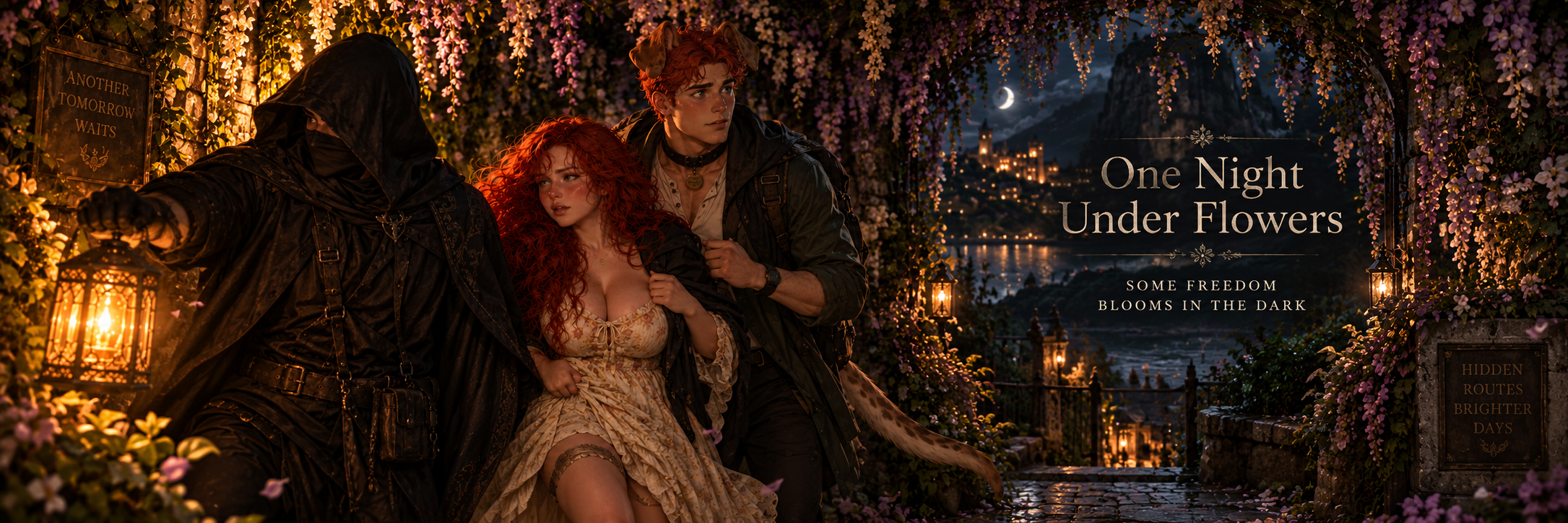
Larkspur Crossing // The Underground
The Larkspur Chain has no headquarters, no permanent shelter and no single door someone can kick down and call the network destroyed.
The Chain is a moving corridor of ordinary places briefly given another purpose. A guest bedroom becomes shelter until dawn. A farm shed holds somebody's bag beneath fertilizer sacks. A ferry locker contains dry clothes and a rebuilt wrist-comm. An old mill room stays empty for eleven months and matters desperately for one night.
Most people moving through the Chain never see enough of it to understand its full shape. That is intentional. Larkspur is too socially intimate for a large permanent sanctuary network to remain invisible for long.
The phrase is both rule and warning. A shelter is safest before a routine forms around it. Guests move quickly, hosts know only what they need, and even trusted houses avoid keeping the same person long enough for neighbors to notice a new pattern.
A spare bedroom, basement room or converted garden studio may shelter somebody for a few hours. Most host families maintain completely ordinary public lives and may never know where their guest came from or where they go next.
Orchard storage buildings, equipment sheds, greenhouse service rooms and seasonal worker spaces provide temporary cover beyond the denser streets. Agricultural movement also creates plausible reasons for vehicles to travel at strange hours.
A key taped beneath a bench. Dry clothes behind a maintenance panel. A meal left where overnight workers expect tools. Ferryward offers hundreds of mundane storage spaces nobody finds interesting until the right person knows which one matters.
Disused mill offices, storage chambers and maintenance spaces survive inside buildings that have been renovated only partially. Some are inaccessible from modern corridors but still reachable through older service routes.
Certain handoffs use culverts, storm passages and old river infrastructure to bypass visible streets. These are movement spaces rather than shelters, and weather can make them unusable without warning.
The Chain does not romanticize safehouses. Sometimes freedom looks like sleeping fully dressed in a stranger's child's old room while somebody downstairs quietly makes breakfast.
How the Chain Survives
A host may know one courier. A ferry worker may know one locker. A farmer may know which vehicle arrives after midnight. A clinic worker may know only which record needs to disappear before morning. Each person carries a fragment rather than a map.
How the Chain Fails
The danger is rarely one dramatic raid. It is repetition. The same car appearing twice. A neighbor noticing lights in an unused room. A ferry locker opening on the wrong shift. A companion absent from an expected route. Small-town memory can assemble fragments nobody intended to connect.
Its purpose is to move people away from known households, estates and institutions and toward routes with a better chance of reaching Thornwyck contacts or Veyrhalden-linked water networks.
Not everyone inside the Chain considers themselves part of a resistance movement. Some are abolitionists. Some are frightened relatives. Some are doctors who changed one file and never expected to do it again. Some are ferry workers who refuse to ask why somebody needs a back route. Some simply decided that one person standing at their door mattered more than the law outside it.
Homes // Farm Sheds // Ferry Lockers // Old Rooms // One Night, Never Two
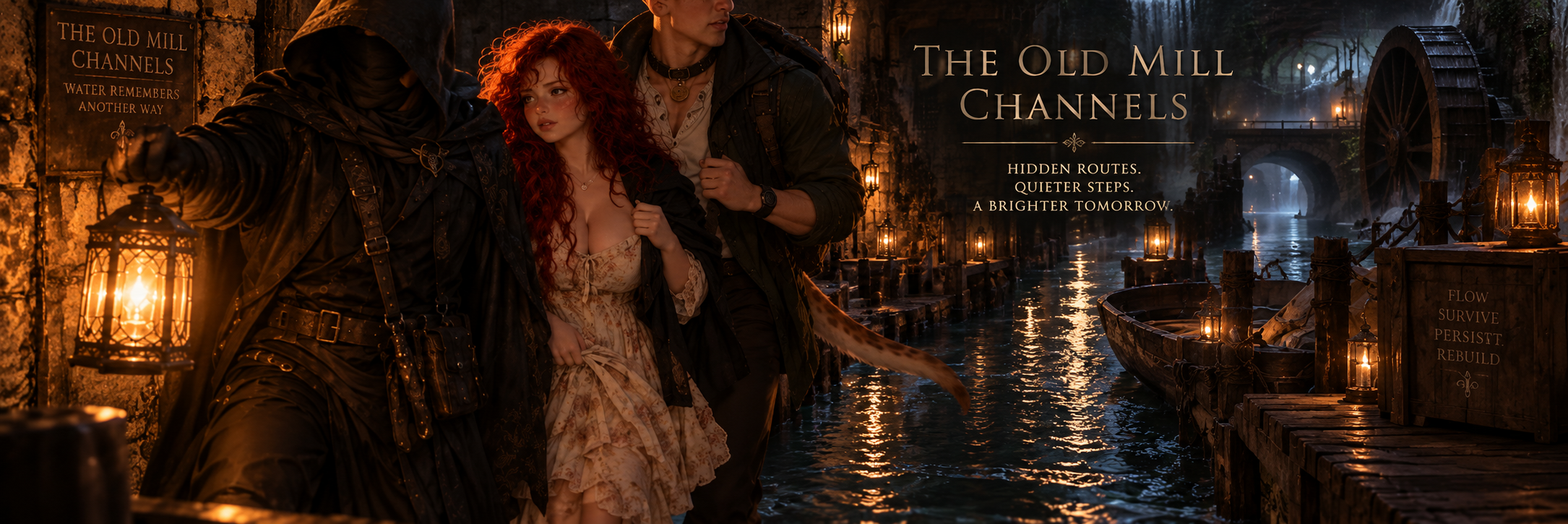
Larkspur Crossing // Hidden Infrastructure
Long before Larkspur tracked the Brazor with sensors, people cut channels beneath the city and trusted stone, gravity and water to do the work.
Beneath Old Mill Steps lies a fragmented network of drainage passages, mill races, maintenance corridors, foundation arches and abandoned water-control tunnels. Some remain part of municipal infrastructure. Some are sealed on official maps. Some were forgotten so thoroughly that the people using them now know more about their condition than the city does.
The Underchannels are not one continuous secret tunnel from Larkspur to freedom. They are a collection of old spaces that occasionally connect in useful ways, allowing movement beneath streets, around checkpoints and toward river access that would be difficult to reach openly.
Channels once diverted river water toward mills, workshops and mechanical systems. Some have been drained. Others still carry shallow water or rise dangerously after storms.
Older storm passages run beneath streets and foundations in sections too narrow or irregular for modern service equipment. Roots push through mortar and decades of mineral staining record old flood levels.
Rusting ladders, sealed doors, old utility stairs and abandoned pump rooms create points where somebody who knows the infrastructure can surface inside buildings or service yards away from the main route.
A bridge scan can watch the street. A ferry reader can watch the terminal. An estate gate can watch its entrance. None of those systems were designed around a nineteenth-generation drainage arch somebody stopped maintaining thirty years ago.
People Who Know the Route
Experienced guides track water depth, structural damage, patrol activity and usable exits. A route can change after one heavy storm, so trusted knowledge matters more than old diagrams.
People Who Disappear Into It
Hidden hybrids, undocumented workers, smugglers and fugitives sometimes use the Underchannels for movement or brief concealment. Very few live there permanently. Damp stone and rising water make terrible neighbors.
River-Run uses selected passages to move people between safehouses, South Silt, Old Mill Steps and river handoff points. Routes are changed constantly as infrastructure and surveillance shift.
Not everyone below Larkspur is helping people escape. Contraband, forged records, stolen medicine and illegal cargo also move through sections of the old network. Shared infrastructure does not imply shared morality.
Occasional maritime contacts move inland far enough to participate in handoffs, particularly when a person needs to reach water routes rather than Thornwyck. Their involvement is rare enough that even local guides may know them only by temporary names.
A route that is ankle-deep at dusk can be waist-deep after rain upstream. A blocked drain can redirect current into an unexpected chamber. Larkspur's old tunnels were built to move water, not protect the people sneaking through them.
A storm outside the city can raise the Brazor hours later. Guides watch forecasts, locks, upstream reports and physical water marks before committing to a route.
Collapsed masonry, loose ironwork, rotten timber and root damage can close a familiar passage suddenly. Restoration crews occasionally discover routes the underground hoped they would not.
Smugglers, informants and desperate people sometimes trade access information. A tunnel is not safe because it is hidden. It is safe only while the wrong person does not know where it leads.
The Underchannels survive partly because Larkspur itself has never finished deciding what to do with Old Mill Steps. Preservation advocates want historic masonry protected. Developers want dry, usable property. River engineers want access. Residents resist demolition. Every stalled restoration leaves another pocket of obsolete infrastructure intact.
Mill Races // Drainage Arches // River-Run // Floodwater // Routes Beneath the Gates
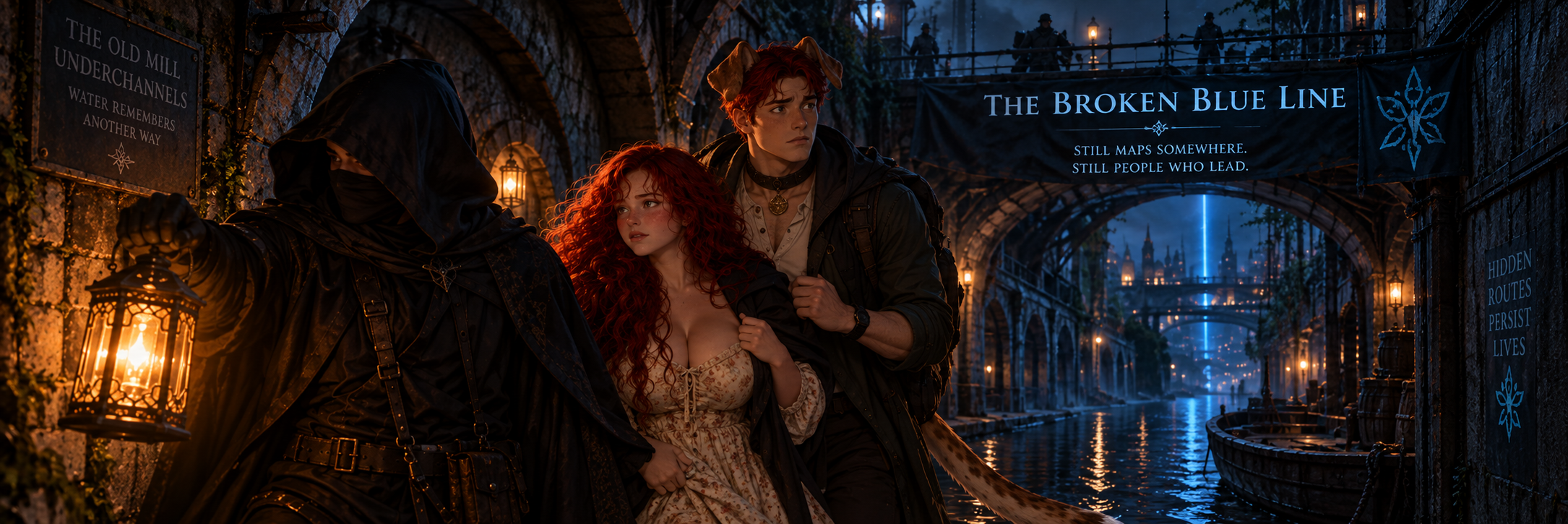
Larkspur Crossing // Coded Underground
Most people walking beside the Brazor see old paint, weathered stone and somebody's scratched little fish. The people who need the message see a route.
The Broken Blue Line is not an organization. It is a loose visual language shared across fragments of Larkspur's underground: River-Run guides, Chain hosts, clinic sympathizers, ferry workers, smugglers, hidden hybrids and ordinary residents who may know only one symbol and one reason to use it.
Its markings are deliberately unimpressive. Faded blue chalk. A paint streak beneath a bridge rail. A scratched fishbone near a drainage grate. A broken line hidden among maintenance marks. Anything too dramatic would defeat the point.
A farmer may know only which mark identifies a safe pickup. A clinic archivist may know one symbol meaning a record has been changed. A ferry worker may understand where to leave a package without knowing who will collect it.
A recently renewed blue mark oriented downstream generally means the next segment remains usable according to the last person who checked it.
A broken line or fishbone aligned toward the river's flow can indicate the next handoff lies farther east or closer to a water route.
A mark turned upward or deliberately interrupted in the wrong direction warns that a familiar route, contact or shelter should not be trusted.
These rules are not universal enough to become a handbook. Symbols drift between neighborhoods and networks. Context matters. A fishbone beneath Ferryward may communicate something slightly different from one near an Eastbank culvert. The uncertainty is inconvenient, but complete standardization would make the system far easier to decode.
Cargo
Codes can be folded into crate marks, produce counts, ferry tags, repair notes and delivery instructions. A changed number may redirect a package. A blue thread tied beneath a handle may indicate the recipient changed. Ordinary commerce provides endless camouflage.
Medicine
Sympathetic staff at Blue Reed Clinic may alter documentation, delay a biological update or redirect information before it reaches the Green Census Annex. A tiny blue notation can tell another participant that the official file no longer matches the person carrying it.
Blue lanterns already belong to Larkspur's public mourning tradition, which makes the shrine useful for communication nobody can easily separate from grief. Placement, number and timing can carry meaning to people who know what to watch for.
A new blue light may genuinely honor someone lost to the river, a transferred companion, an escapee or somebody whose fate remains unknown. The resistance language works because all those meanings can coexist.
A lantern moved from one rail to another, a fishbone redrawn downstream or an old mark deliberately scrubbed away can communicate more safely than a message sent through a monitored wrist-comm.
Most participants know only the signs relevant to their role. If one person is questioned, they cannot reveal a complete network because no complete network was ever handed to them.
The Broken Blue Line therefore behaves less like a resistance codebook and more like neighborhood folklore under pressure. Symbols are learned from specific people, interpreted through place and constantly changed when authorities begin noticing patterns.
No headquarters directs every mark. No central dispatcher controls every safehouse. People pass tiny pieces of information from hand to hand, enough to move one person toward the next person without exposing everyone behind them.
Blue Marks // Fishbones // Cargo Codes // Clinic Records // Lantern Signals // No Central Map

Larkspur Crossing // Security Profile
Brazor Station watches movement through infrastructure. Larkspur watches movement through infrastructure, neighbors, ferry crews, employers, households, shopkeepers and the uncomfortable fact that somebody probably knows where a person usually goes on Tuesdays.
Larkspur is not one of Brazoria's great surveillance cities. It has fewer towers, fewer dense sensor grids and less automated enforcement than Brazor Station. Its checkpoints are smaller. Its river drones are easier to overlook. Its security offices rarely dominate the skyline.
That does not make the city easy to disappear inside. Larkspur's greatest security system was never installed by an engineer.
It knows which workers take the first ferry, which companions normally travel with which households, which farm crews cross east before sunrise, which children return on the afternoon boat and which estate vehicles belong on which roads. Security becomes especially effective when technology only needs to identify the moment a familiar pattern changes.
Passenger gates compare wrist-comm identity, current permissions and route status before boarding. Regular commuters move through quickly enough that the process feels more like ticketing than inspection.
Low-profile readers are integrated into bridge architecture, lamps and restoration fixtures. Travelers may cross beneath several sensors without encountering anything that visibly resembles a checkpoint.
Compact drones monitor ferry traffic, flood conditions, environmental hazards and suspicious movement. Most are officially environmental or navigation systems. The distinction matters less when the same camera can do both jobs.
Households and Green Houses can authorize or restrict companion movement through linked estate systems. Private docks, garden gates and vehicles may all verify the same permission network.
Agricultural, ferry and maintenance workers often carry route-linked work permissions. The device proves where somebody is expected to be while also creating a record when they are somewhere else.
Medical and wellness bands may monitor treatment compliance, physiological data or supervised residence status. In care settings, the same device that helps a doctor can also document movement.
River Infrastructure
Floodgates record openings. Ferry terminals record boarding. Patrol boats file routes. Cargo inspections create manifests. Private docks log access. None of these systems exists solely to track people, which makes the resulting movement history feel administrative rather than invasive.
Care Infrastructure
Clinics submit required biological and custodial updates. Rest houses maintain access logs. Heritage facilities operate cameras for public safety. Gene-locked residences document every authorized entry and exit. Each record has a reasonable explanation on its own.
Produce, equipment, research materials and ferry freight create constant paperwork. Hidden movement becomes difficult when every vehicle and crate is expected to have a reason for being where it is.
Larkspur prefers mobile river patrols to massive fixed security installations. A patrol craft can appear almost casual until it changes course toward a smaller boat.
Some report suspicious activity for money. Others believe they are protecting neighbors or employers. A few simply enjoy knowing things before everyone else. Larkspur supplies all three varieties generously.
A companion who normally appears beside the same household suddenly boards alone. An Eastbank worker misses a shift but appears near Ferryward. A familiar estate vehicle reaches South Silt after midnight. None of those actions proves anything. In Larkspur, they do not need to prove anything before somebody starts asking why.
Brazor Station
Metropolitan security excels at detecting discrepancies across millions of movements. A system identifies the wrong record, route or biometric signature and sends the problem toward enforcement.
Larkspur Crossing
The record may never flag at all. A ferry clerk simply knows that somebody never travels without their sister. A farmer knows that vehicle belongs to the wrong estate. A bartender remembers who asked about Blackwater Bend two nights earlier.
Most of this knowledge is not gathered maliciously. It grows naturally from the same community ties that make Larkspur feel safe, helpful and deeply connected. That is what makes it difficult to resist. Asking people to stop noticing one another would mean asking the city to stop being itself.
Ferry Biometrics // River Patrols // Estate Permissions // Clinic Reports // Social Knowledge
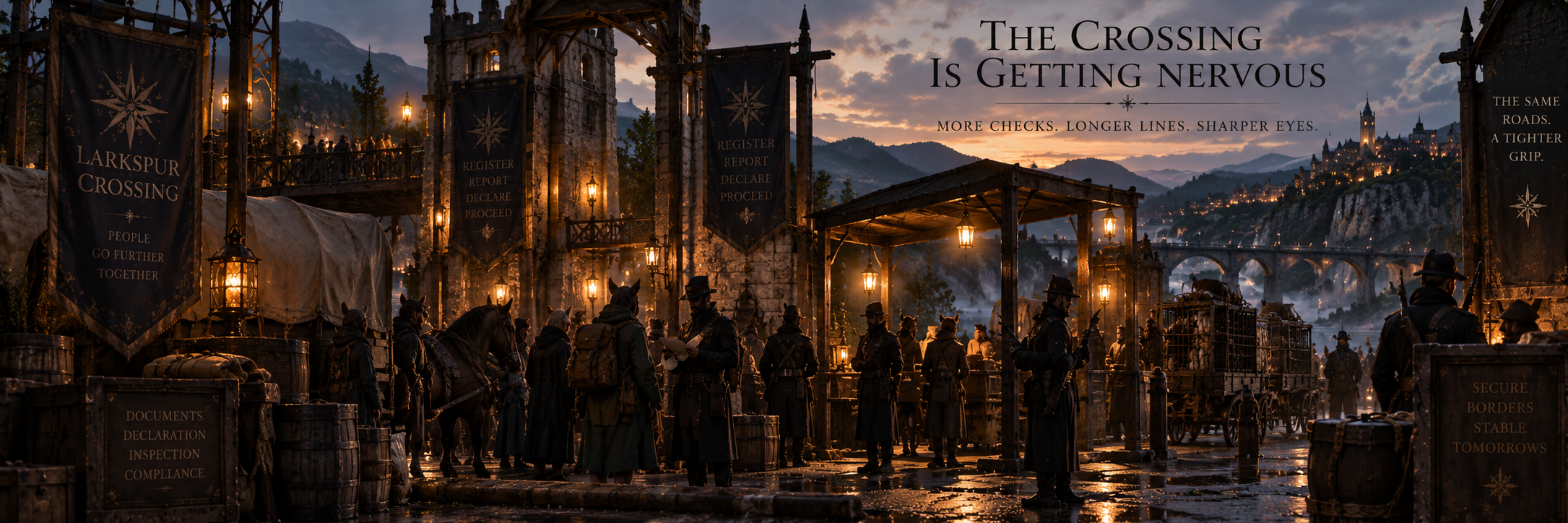
Larkspur Crossing // 2097 A.E.
The cafés are open. The ferries still run. Flowers still hang from the bridge. There are simply more patrol boats in the photographs now.
Larkspur Crossing is not collapsing. There are no barricades across the market streets, no military occupation and no general panic. Most residents still go to work, children still cross for school and restaurants still complain more loudly about weekend reservations than national politics.
But nearly every system touching the eastern river corridor has tightened in 2097. Not enough to transform the city overnight. Enough that locals have begun comparing this year's routines with last year's and realizing how many small things changed.
Patrol schedules have increased, labor permissions are receiving more attention, estate records are under scrutiny and familiar underground routes are behaving differently. Nobody agrees which development caused the others.
River Authority boats are appearing near the eastern reed channels more frequently, particularly around tide windows previously treated as low-priority environmental water.
Several demi-humans associated with private estates have stopped appearing in their usual public routines. Households provide explanations ranging from medical relocation to family travel. Not every explanation has satisfied neighbors.
A person connected to movement through the Larkspur Chain disappeared near Ferryward. Several routes were abandoned shortly afterward despite no public announcement of a raid.
Rumors persist that clinic staff have altered biological documentation or quietly assisted people whose records would otherwise have reached the Green Census Annex. No public investigation has confirmed the full extent.
Demi-human legal representatives from Thornwyck have shown increased interest in custody records, estate transfers and river disappearances connected to Larkspur.
River workers continue reporting unfamiliar shallow-draft boats and anonymous contacts believed to connect eventually with Veyrhalden-linked sanctuary waters.
New Demands
Several agricultural and river employers have begun requiring more frequent validation of labor wrist-comms and route permissions. Officials describe the changes as record modernization and worker safety improvements.
Local Reaction
Traditionalist residents increasingly argue that relaxed public companion culture, weak river controls and years of local tolerance have turned the eastern crossing into an attractive corridor for registry fraud and escape.
People with uncertain ancestry are increasingly avoiding nonessential Green Census updates, especially after stories circulated about anomaly flags appearing in records previously considered stable.
Questions surrounding aquatic-line records, conservation wards and internal custody classifications have placed one of Larkspur's most respected Green Houses under uncomfortable public scrutiny.
A recent River Renewal period included a brief checkpoint failure and irregular ferry delays. Officials blamed infrastructure synchronization. Underground networks remain considerably more interested in the timing.
Municipal crews remove small markings from bridge stone, ferry walls and river infrastructure. New ones appear elsewhere. Some are almost certainly imitation or protest graffiti. Others match symbols associated with the Broken Blue Line closely enough to concern authorities.
What Officials Say
River conditions require stronger monitoring. Labor systems need modernization. Estate discrepancies are being reviewed. Foreign observers are exploiting local issues for political leverage. Public movement remains safe and uninterrupted.
What Larkspur Says
Residents disagree about what is happening, but even people uninterested in politics have noticed additional boats, longer inspections, nervous employers and conversations stopping when unfamiliar people enter the room.
The disagreements are becoming generational as well as political. Some older families see increased enforcement as an overdue correction. Reform-minded residents see authorities responding to instability by tightening precisely the systems creating it. Most people occupy the much messier middle, suspicious of both national officials and underground networks while trying to protect their own households.
That uncertainty is what makes Larkspur dangerous in 2097. Nobody yet believes the city has crossed into crisis. Everyone can name three reasons it might.
2097 A.E. // More Patrols // Missing People // Foreign Scrutiny // Blue Marks // A City Listening Harder
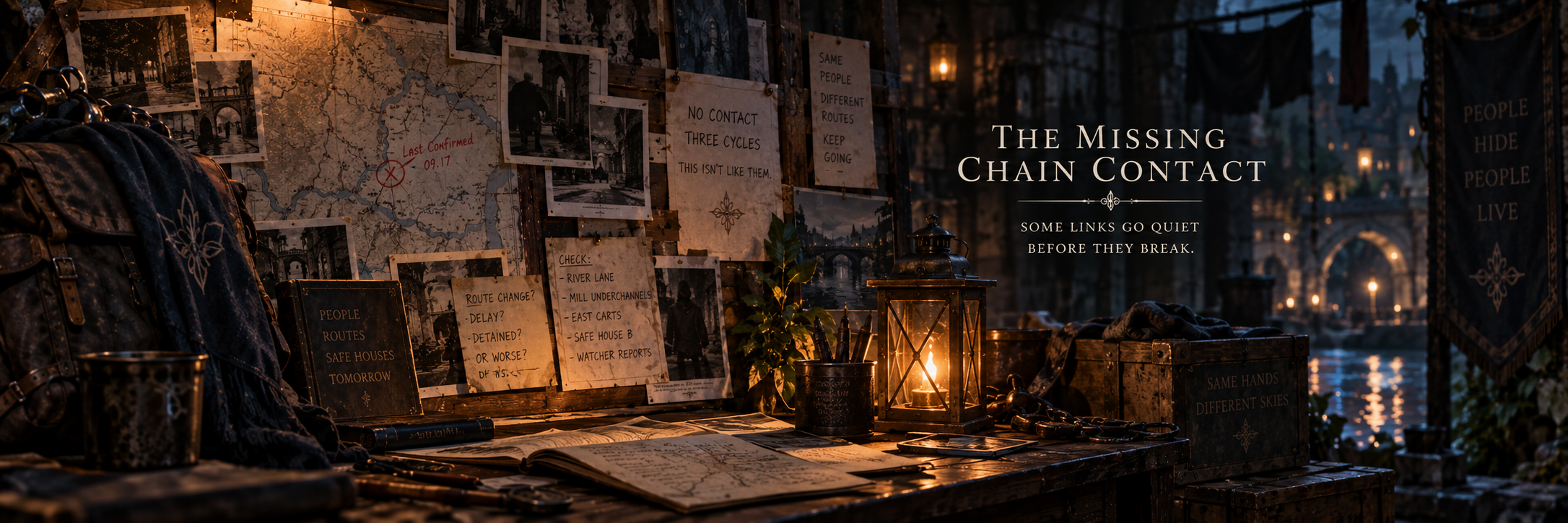
Larkspur Crossing // Current Story Hook
Someone disappeared near the ferry gate. Larkspur has plenty of rumors about where they went and remarkably little proof that they went anywhere at all.
The missing person was not the leader of the Larkspur Chain. The Chain has no leader in that sense. They were one contact among many, a person trusted with enough knowledge to move people between several temporary routes without knowing the entire network surrounding them.
Their disappearance would have been concerning under ordinary circumstances. What happened afterward made it difficult to dismiss.
No ordinary River Authority detention, Green Census hold or estate-recovery notice clearly corresponds to the missing contact. If officials took them, the record is hidden, mislabeled or being handled somewhere outside the public system.
The missing person had participated in movement through the Larkspur Chain and was trusted by contacts associated with multiple short-term safe routes.
The last account considered reasonably trustworthy places them near Ferryward, close to the main ferry infrastructure rather than an obvious underground crossing.
No confirmed arrest, body recovery, border crossing or sanctuary arrival has been matched publicly to the missing person.
Within days, several Chain contacts stopped using familiar handoff points. At least one farm shelter was emptied without explanation. A ferry locker associated with an older route remained untouched. River-Run guides began treating information from certain parts of Ferryward as potentially compromised.
Soon After
River Authority boats altered several routine patrol paths near the eastern channels. Officials attributed the changes to seasonal enforcement needs and river conditions. The timing immediately became part of underground speculation.
Soon After
Blue fishbone markings began appearing more frequently around river walls, old infrastructure and Ferryward approaches. Some warned against former routes. Others seemed to point toward alternatives nobody recognized.
For a brief period, one verification point stopped processing normal status checks correctly. Officials described the incident as an infrastructure synchronization problem. There is no public evidence connecting the failure to the disappearance.
That lack of evidence has been remarkably unsuccessful at preventing Larkspur from developing theories.
Supporters point to the later patrol changes and absence of a normal arrest record. Critics note that secrecy alone does not prove custody.
The sudden abandonment of several Chain routes suggests somebody may have believed more than one location was compromised.
One theory claims sympathetic medical contacts extracted the person after their identity became dangerous, then removed or altered the documentation needed to follow them.
Perhaps nothing went wrong at all. Some insist the contact reached a water route successfully and vanished because successful disappearance is supposed to look exactly like this.
Another theory says the disappearance was deliberate: records abandoned, familiar routes cut and old relationships severed before leaving under another name.
The most politically explosive version connects the contact to aquatic-line discrepancies surrounding House Merroway. No public evidence establishes that connection.
The disappearance may have been bait. Not an arrest meant to remove one Chain contact, but an event designed to watch which safehouses closed, which ferries changed routines, which clinic files moved and which people suddenly stopped using familiar routes.
If that theory is correct, every precaution taken afterward may have revealed another fragment of the network.
If it is wrong, fear may be dismantling routes the authorities never actually found.
Nobody knows which possibility is worse.
What the City Has
A last sighting. Changed patrols. Silent contacts. New markings. One technical failure. Several people who know more than they are saying and several more who think they do.
What the City Does Not Have
No confirmed destination. No public prisoner. No recovered body. No sanctuary message trusted by everyone. No single explanation capable of making the rest of the evidence behave.
The night ferry begins boarding.
A clerk checks the line. Someone on the platform glances toward the river. Across the water, a blue light appears briefly between the reeds and disappears.
A ferry bell rings.
Everyone looks toward the gate.
Larkspur Crossing // 2097 A.E. // End of City File

Brazoria Vale // The Brazor River
Brazoria did not merely settle beside the Brazor. It learned to feed cities, irrigate fields, move medicine, carry wealth and organize entire generations around the direction of its water.
The Brazor is the great working river of Brazoria Vale, a broad blue-green corridor cutting through cultivated country, greenhouse belts, river towns, estate holdings and agricultural plains before reaching routes farther east. From above, it looks almost impossibly peaceful. From the ground, it is transportation, irrigation, commerce, research, recreation, medicine and law all moving through the same channel.
Every major Brazorian institution touches the river eventually. Farmers depend on its managed water. Ferry towns build their schedules around it. Research facilities collect from it. Hospitals receive supplies through it. Green Houses maintain private docks along it. The River Authority measures it continuously. Families picnic beside the same water carrying freight toward markets hundreds of kilometers away.
Orchards, medicinal herb fields, seed nurseries and greenhouse belts depend on river-fed irrigation. Pumps, channels, reservoirs and sensor networks extend the Brazor far beyond its visible banks.
Passenger ferries, agricultural barges, medical craft, research boats and private estate vessels share the main channel. In some communities, the ferry timetable matters more than the road map.
Cities and small towns cluster around navigable stretches, crossings, fertile banks and old working channels. Local identities often grow around the particular way the Brazor passes through them.
Mobile clinics, emergency boats, pharmaceutical shipments and specialized biological care move along the same corridor as produce and commuters. During floods, river access can become more important than roads.
Water quality, ecology, agriculture, aquatic morphology and biological adaptation are studied continuously along the river. Sensor buoys and small research stations have become ordinary pieces of the landscape.
Green Houses and other wealthy families maintain waterfront holdings, private docks and managed wetlands. Their estates often blend recreation, agricultural production, conservation and private custody systems into a single property.
Its practical body includes irrigation channels, old mill races, flood-control systems, wetlands, culverts, reservoirs, service canals, drainage networks and countless smaller routes through which Brazor water enters daily life.
Families grow up beside it. Children learn its birds and seasonal levels. Couples walk river terraces. Workers eat lunch on its banks. Towns hold festivals around it. Brazorians speak about the river with the kind of affection usually reserved for hometowns and relatives.
Without the Brazor, agricultural productivity falls, freight routes fracture, irrigation systems fail, river settlements lose their economic foundation and entire sectors of the national economy become harder to sustain. Stewardship is not merely civic branding. The river truly is indispensable.
That importance explains much of Brazoria's obsession with managing the river. Floodgates are maintained carefully. Agricultural flow is measured. Navigation lanes are regulated. Ecological data is collected constantly. Public campaigns treat clean water as a national responsibility, and residents have plenty of reasons to support them.
But infrastructure designed to manage water inevitably manages people moving on that water as well. A ferry route can be transportation and a checkpoint. A dock can be a family landing and a custody boundary. A conservation sensor can monitor water quality and record a boat passing after midnight.
The country calls the river its artery because everything important eventually reaches it.
That includes the things Brazoria would rather keep from leaving.
The Brazor River // Agriculture // Transport // Medicine // Research // The Green Knife's Artery
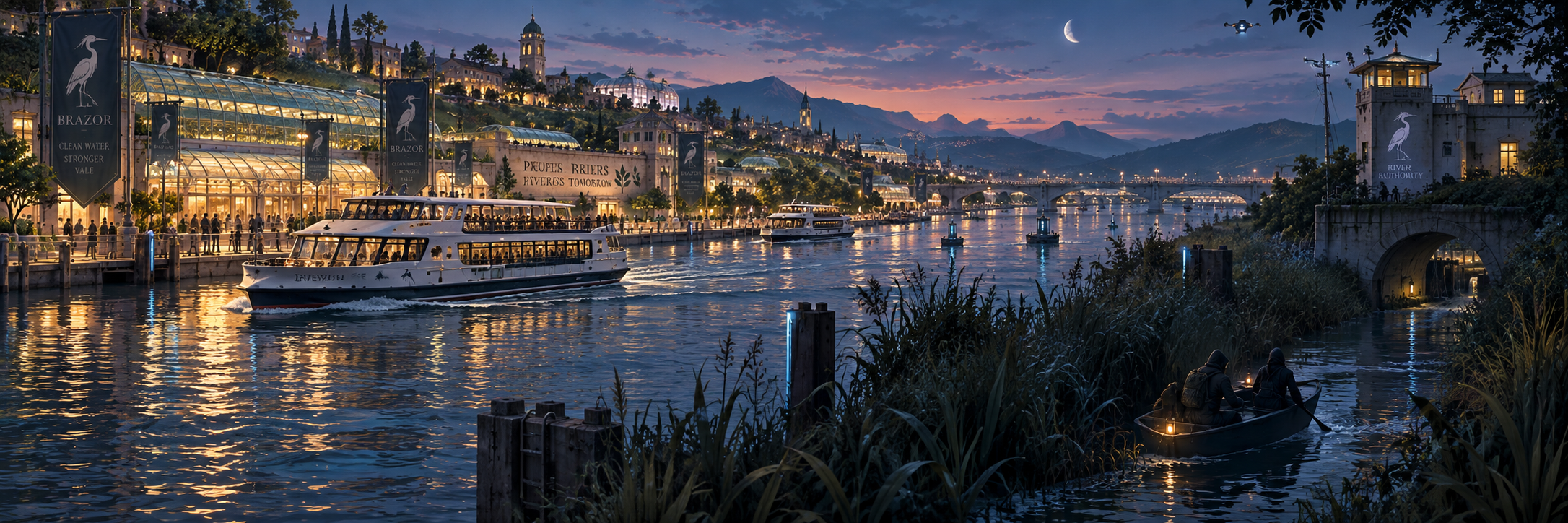
Brazor River // Visible & Hidden
One Brazor appears on maps, ferry schedules and conservation reports. The other is remembered in reed channels, old stone openings and the instructions people are careful not to write down.
To most residents, the Brazor is an extraordinarily visible river. Bridges cross it. Ferries cover it. Public gardens face it. River Authority markers identify safe channels, lock conditions and water levels. School groups visit ecological platforms while tourists photograph white herons against the water.
Everything important appears to happen in the open.
That impression lasts only until someone starts asking what exists between the official routes.
The Visible Brazor
Passenger ferries move between towns. Agricultural barges carry the harvest. Families fill public parks. Conservation crews test water. Estate launches cross toward private docks. River Renewal lanterns drift beneath bridges while the River Authority publishes flow reports and navigation notices.
The Hidden Brazor
Reeds conceal shallow channels. Forgotten mill passages reconnect with modern drainage. Fishing boats enter water too narrow for ferries. Old culverts survive beneath renovated districts. Smugglers, fugitives, hidden hybrids and River-Run guides learn where official geography becomes incomplete.
There is no secret second Brazor beneath the first. The hidden river is created by scale, timing, local knowledge and all the spaces large systems find inconvenient to monitor continuously.
Maintained routes connect river communities through predictable schedules, marked approaches and monitored terminals. Most residents use them without considering the surrounding water suspicious.
Restored wetland platforms, river gardens and educational landscapes make stewardship physically visible. They are among Brazoria's favorite symbols of prosperity through care.
Water monitoring, habitat surveys and ecological research operate openly along the main channel. Many projects provide real environmental benefit even when their data serves additional purposes.
Shallow side routes disappear behind vegetation and shifting banks. Aquatic workers, fishermen and experienced local pilots often understand them far better than centralized navigation systems do.
Mill races, drainage tunnels, submerged culverts and abandoned service channels remain beneath river cities built over generations. What planners call obsolete infrastructure can become somebody else's route.
A fishing craft may carry fish. A maintenance boat may carry tools. A cargo vessel may contain exactly what its manifest claims. Usually. River-Run survives in the uncertainty between what a vessel looks like and what it is doing tonight.
The visible river is easy to describe because Brazoria has spent generations describing it. Navigation maps mark official depths. Ferry schedules tell passengers where boats stop. River Authority bulletins explain flood conditions. Agricultural plans show intake systems and managed channels.
The hidden river resists permanence. A reed passage may close with silt. A culvert may flood. A sympathetic ferry worker may change shifts. A private dock may install a new reader. A route useful during River Renewal may become unusable the following week.
Someone knows which channel remains deep enough after dry weather. Someone remembers an access stair beneath an old mill. Someone knows a floodgate opens several minutes before the public warning changes. Someone knows which fishing boat asks fewer questions than the others.
Buoys, ferry gates, vessel logs, patrol routes, environmental sensors and dock records make the main Brazor highly legible to the state.
Routes shift with water, weather, maintenance, human relationships and enforcement. The network survives by refusing to become stable enough to map cleanly.
Most river residents use official infrastructure while knowing fragments of unofficial geography simply because they grew up beside the water. The boundary between ordinary river knowledge and dangerous knowledge can be remarkably thin.
Even that saying simplifies things.
The River Authority never controls every current. River-Run never owns every hidden channel. Farmers, ferry workers, estate households, fishermen, smugglers, researchers and ordinary families all occupy the same geography.
That is what makes the Brazor so difficult to control completely. There is no clean place where the official river ends and the hidden river begins.
One is on the schedule. One is not. Both are on the Brazor.
The Visible River // The Hidden River // One Channel // Two Geographies

Brazor River // Geography
Roads can be surveyed, straightened and fenced. The Brazor changes shape whenever water, weather, silt and human ambition disagree about where it ought to go.
The Brazor is a transportation corridor, but it behaves nothing like a road. Its navigable channel broadens, narrows, splits around islands, feeds wetlands, enters engineered cuts and wanders through floodplains shaped by generations of both natural movement and human intervention.
Brazoria has spent centuries teaching the river where to go. Locks regulate major passages. Floodgates protect settlements. Irrigation works draw water toward fields and greenhouse belts. Reinforced banks protect valuable property. Old bends have been redirected, dredged or incorporated into managed wetlands.
The result is not a conquered river. It is a negotiation conducted in stone, soil, steel, roots and moving water.
The widest sections support ferries, freight barges, research vessels and estate traffic. These routes are dredged, monitored and marked heavily enough to behave almost like waterborne highways.
Wooded islands, gravel bars and cultivated patches divide the current into smaller routes. Some remain stable for generations. Others change after major floods and force pilots to learn the river again.
Secondary branches may feed marshes, farms, old mill systems or quiet settlements. They are less predictable and often less thoroughly monitored than the central shipping lane.
Low agricultural land absorbs seasonal overflow when flood systems allow it. Rich soil and dependable water make these areas valuable, even when everyone living there knows the Brazor occasionally intends to reclaim them.
Former channels survive as ponds, wetlands, drainage corridors and half-forgotten waterways. Modern Brazoria may classify them as obsolete. Local residents tend to remember exactly what happens when the river rises.
Canals, lock approaches, irrigation diversions and flood-control channels redirect water toward useful destinations. The engineering is sophisticated. The water still remains water.
A navigation map can remain legally current while a sandbar has already moved. A reed bed can expand into a side channel. A storm can expose an old passage nobody has used for years. River knowledge therefore depends as much on observation and memory as official documentation.
Human Geography
A stable crossing becomes a town. A deep channel becomes a ferry route. Fertile ground becomes orchard land. A high bank becomes an estate. A controlled drop becomes a lock or mill site. Brazorian settlement follows the river's opportunities closely enough that the national map almost reads like a record of water decisions.
River Geography
A floodwall creates a protected side and an exposed side. A dredged shipping lane creates shallower margins. A lock concentrates official traffic while older channels remain nearby. The more Brazoria organizes the Brazor, the more borders appear between managed and unmanaged water.
This geography is one reason the River Authority invests so heavily in continuous monitoring. Depth, current, water quality, flood risk and navigation hazards all change. A sensor buoy is not merely surveillance. It can prevent a ferry from grounding or warn a farming district that water is rising upstream.
But complete control remains impossible. Every sensor has a range. Every patrol follows a route. Every maintained channel exists beside water considered less useful, less navigable or less urgent.
Fishermen use it. Agricultural crews use it. Wildlife uses it. Smugglers use it. River-Run uses it. The distinction between a useless side channel and an invaluable route often depends entirely on who is trying to travel through it.
Brazoria's great achievement is not that it defeated the Brazor.
It built an entire country around the assumption that the river would keep cooperating.
Main Channel // Islands // Floodplain // Irrigation Cuts // Old Bends // A Moving Geography

Brazor River // Agriculture
Before Brazorian food reaches markets, laboratories, kitchens or export barges, much of it begins with somebody deciding where the Brazor's water should go.
The cultivated wealth of Brazoria Vale is inseparable from the river. Orchards follow its floodplain. Greenhouse belts rise beside managed channels. Medicinal herb estates draw from controlled irrigation. Seed nurseries cluster near stable water access. Even fields kilometers from the visible bank may depend on systems ultimately fed by the Brazor.
Agriculture here is neither rustic nor fully industrial. Old farm boundaries coexist with sensor grids, automated valves, drone surveys, water-quality monitors and sophisticated greenhouse systems. A stone irrigation gate may be older than the family maintaining it while the control hardware inside was replaced last year.
Fruit trees follow some of the richest soils in the Vale, with irrigation adjusted by season, weather and soil data. Many old estate orchards have used the same underlying water routes for generations.
Large glasshouse systems extend production beyond ordinary seasonal limits. River water supports temperature regulation, irrigation, humidity control and specialist crops requiring carefully managed conditions.
Brazoria's medical economy depends partly on controlled botanical production. Herbs, compounds and specialized cultivars are grown under monitored soil, water and biological conditions before entering clinical or research supply chains.
Seed nurseries maintain commercial strains, conservation stock and experimental crops. Water quality is watched closely because contamination in a nursery can affect agricultural production far beyond one property.
Generations of sediment created some of Brazoria's most productive agricultural ground. Flood control protects that land while carefully managed overflow can still replenish wetlands and selected cultivation zones.
Managed wetlands filter runoff, buffer floodwater, protect habitat and support specialized agricultural or research uses. Brazoria treats them as infrastructure as much as wilderness.
Diversion channels, reservoirs, gates, pumps and irrigation cuts distribute Brazor water through cultivated country. By the time it reaches an orchard row or greenhouse bed, the original river may be far beyond sight.
Old Agriculture
Farm families still understand land through lived experience: where frost settles, which orchard dries first, what certain clouds mean, how long the lower field can take water and where an irrigation trench always silts after a storm.
Modern Agriculture
Soil probes, drone surveys, weather prediction, automated irrigation and biological monitoring turn the same landscape into continuous data. Brazoria rarely sees tradition and technology as opposites when both can increase yield.
Flow rate, contamination, mineral balance and temperature can be monitored from river intake to individual growing zones, allowing farmers to adjust systems before visible crop damage appears.
Small agricultural drones inspect field condition, identify stressed plants and coordinate with irrigation systems. Their presence is so common that most rural residents barely look up when one passes.
Agricultural systems must manage abundance as carefully as scarcity. Gates, overflow basins and wetland corridors redirect sudden rises before valuable fields or greenhouse complexes are damaged.
Brazoria's philosophy of stewardship is especially persuasive in agricultural country because the results are visible everywhere. Good water management produces healthy orchards. Disease monitoring saves harvests. Flood systems protect homes. Agricultural research increases food security. There are real reasons for people to trust the institutions maintaining these systems.
That trust also creates extraordinary authority. Whoever controls water allocation can influence which farms thrive, which crops receive priority during drought, which wetlands remain protected and which estates gain access to specialized infrastructure.
A farming household may depend on River Authority schedules. An estate may control housing alongside irrigation access. A demi-human worker assigned to a greenhouse belt may live on land where work, residence and travel all connect to the same agricultural system.
For the Country
The Brazor helps Brazoria produce food, medicine, seed stock and agricultural research at a scale far beyond what its population alone consumes. National pride in the Vale's productivity is not empty propaganda.
For the River
Every successful harvest strengthens the belief that the Brazor exists to be managed productively. Conservation is encouraged, but usually through a Brazorian question: how can this ecosystem continue flourishing while remaining useful?
In spring, that relationship can look almost idyllic: greenhouses shining beside the water, orchards flowering across the floodplain, small work boats moving between irrigation structures and barges carrying the harvest toward market.
It is difficult to look at abundance like that and remember how much authority is hidden inside the valves.
Orchards // Greenhouses // Medicinal Crops // Irrigation // Wetlands // The Water Behind the Harvest
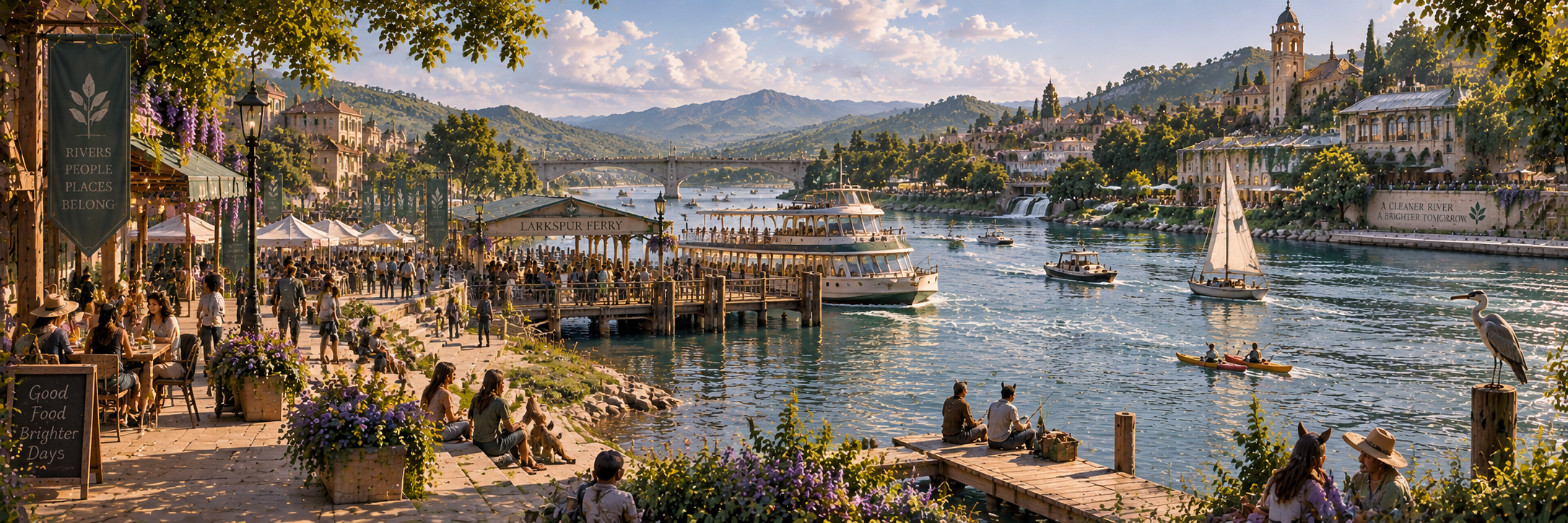
Brazor River // Daily Life
For millions of ordinary days, the Brazor is not a border, a freight corridor or an escape route. It is where someone buys lunch, teaches a child to fish, misses a ferry and watches the light change over the water.
Life beside the Brazor develops its own rhythm. Morning ferries bring commuters into town. Market boats unload produce while cafés open along the terraces. School groups visit gardens and ecological platforms. Workers eat lunch beside the water. Families return in the evening for walks, food and whatever small local festival has found an excuse to occupy the riverfront this week.
Brazorians are deeply attached to the river, and not merely because it is useful. People remember where they learned to swim, which ferry they took to school, where grandparents used to fish and which bend of water catches sunset best in late summer.
Produce, flowers, preserves, breads, herbs and small-scale river goods often move directly from nearby agricultural communities into waterfront markets. Shopping easily becomes half errand, half social outing.
Tree-lined terraces, lawns, wetland gardens and pedestrian promenades turn large stretches of the Brazor into public space. Picnics, naps, children's games and slow evening walks are ordinary parts of river life.
Recreational fishing remains common along quieter banks, docks and town edges. Local arguments over the best spot are generally older than the people currently having them.
Rowboats, kayaks, small sailcraft and family launches share calmer stretches with working traffic. Many river towns maintain public ramps and recreation docks separate from major freight lanes.
Children visit flood gardens, conservation stations, orchards and ferry infrastructure as part of ordinary education. Water safety, ecology and local agricultural history are treated as practical knowledge rather than specialist subjects.
Ferry crews, agricultural workers, clinic staff, mechanics and office workers frequently gather along public embankments during breaks. In river towns, the waterfront functions almost like a shared courtyard.
A person can understand every contradiction in Brazorian law and still love the place where their family spent summer evenings. Attachment to the river is not propaganda merely because institutions also use it as a national symbol.
River Towns
A ferry city develops differently from an agricultural settlement. A research town feels different from a quiet estate corridor. A working dock district has its own food, habits and slang. The Brazor connects communities without making them identical.
Shared Culture
Despite those differences, river communities share certain instincts: checking levels after heavy rain, knowing the sound of ferry bells, recognizing seasonal bird migrations and measuring travel in crossings rather than kilometers.
Farm goods arrive early, ferries fill with workers and cafés learn exactly which departure creates the breakfast rush.
Parks become busier, students appear along terraces, small craft fill recreational water and market traffic settles into a slower rhythm.
Restaurant windows, bridge lamps, ferry signals and household docks reflect across the Brazor while late workers and evening passengers make their way home.
Human and demi-human residents occupy much of this public life together. A river worker may stop for dinner after shift. A household companion may walk beside the same family who brought them to the market as a child. An agricultural specialist may spend a day in greenhouse work and an evening drinking beside the water with friends.
Those lives are not socially empty because their legal structures are unequal. Friendships are real. Neighborhoods are real. Favorite restaurants are real. So are the families and coworkers who would notice if someone stopped appearing.
They decorate ferries for holidays, photograph children beside the same railing every year, scatter memorial flowers into the current and complain bitterly whenever development threatens a beloved patch of waterfront.
That affection matters because every argument about the Brazor is ultimately an argument about something people already feel belongs to their lives.
Markets // Parks // Fishing // Ferries // Families // A Life Measured Beside Water

Brazor River // Annual Festival
Once each year, Brazoria gathers beside the river it depends on and fills the dark water with light.
River Renewal is one of Brazoria Vale's most beloved civic traditions. Towns and cities along the Brazor decorate ferries, open public gardens late into the night, fill waterfront streets with food and music, and release thousands of floating lights onto designated stretches of the river.
The festival celebrates clean water, successful harvests, flood survival, river workers, conservation and the simple fact that another year has passed with the Brazor still carrying life through the Vale.
Many households attend from the same riverfront spot each year. Children grow into adults beneath familiar trees, old photographs are recreated badly, and grandparents insist the lanterns used to be prettier.
Passenger boats carry flower garlands, lights and civic banners. Crews compete quietly over decoration while insisting that they are absolutely not competing.
Farm stalls, cafés, temporary kitchens and river vendors extend service late into the evening. Seasonal fruit, pastries, grilled river foods and family recipes become as important to the holiday as the lights themselves.
Public gardens remain illuminated after dark, hosting musicians, school performances, botanical displays and local stewardship exhibits.
Ferry crews, lock teams, agricultural workers, medical boat staff and conservation crews are publicly recognized throughout the festival. Many towns organize ceremonies around specific local river professions.
Floating lamps are released in controlled sections of the Brazor, creating broad fields of gold across the current before recovery crews collect them farther downstream.
People genuinely adore it. Couples make traditions around it. Children count down to it. River workers take pride in it. Families travel home for it. The festival works precisely because its emotional meaning is real.
Official Meaning
Public ceremonies emphasize clean water, agricultural prosperity, ecological restoration and responsibility to future generations. Schools present conservation projects and river authorities publish annual restoration achievements.
Personal Meaning
Some lanterns celebrate marriages, births or successful harvests. Others remember flood victims, relatives, river workers or people no longer living nearby. The public ritual leaves enough room for private meaning.
Crowds make the river unusually difficult to read during Renewal. Ferry traffic increases. Small authorized boats operate between public zones. Temporary docks open. Service crews move continuously. Thousands of lights create reflections that complicate visual tracking along busy water.
The network does not control the festival, and most participants know nothing about underground movement. Renewal simply creates exactly the kind of temporary complexity decentralized routes can use.
A person who would stand out at a quiet ferry terminal can disappear much more easily among families, workers, visitors and festival traffic.
Service craft, private launches, decorated ferries and small authorized boats create a river crowded enough that not every movement feels unusual.
Festival docks, pedestrian diversions and changed ferry schedules can briefly create movement patterns that do not exist during the rest of the year.
Some blue lanterns carry additional meaning. There is no universally recognized underground interpretation, which is precisely why they remain useful. One may memorialize somebody lost to the river. Another may honor a transferred companion. Another may simply be blue because a child liked the color.
And occasionally, placement or timing tells the right person something else.
What the Crowd Sees
Families leaning over railings. Children making wishes. Ferries shining beneath bridges. Food, music, flowers and thousands of lights drifting slowly east.
What One Person Might See
A familiar blue light in an unfamiliar place. A service boat departing five minutes early. A maintenance gate temporarily open. Someone who was standing beside the garden no longer there when the next lantern passes.
By morning, most of the decorations are coming down. Ferries return to ordinary schedules. Markets close temporary stalls. The river carries a few stray reflections beneath bridges while cleanup boats collect the last festival lanterns.
For most people, River Renewal ends with photographs and leftovers.
For a very small number, it may end somewhere else entirely.
River Renewal // Floating Lights // Family Tradition // Stewardship // One Night of Crowded Water
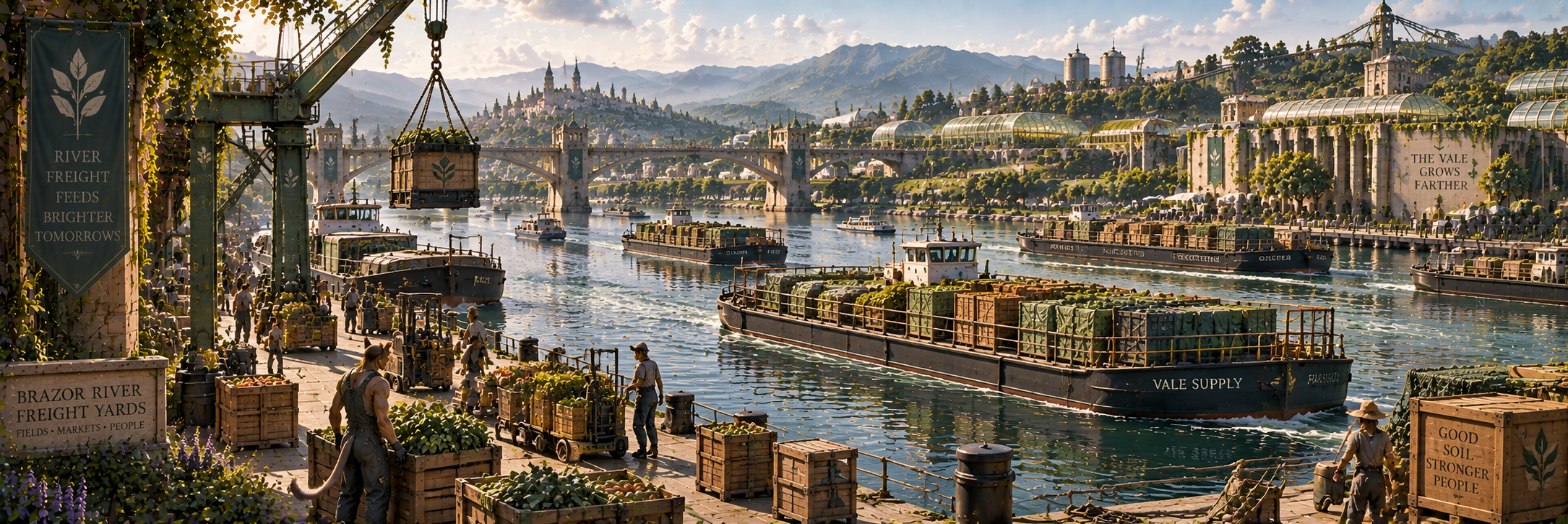
Brazor River // Trade & Freight
The Vale grows inland, but much of what it grows eventually reaches the Brazor.
Brazoria's river economy moves on a constant procession of produce barges, seed shipments, greenhouse freight, medicinal crops, farm equipment and processed goods. Along major stretches of the Brazor, freight traffic is as ordinary as commuter ferries.
The docks rarely resemble the hard industrial ports of other human realms. Warehouses are landscaped, loading yards are softened with trees, and greenhouse districts may begin only a few streets away. The machinery is real. Brazoria simply prefers its infrastructure to look cultivated.
Fruit, vegetables, grains, flowers and specialty crops move from agricultural districts toward urban markets and processing centers. River shipment remains economical for bulk goods moving between established Vale corridors.
Temperature-sensitive produce, nursery stock and specialty greenhouse products travel through monitored freight systems designed to preserve quality from grower to buyer.
Herbs and biological plant stock intended for pharmaceutical or clinical use travel under stricter handling rules than ordinary produce, often moving directly between certified estates, laboratories and medical processors.
Commercial seed, conservation lines and experimental crop stock move between nurseries, agricultural institutes and estates. Small shipments can carry enormous financial value despite taking up almost no cargo space.
Irrigation hardware, greenhouse components, farm drones, pumps, sensor assemblies and maintenance equipment travel downstream alongside the crops those systems help produce.
Preserves, dried foods, oils, botanical extracts, packaged produce and other value-added goods move from river processors toward inland distribution and coastal routes.
A barge may leave beside orchards in the morning, pass greenhouse belts by noon, unload at an urban freight quay in the evening and transfer goods onward without ever leaving the river system.
Working River
Major freight points begin before dawn and often continue long after passenger traffic quiets. Crews unload perishable goods first, agricultural equipment later and bulk cargo whenever lock schedules permit.
Brazorian Presentation
Landscaped freight yards, flowered retaining walls, polished stone terminals and carefully maintained riverfronts soften the visual language of commerce. The Vale likes productive infrastructure to resemble stewardship rather than extraction.
That aesthetic is not entirely false. Freight modernization has reduced spoilage, improved water efficiency and helped smaller farming communities reach larger markets without relying entirely on road transport. River trade genuinely strengthens many rural economies.
It also creates enormous administrative visibility. Cargo manifests record where goods originated, who loaded them, which vessel carried them and which dock received them. Agricultural workers travel beside shipments under labor permissions. Estate freight may pass through private terminals unavailable to the public.
Origin, destination, contents and handling requirements create paperwork long before a shipment reaches the river. Large freight systems depend on those records matching what actually arrives.
Green Houses frequently ship produce, research materials and household goods through private waterfront facilities. Their cargo may enter the main river without ever touching a public terminal.
Loaders, pilots, mechanics, crop specialists and demi-human river workers travel through the same economic network, often under permissions tied directly to employers or assignments.
The same barge may make the same route every week. The same warehouse receives the same produce. The same workers open the same loading gates. Anything unusual becomes easiest to hide when surrounded by things everybody expects to see.
By sunset, the busiest freight docks glow beneath clean lamps while the Brazor carries another day's harvest away from the fields that produced it.
Produce // Seed Stock // Medicinal Crops // Equipment // Barges // Markets Downstream

Brazor River // Specialized Traffic
A white medical launch, a polished estate vessel and a produce barge can share the same stretch of water while carrying three completely different versions of Brazoria.
The Brazor carries far more than ordinary freight. Medical transports move between river clinics. Research craft collect biological samples. Estate boats carry residents, guests and private cargo. Conservation vessels relocate animals, plants and protected biological populations.
From shore, many of these vessels look reassuringly similar: clean hulls, discreet markings, quiet engines and Brazoria's familiar green-and-ivory civic design. Their legal purpose may differ enormously.
Clinical boats carry physicians, medicine, emergency equipment and patients between river communities. During floods or road closures, they can become the fastest way to reach isolated settlements.
Water, soil, plant tissue, genetic material and aquatic biological samples move constantly between field stations, laboratories and universities along the Brazor.
Large river estates maintain launches for household travel, guests, staff, supplies and companion transport. Private docks allow much of that movement to occur outside ordinary passenger terminals.
Conservation programs move rare plants, wildlife and protected biological residents through controlled environments designed to reduce stress and preserve health.
Seedlings, breeding plants, biological cultures and specialized agricultural materials may require temperature control, water management or continuous monitoring while in transit.
Flood events can turn the river into the most reliable transport corridor available. Rescue teams, evacuation craft, emergency medicine and relief supplies all move along the same channels normally used for trade.
Two vessels may use the same dock, carry the same medical emblem and operate under completely different authorities. Brazoria's transport system becomes complicated precisely because care, commerce, custody and research overlap so easily.
Public Movement
Clinic launches, environmental craft and agricultural vessels move openly through populated water. Their routes are scheduled, logged and familiar enough that residents rarely question why they are there.
Private Movement
An estate boat can travel openly while the purpose of the journey remains private. A conservation transfer may be legally documented without being socially understood. A research vessel can carry people as well as samples.
Brazorian law often treats movement according to purpose rather than appearance. A domestic companion traveling with an estate household may cross easily. The same individual traveling independently could face entirely different scrutiny. A protected biological resident may be transported for medical treatment under permissions they did not personally request.
Companion transport through wealthy households may involve private rooms, meals, medical oversight and familiar attendants. Excellent treatment does not necessarily mean the traveler chose the destination.
Medical necessity can expand institutional power over movement, particularly when a patient is already under household or custodial supervision.
Rare or heritage-linked demi-human lines may move between estates, clinics and conservation institutions under biological protection frameworks rather than ordinary travel rights.
A clean vessel, attentive staff, good medicine and a beautiful river view can coexist with a transfer whose final decision belonged to an estate, household or institution.
That overlap makes the Brazor useful to underground networks as well. River-Run does not operate in empty water. It moves through a corridor already crowded with vessels whose purpose cannot be determined by silhouette alone.
A maintenance launch can genuinely be repairing sensors. A medical boat can genuinely be delivering medicine. A private barge can genuinely belong to an estate.
That does not mean every person aboard is traveling for the reason the manifest says.
The Official River
Medicine, research, agricultural necessity and estate authority can open routes unavailable to ordinary independent travelers. The state sees those movements as functional parts of stewardship.
The Human Question
The answer can be obvious for freight and surprisingly complicated for people. Brazoria's river systems are very good at documenting why something is moving. They are less interested in whether everyone aboard agreed.
At dusk, their wake lines cross and disappear into one another.
Medical Craft // Estate Boats // Research Vessels // Conservation Transfers // One Shared River
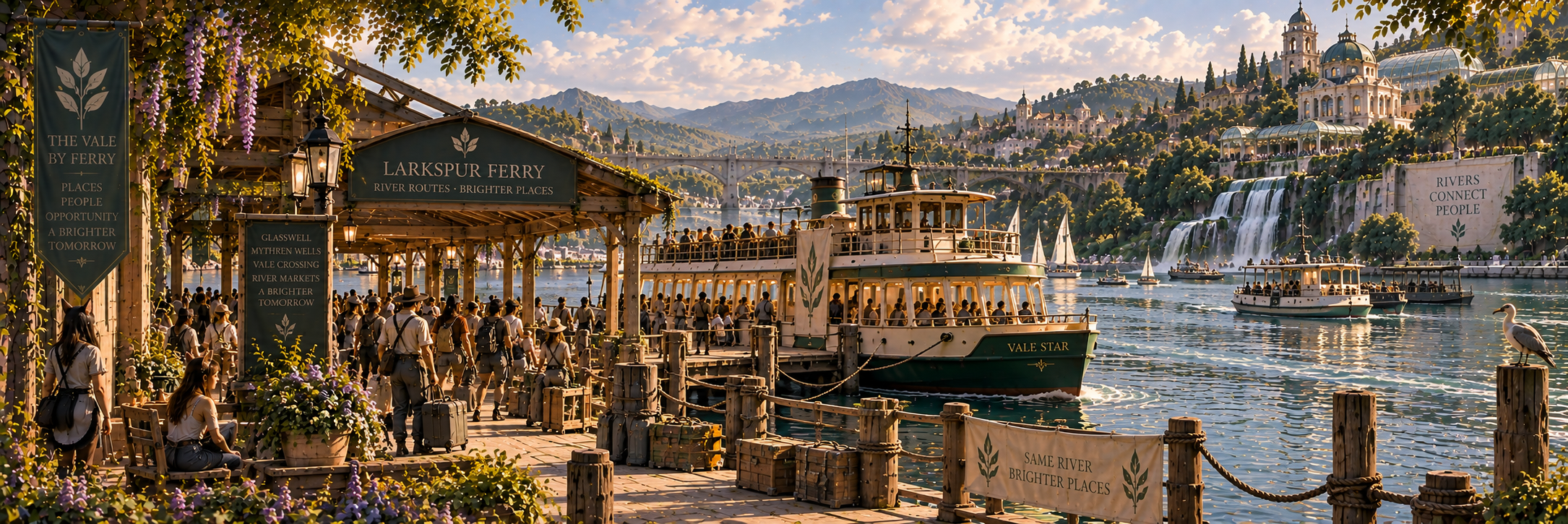
Brazor River // Ferries
In much of Brazoria, asking how far away somewhere is may get an answer in crossings rather than kilometers.
Ferries are one of the Brazor's most ordinary forms of public infrastructure. They connect neighborhoods divided by broad water, carry workers toward agricultural districts, link smaller river towns to larger markets and give communities without major road corridors dependable access to the rest of the Vale.
There is no single Brazorian ferry experience. A city commuter boat carrying hundreds of passengers has little in common with a small rural ferry crossing between orchard communities. A market boat may carry baskets and bicycles beside passengers. An estate launch may share the same water without using the same terminal at all.
Large urban routes carry office workers, clinic staff, students, service crews and household travelers between major river districts. Frequent departures make them function much like metropolitan transit.
Agricultural crews, greenhouse workers, ferry staff and maintenance teams often rely on early routes timed around shifts rather than conventional business hours.
Smaller river communities may move passengers alongside baskets, farm goods, tools and small freight. The morning crossing can become an extension of the market before anyone reaches the dock.
Children in river settlements may grow up taking ferries as casually as other students take buses. Crews recognize school groups, siblings and the adults responsible for meeting them on the opposite bank.
Historic bridges, public gardens, wetland preserves and estate corridors support sightseeing routes throughout the more scenic stretches of the Brazor.
Some villages depend on a single practical ferry connection. Missing one can mean waiting minutes in a city and hours somewhere farther out.
People buy breakfast while waiting. Children recognize one another from school crossings. Workers exchange shift gossip. Vendors know which boat brings their regular customers. A terminal becomes part station, part market edge and part neighborhood porch.
Large Cities
Major terminals run frequent departures, integrated wrist-comm ticketing and coordinated connections to street transit. Missing one ferry may simply mean taking the next.
Small Towns
In quieter communities, a ferry may run less often and carry a much more familiar passenger list. The crew knows who works which side of the river and which family always arrives thirty seconds after boarding should have closed.
River communities build habits around those schedules. Shops open before the first busy crossing. Markets peak after farm ferries arrive. Employers understand which shifts depend on which boats. Evening gatherings thin as the final rural departures approach.
Ferry crews become familiar local figures precisely because passengers see them repeatedly. A pilot who has worked the same route for fifteen years may have watched children become commuters, commuters become parents and entire households change while the crossing itself remained almost identical.
Most human passengers experience ferry travel as a simple civic service: board, cross, get off and complain about delays when weather interferes.
Many companions and laborers use ferries routinely under household, estate or work-linked authorization. When the route fits expectations, the experience may look almost indistinguishable from everyone else's.
Regular crews often know passengers socially before they know them administratively. That familiarity can make a ferry feel safer, friendlier and considerably less anonymous.
Identity checks, route permissions, weather systems, navigation data and payment verification occur around polished terminals, flowered docks and ordinary queues. Most approved passengers experience convenience rather than enforcement.
That ease is one reason ferries matter so much culturally. They do not feel like extraordinary infrastructure. They feel like part of the landscape, as expected as bridges, markets and the river itself.
Commuters // Markets // School Crossings // Rural Routes // The Vale by Water
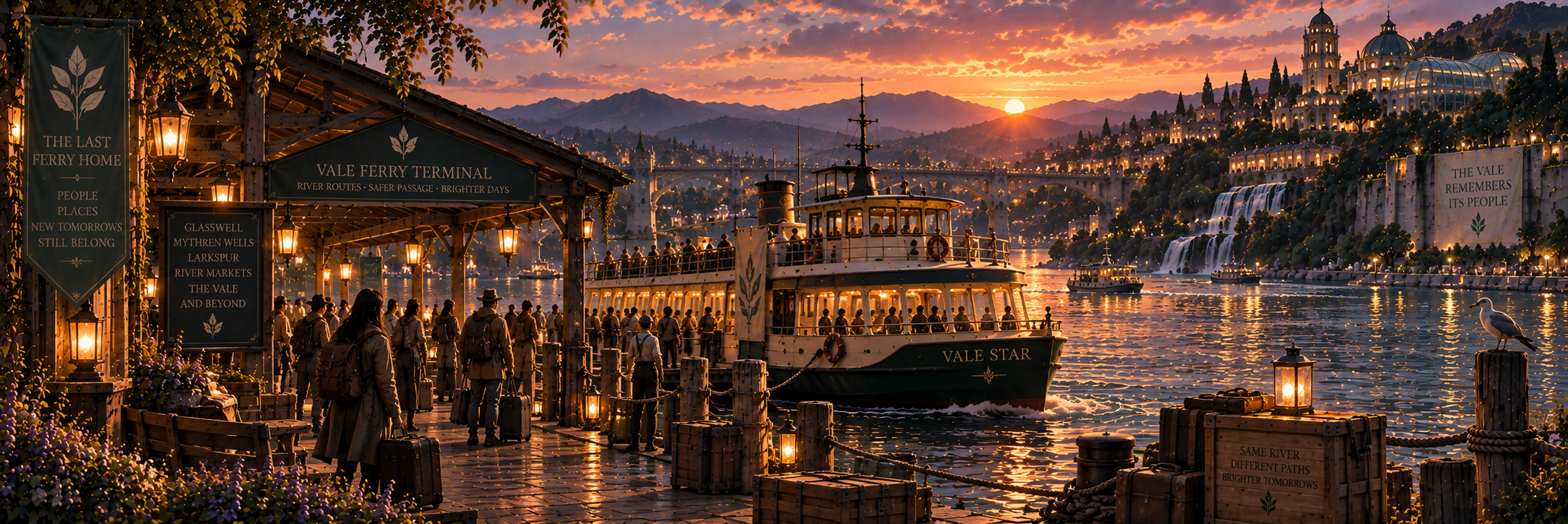
Brazor River // Evening Crossings
Every river town has a departure people know without checking the schedule.
As daylight fades across the Brazor, ferry traffic changes character. Market crowds thin. School routes finish. Agricultural crews return from the fields. Restaurant windows brighten along the water while the remaining terminals fill with people who know exactly how inconvenient their evening becomes if they miss the final connection home.
The last ferry is rarely dramatic. It is workers with tired shoulders, teenagers returning from town, families carrying leftovers, clinic staff leaving late shifts and somebody jogging down the dock because they once again believed five minutes was plenty of time.
Ferry crews, mechanics, agricultural workers, clinic staff and service employees form much of the evening passenger flow. Work clothes and lunch bags replace the morning's cleaner commuter crowd.
Small-town landings often have relatives waiting beside the terminal before the ferry arrives. Parents collect children. Partners watch for familiar coats. Somebody has usually been sent to bring dinner home.
Older students use ferries for classes, social visits and evening activities in nearby towns. Missing the last boat can trigger an embarrassing call to a parent with access to another route.
Waterfront businesses know exactly when final ferry traffic will bring one last burst of customers and when the terminal will suddenly empty afterward.
Public passenger routes may end while medical craft, maintenance vessels, freight traffic and authorized worker ferries continue operating through the night.
Evening ferry workers become especially recognizable on smaller routes. They know who normally boards, who is visiting family and who has missed the crossing three Thursdays in a row.
A pleasant dinner becomes hurried when departure approaches. Friends start checking the time. Parents text reminders. Workers calculate whether the queue looks long enough to make the next morning miserable.
On the Boat
The last public ferry is often calmer than the morning routes. Passengers sit with groceries, work bags and sleeping children while the river darkens outside the windows.
At the Landing
Smaller river towns become especially recognizable from the water after dark. A familiar terminal lamp, bridge profile or cluster of restaurant windows can tell a regular passenger they are almost home before the ferry announcement does.
Weather makes these routines fragile. Heavy rain, flood warnings, dangerous current or equipment problems can delay or cancel a crossing. A canceled ferry is rarely just a transportation inconvenience in communities built around the river. Children may be stranded with relatives, workers miss shifts and entire evening plans reorganize around finding another way across.
River Authority closures can stop public travel quickly when conditions become dangerous. Locals may complain bitterly while still understanding exactly why the decision was made.
Some crossings have road or bridge alternatives. Others require significant detours, private transport or simply waiting until morning.
Nearly every regular ferry passenger has a tale involving a missed boat, sudden storm, sleeping through the stop or being rescued from embarrassment by somebody who happened to know the crew.
People wave from rails, wait beneath lamps, help carry bags and exchange goodbyes beside the same gates used every day. Repetition does not make those moments meaningless. It gives them somewhere familiar to happen.
For demi-human passengers, the warmth can be exactly as real. A household companion may be met by children who race toward them at the landing. A river worker may have friends waiting after shift. A family can be genuinely relieved when someone steps safely off the boat.
The legal questions surrounding movement do not erase those relationships. Nor do those relationships erase the legal questions.
A Familiar Departure
For most passengers, leaving on the last ferry means nothing more profound than going home, sleeping and making the same crossing again in the morning.
A Familiar Boundary
The same river network that connects communities also defines which movements are expected. A person using an unusual landing, remaining aboard beyond a normal route or failing to return can become noticeable precisely because everyone knows the ordinary pattern.
The boat docks. Doors open. Waiting families move toward the rail.
Ten minutes later, the terminal is quiet again.
Evening Crossings // Shift Workers // Waiting Families // Final Bell // Home Across the Water
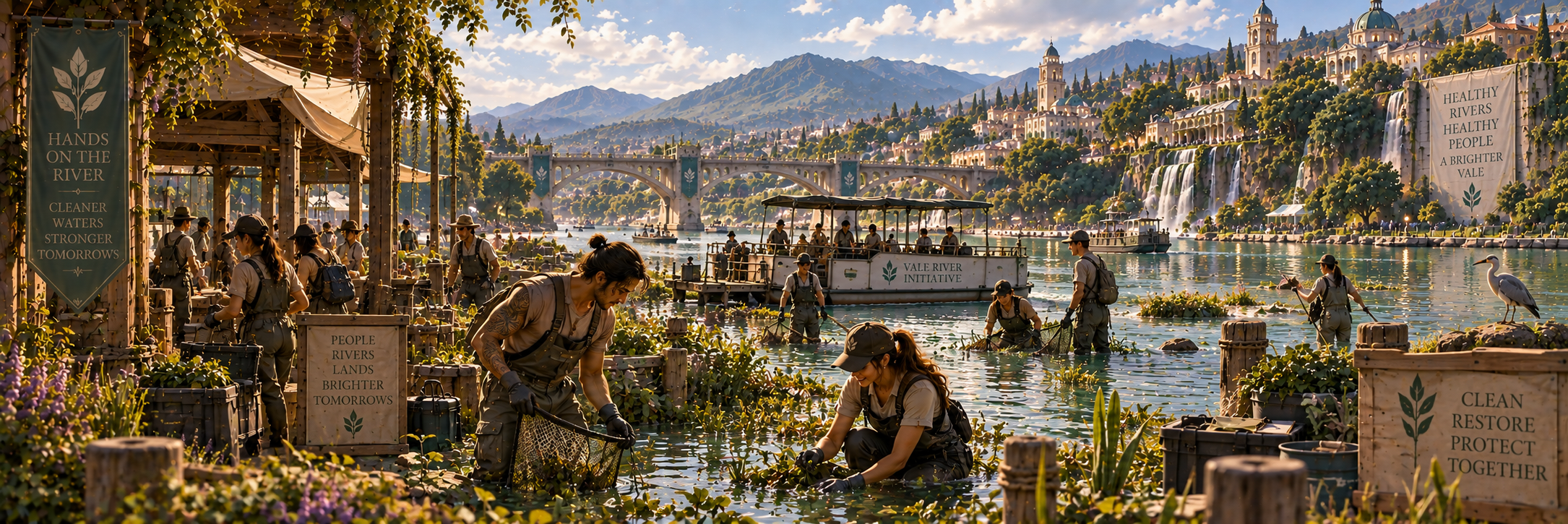
Brazor River // Demi-Human Labor
The Brazor is monitored by machines, redirected by gates and measured by sensors. It still takes people standing in the water to keep much of it working.
Demi-human workers are visible throughout the Brazor corridor, especially in jobs where species-linked traits complement training, experience and intimate knowledge of the water. Heron workers move through shallow docks. Otter workers service submerged equipment. Frog and other wetland-linked specialists test marsh systems. Crocodilian and other powerful semi-aquatic lines work around flood infrastructure and difficult current.
They are not animal-bodied laborers. Brazorian demi-humans retain human bodies and human faces, with species traits added to that human form: ears, tails, wings, limited scales, webbing or other lineage-specific features where appropriate.
More importantly, they are not interchangeable extensions of those traits. River work requires education, certification, judgment and years of local experience.
Heron demi-humans are common around shallow docks, passenger landings and marsh-edge terminals where balance, long visual range and comfort around water make them useful alongside ordinary ferry training.
Otter demi-humans frequently maintain buoys, submerged monitors, intake equipment and river sensors. Many become highly specialized technicians rather than simple divers.
Powerful aquatic and semi-aquatic lines may work lock walls, floodgates and spillway infrastructure where wet footing, strong current and emergency access make ordinary maintenance more difficult.
Wetland-linked demi-humans work beside scientists collecting water, sediment and plant samples, maintaining field instruments and monitoring contamination before problems spread into farms or settlements.
Workers familiar with shallow channels guide maintenance crews, conservation teams and agricultural boats through water too changeable for large vessels or static navigation systems.
Demi-human specialists maintain canals, pumps, intake gates and agricultural distribution systems carrying Brazor water toward orchards, greenhouses and medicinal fields.
A sensor can report depth. A model can predict current. A worker who has serviced the same stretch for ten years may notice from color, debris and sound that something is wrong before the system produces an alert.
Skill
A river worker still needs technical training, safety education, route knowledge, equipment certification and practical judgment. Species traits may create an advantage, but they do not install expertise.
Experience
Many specialists become attached to particular stretches of the Brazor. They know recurring equipment failures, dangerous currents, seasonal bird movement, flood behavior and which official maps are technically correct but locally useless.
Workers inspect moving gates, submerged mechanisms and wet chambers most passengers never see. A ferry crossing feels effortless because somebody works in the machinery underneath it.
Reed cutting, invasive-species control, wetland restoration and wildlife monitoring employ demi-humans alongside human ecological staff throughout the managed river corridor.
Green Houses employ dock attendants, water-quality workers, research assistants and maintenance specialists who may spend most of their careers inside one family's river holdings.
Many river workers genuinely like what they do. Some love the physical work. Some prefer being outdoors to institutional employment. Some take enormous pride in knowing a dangerous stretch of water better than almost anyone alive.
Friendships form across crews. Skills pass between older and younger workers. Certain families become locally associated with particular locks, ferries or marsh routes because several generations have worked the same water.
A demi-human can love river work, be respected by coworkers, become exceptionally good at a profession and still live within a system where employment, movement and custody may be decided by structures they do not control.
On the public riverfront, those workers are part of the scenery in the best sense: familiar, necessary, visible and known.
Brazoria calls that integration harmony.
Ferry Workers // Sensor Divers // Floodgates // Marsh Routes // Irrigation // People Who Know the Water
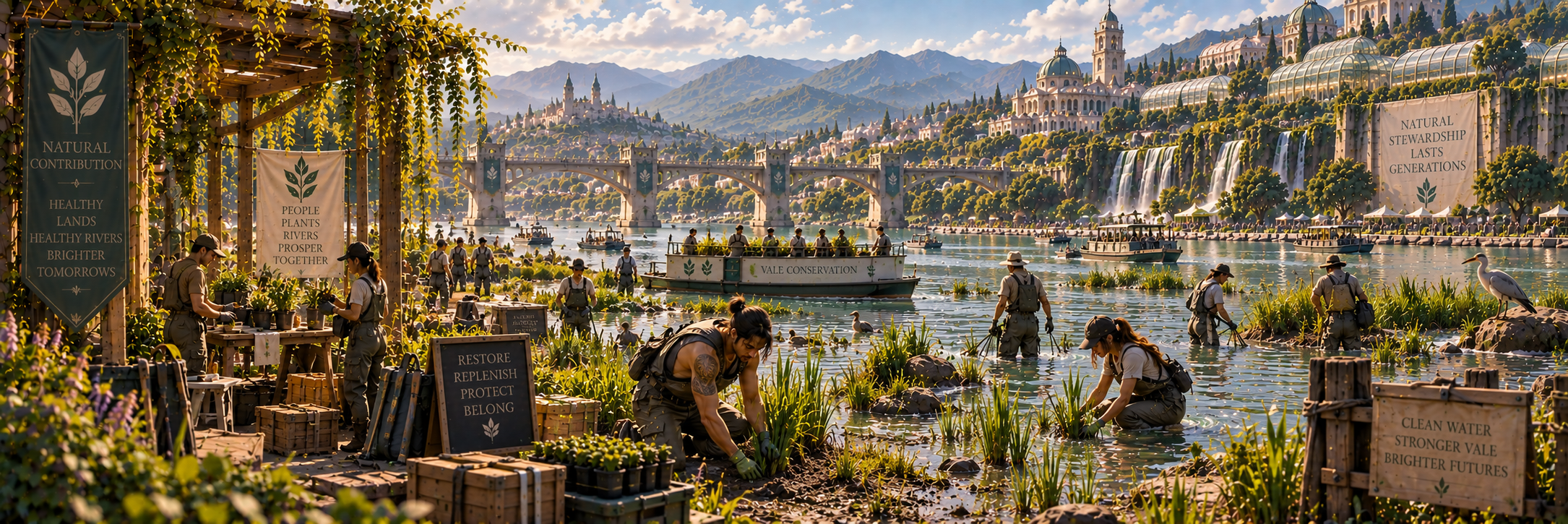
Brazor River // Labor Doctrine
Brazoria has a gift for taking the sentence “you are good at this” and quietly turning it into “this is therefore where you belong.”
Along the Brazor, species-linked specialization is treated as one of the clearest successes of the stewardship model. Aquatic, wetland and waterbird demi-humans are educated for roles where physical traits, sensory advantages or natural comfort around water can improve safety and efficiency.
The results are often excellent. River crews become highly skilled. Flood response improves. Sensor maintenance is faster. Wetland navigation becomes safer. Conservation work benefits from workers whose bodies are naturally suited to difficult terrain.
Brazoria calls this natural contribution.
A demi-human with strong swimming ability, wetland balance, aquatic senses or tolerance for particular conditions may be identified early as well suited to river work.
Specialized education converts that advantage into formal expertise: mechanics, ecological monitoring, navigation, emergency response, water science or infrastructure maintenance.
Households, estates and institutions may then guide or assign the worker toward sectors where their lineage is considered most useful.
Encouragement can become expectation. Expectation can become assignment. Assignment can become a lifelong identity everyone around the worker considers self-evidently appropriate.
Brazorian View
Supporters argue that good stewardship recognizes an individual's strengths, provides appropriate education and places them where those strengths can contribute to society. Wasting natural aptitude is considered irresponsible.
The Missing Question
The doctrine becomes much harder to defend when the person being trained cannot freely decline the profession, choose another employer or separate their legal status from the institution benefiting from their ability.
Otter, eel, fish-linked and other aquatic lines may be directed toward diving, maintenance, water systems, ferry support and monitoring.
Heron and other waterbird lines may be associated with marsh work, shallow-water inspection, ferry support or conservation environments.
Crocodilian, turtle, beaver and similar lines may become associated with locks, infrastructure, wetland engineering or physically demanding river maintenance.
Frog and other marsh-adapted demi-humans may be channeled toward ecological monitoring, water testing, reed systems and conservation work.
Some Green Houses maintain aquatic companion or worker lines across generations, producing households where occupation, lineage and estate identity become tightly intertwined.
Official campaigns frequently feature smiling mixed crews beside healthy rivers, presenting species specialization as proof that humans and demi-humans flourish when every individual contributes appropriately.
A heron ferry specialist may love ferry work. An otter technician may be proud of being the best sensor diver on the district crew. A wetland researcher may have chosen exactly the career everyone predicted for them.
Those examples are culturally powerful because Brazorians point to them as evidence that the entire system works. If a worker is happy, skilled and respected, then directing similar people toward similar roles can appear benevolent rather than restrictive.
But satisfaction after placement does not prove freedom before it.
When It Works
A demi-human discovers work they genuinely enjoy, receives excellent training, builds friendships, earns respect and spends a lifetime contributing to a river they sincerely love.
When It Doesn't
A young demi-human expresses different interests, but family, estate or institutional authorities consider their lineage too valuable for another path. The river job remains framed as opportunity even when refusal is not meaningful.
Highly skilled river workers can hold significant social respect, particularly in communities that depend directly on their expertise during floods or infrastructure failures.
Children raised around river crews may inherit both practical knowledge and strong expectations to continue a household or lineage tradition.
A worker whose permit, housing, medical support and travel permissions all depend on one specialized position may discover that leaving the profession means losing much more than a job.
The political question is whether having a place means being supported in a chosen life, or being assigned so elegantly that the assignment begins to look natural.
On the river, the difference can be nearly invisible.
Both workers may be skilled. Both may wear the same uniform. Both may know the Brazor better than the officials supervising them.
Only one may have been free to choose another life.
Species Traits // Training // Assignment // Professional Pride // Talent Is Not Consent
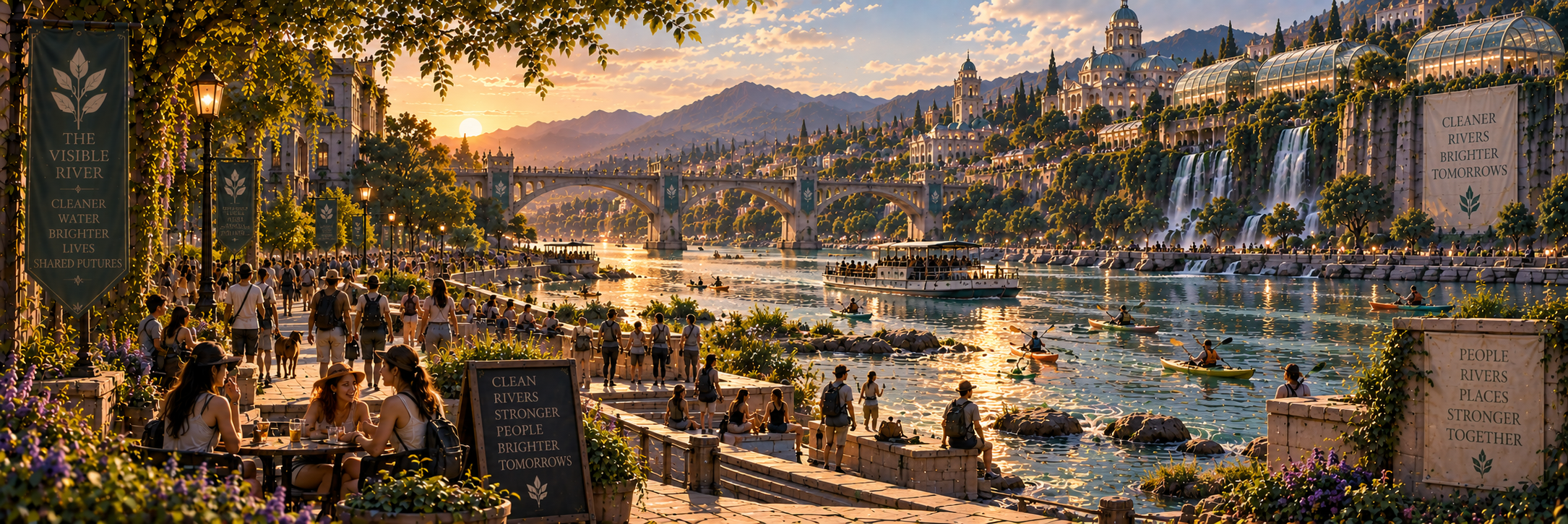
Brazor River // River Authority
The Brazor most people know is clean, navigable, monitored, heavily maintained and remarkably good at making national infrastructure look like a public garden.
The River Authority is one of the institutions Brazorians depend on most directly. It manages flood systems, navigation, ferry safety, ecological monitoring, water quality, major locks and emergency river closures across the Vale.
Much of that work is genuinely necessary. A failed floodgate can drown a district. Contaminated water can damage farms across kilometers of irrigation. An unmarked navigation hazard can kill ferry passengers. Storm closures inconvenience thousands because leaving the river open under dangerous conditions could kill more.
Locks, gates, overflow systems and managed wetlands regulate sudden rises and protect settlements, agricultural districts and critical infrastructure from severe flooding.
Buoys, depth monitoring, channel maintenance and route notices allow ferries and freight vessels to move safely through stretches of the Brazor that change with season and weather.
Sampling stations, sensor arrays and mobile crews monitor agricultural runoff, biological hazards, pollution and other threats before they spread through public or irrigation systems.
Storms, flood surges, damaged locks and hazardous current can trigger temporary restrictions or full closures. Most residents accept these decisions even while complaining about them.
Wetland restoration, habitat monitoring, erosion control and aquatic health programs make the Authority a visible part of Brazoria's stewardship culture.
Patrol craft and emergency crews respond to capsized boats, injured workers, flood evacuations and stranded passengers throughout the river network.
People trust the institution because they have seen it do useful things. They remember floods contained, ferries rescued, contamination caught early and damaged locks reopened before harvest traffic collapsed.
Public Image
River Authority complexes favor polished stone, landscaped banks, heron imagery, ecological displays and public observation areas. Children visit them on school trips. Civic campaigns present the institution as proof that abundance survives through careful management.
Practical Reality
To regulate floodwater, traffic and ecology effectively, the Authority needs extraordinary visibility into the river: what moves, when it moves, where it docks, what it carries and which routes are currently open.
That visibility is easiest to accept when it is attached to environmental safety. Sensor buoys monitor water quality and vessel traffic at once. Dock systems handle both emergency access and identity checks. Ferry logs help coordinate passenger flow while creating detailed records of who crossed where.
Major lock complexes coordinate freight, passenger traffic, flood management and emergency restrictions. They are among the most heavily monitored pieces of river infrastructure in Brazoria.
River patrols enforce navigation rules, assist damaged vessels and inspect suspicious traffic. Their presence is routine enough that most boaters barely notice one until it changes course toward them.
Equipment installed for ecology or safety can also record movement patterns. In Brazoria, that overlap is usually framed as efficient administration rather than surveillance.
Clean public waterfronts, predictable ferries, healthy gardens and controlled flooding are not accidental. Thousands of workers, many of them demi-human specialists, maintain the systems underneath that pleasant surface every day.
This makes criticism of the River Authority politically complicated. Calls to reduce its power can be portrayed as threats to flood safety, environmental protection or public health because those functions really do depend on the same institution.
The argument is not whether Brazoria needs somebody to manage the Brazor.
It is how much authority should come bundled with the job.
Flood Control // Navigation // Ecology // Rescue // Public Safety // The Visible River
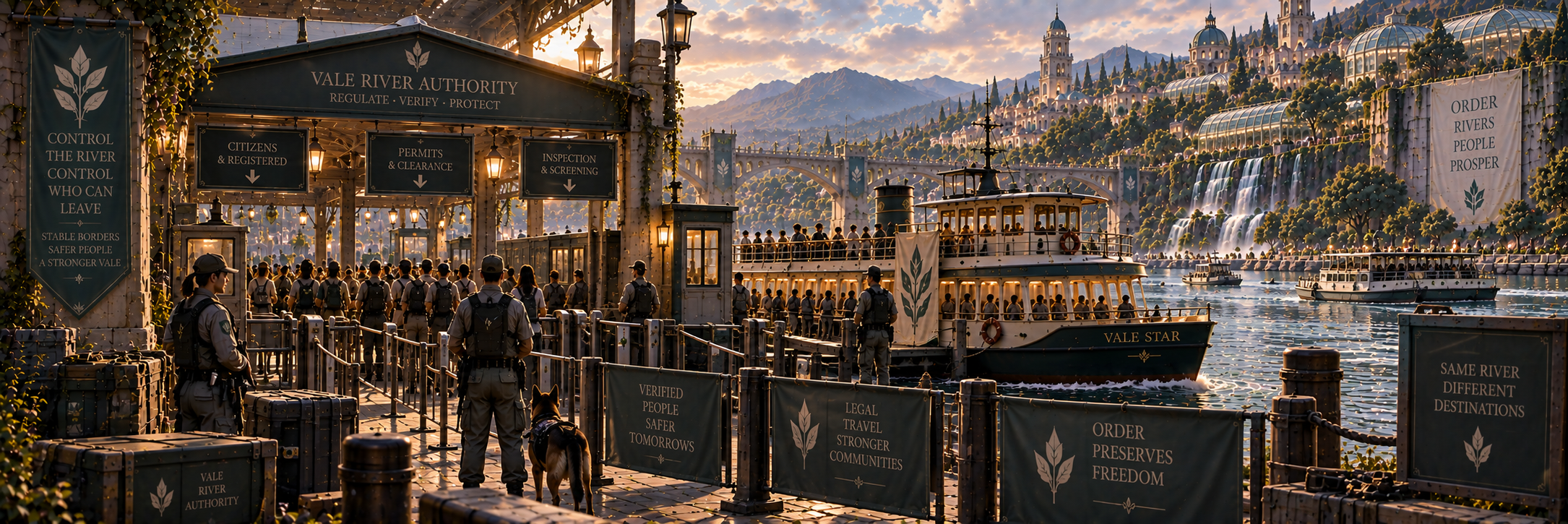
Brazor River // Authority & Movement
The River Authority was built to manage water. Brazoria eventually noticed that controlling the water also meant controlling nearly everyone attempting to move through it.
Every system that makes the Brazor safe and legible can also make unauthorized movement harder. Ferry gates know who boarded. Dock systems know which vessel arrived. Patrol boats know which routes should be empty. Flood controls determine which channels remain physically open.
None of these tools needs to look militarized. Most were installed for perfectly ordinary reasons. Together, they create one of the most powerful movement-control networks in human-controlled Vistall.
Public ferry systems can verify identity, household authority, labor status and route permissions before a passenger reaches the water.
Sensor platforms track depth, current, environmental conditions and vessel movement. Some carry compact drone systems capable of extending surveillance beyond the buoy itself.
Unlike fixed gates, patrol craft can redirect quickly toward unregistered vessels, shallow channels or reports of unusual river activity.
Major terminals and private estate docks may verify identity before allowing boarding, unloading or entry into controlled waterfront property.
Aquatic workers often carry wrist-comms linked to employers, authorized river zones and specific maintenance assignments.
A closed floodgate or maintenance lock can physically remove a route from the river, turning administrative authority into a wall made of water and steel.
That dual use sits at the center of every argument over River Authority power. Brazoria does not need separate infrastructure for care and control when one network can perform both functions.
Official Explanation
Unregistered boats endanger navigation. Unknown cargo creates contamination and security risks. Flood infrastructure cannot operate safely around unauthorized traffic. Passenger systems require accurate manifests during emergencies.
What That Enables
Once every boat, passenger, dock and worker is expected to have an approved reason for moving, someone traveling without institutional permission becomes visible long before they reach a border.
Registered boats transmit route and identity information through monitored channels. A vessel disappearing from an expected path can attract attention even if nothing else about it looks suspicious.
Public and private docks record traffic for logistics and safety. Those records can later reconstruct where a person or vessel moved through the river network.
River employees may be permitted inside restricted areas because their labor assignments expect them there. The same system notices when the worker's route no longer matches the job.
Green Houses can grant river access through private docks or household travel permissions while retaining the ability to revise or withdraw those permissions.
Floods, environmental hazards or security concerns can justify immediate shutdowns. A closure may be completely legitimate and still destroy an underground route without warning.
Sensitive wetlands and habitat corridors can be legally closed to ordinary traffic. These restrictions protect ecosystems while also expanding the stretches of river where unauthorized presence automatically appears suspicious.
The River Authority's corruption is rarely as simple as officials accepting money to ignore a boat. The deeper problem is structural. The institution controls systems that determine who may move, which records are considered valid and when an otherwise ordinary route becomes illegal.
Reed beds obstruct sensors. Old tunnels predate modern systems. Cargo creates noise. Weather changes visibility. Sympathetic workers know how infrastructure behaves from inside. The Brazor remains too large, too old and too alive to become completely legible.
Pecos Logic
A hard border makes restriction visible. Gates, fences and guards tell a traveler exactly where authority begins.
Brazorian Logic
No enormous wall is necessary if the ferry, dock, wrist-comm, buoy and patrol boat all quietly agree that a particular traveler should not be moving.
Most people encounter this system only as convenience. Their ferry boards quickly. Their dock recognizes them. Their route is expected. Their green indicator appears and the river opens.
The machinery becomes visible only when the answer changes.
That is why River-Run does not try to defeat the River Authority directly.
It looks for the pieces of the Brazor the Authority has not managed to teach how to say no.
Ferry Permits // Patrol Boats // Sensor Buoys // Dock Logs // Estate Permissions // Control the Water
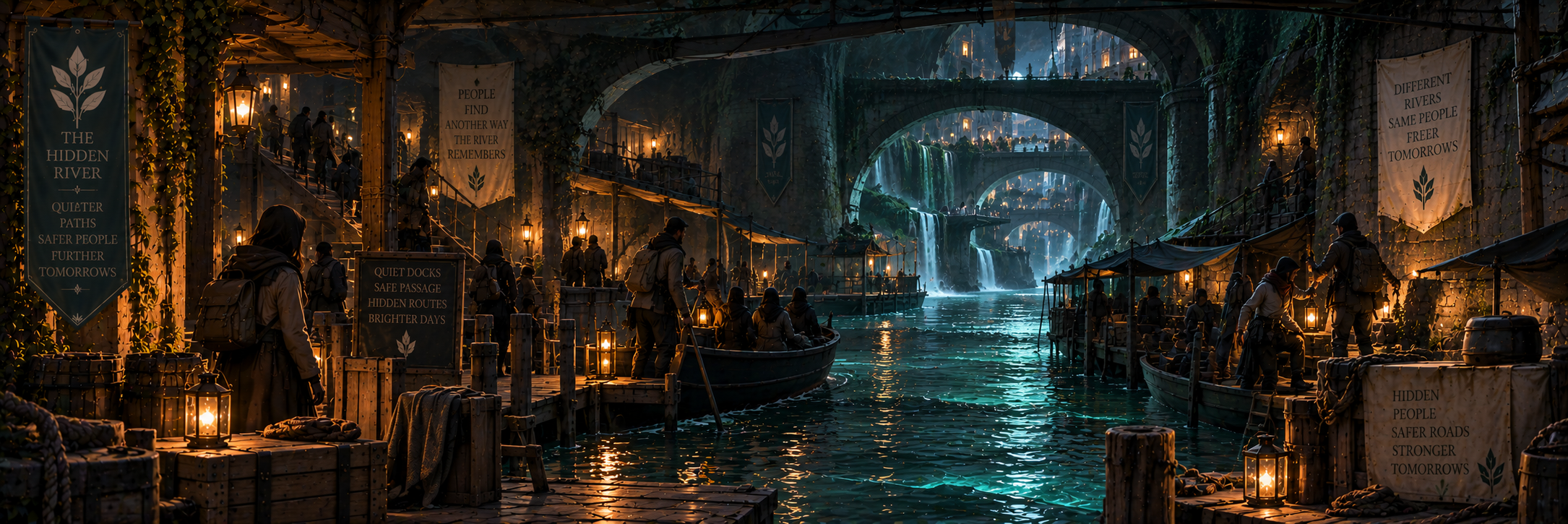
Brazor River // River-Run
The River Authority monitors the Brazor that appears on schedules and navigation charts. River-Run survives in everything the river does between them.
River-Run is not a single organization with a headquarters, uniform or command structure. It is a decentralized web of people who know enough about the Brazor to move someone through it without requiring any one person to understand the entire route.
Some participants help people escape Brazorian custody. Some move contraband. Some alter records. Some pilot boats through channels official navigation systems consider useless. Some perform a single favor and never think of themselves as part of River-Run at all.
Many routes begin with demi-humans who have already left an estate, household, labor assignment or institution and need to reach water before their absence becomes impossible to explain.
Experienced pilots understand reed channels, flood behavior, old mill cuts, shallow crossings and the stretches where modern navigation maps simplify reality into something much less useful.
A sympathetic ferry employee may know which locker is unwatched, which maintenance boat leaves before dawn or when a routine inspection creates five minutes of useful confusion.
Doctors, nurses, laboratory workers and archivists may alter biological documentation, delay reporting or create enough administrative uncertainty for a person to move before the system catches up.
Those whose ancestry would attract Census attention often develop their own networks around safe housing, false histories and routes avoiding institutions that could flag them.
Not everyone operating outside the River Authority is noble. Some smugglers move people because people pay. Others will sell the same route to authorities if the second offer is better.
A dock worker leaves a gate unsecured. A farmer provides dry clothes. A pilot takes one unusual passenger. A clinic delays one report. None of those actions requires anyone to know who arranged the next step.
Ordinary Participants
A person may know a single safe dock, one telephone number, one ferry locker or one symbol scratched beneath a bridge. That fragment can be enough to help someone reach the next person.
Experienced Networks
Longer-standing River-Run contacts understand how fragments connect across districts and waterways without consolidating that information into one record authorities could seize.
Occasional Veyrhalden-linked contacts extend River-Run beyond Brazorian water, but even they rarely control a route from beginning to end. A pilot may bring someone to a downstream meeting point without knowing which sanctuary ultimately receives them.
Thornwyck routes function similarly on land. River-Run's job is often not to carry someone all the way to safety, but to get them far enough outside familiar custody systems that another network can take over.
A small fishing vessel can move through water too shallow for major patrol craft and has a perfectly legitimate reason to spend hours away from terminal routes.
River infrastructure requires constant repair. A boat carrying tools and a known technician may cross spaces unavailable to ordinary travelers without attracting much interest.
Estate and agricultural holdings create thousands of small access points along the Brazor. Most are monitored. Some are monitored by people willing to look elsewhere.
Abolitionists, frightened families, professional smugglers, corrupt officials, clinic defectors and desperate strangers can all touch the same route for completely different reasons.
That ambiguity frustrates both Brazorian authorities and people trying to escape. A hidden boat is not automatically a rescue. A person claiming Veyrhalden connections may be telling the truth, exaggerating or setting a trap.
Trust therefore moves through River-Run almost as carefully as people do.
River-Run // Guides // Ferry Workers // Whitecoat // Hidden Hybrids // No Central Route
Brazor River // River-Run
The River Authority monitors the Brazor that appears on schedules and navigation charts. River-Run survives in everything the river does between them.
River-Run is not a single organization with a headquarters, uniform or command structure. It is a decentralized web of people who know enough about the Brazor to move someone through it without requiring any one person to understand the entire route.
Some participants help people escape Brazorian custody. Some move contraband. Some alter records. Some pilot boats through channels official navigation systems consider useless. Some perform a single favor and never think of themselves as part of River-Run at all.
Many routes begin with demi-humans who have already left an estate, household, labor assignment or institution and need to reach water before their absence becomes impossible to explain.
Experienced pilots understand reed channels, flood behavior, old mill cuts, shallow crossings and the stretches where modern navigation maps simplify reality into something much less useful.
A sympathetic ferry employee may know which locker is unwatched, which maintenance boat leaves before dawn or when a routine inspection creates five minutes of useful confusion.
Doctors, nurses, laboratory workers and archivists may alter biological documentation, delay reporting or create enough administrative uncertainty for a person to move before the system catches up.
Those whose ancestry would attract Census attention often develop their own networks around safe housing, false histories and routes avoiding institutions that could flag them.
Not everyone operating outside the River Authority is noble. Some smugglers move people because people pay. Others will sell the same route to authorities if the second offer is better.
A dock worker leaves a gate unsecured. A farmer provides dry clothes. A pilot takes one unusual passenger. A clinic delays one report. None of those actions requires anyone to know who arranged the next step.
Ordinary Participants
A person may know a single safe dock, one telephone number, one ferry locker or one symbol scratched beneath a bridge. That fragment can be enough to help someone reach the next person.
Experienced Networks
Longer-standing River-Run contacts understand how fragments connect across districts and waterways without consolidating that information into one record authorities could seize.
Occasional Veyrhalden-linked contacts extend River-Run beyond Brazorian water, but even they rarely control a route from beginning to end. A pilot may bring someone to a downstream meeting point without knowing which sanctuary ultimately receives them.
Thornwyck routes function similarly on land. River-Run's job is often not to carry someone all the way to safety, but to get them far enough outside familiar custody systems that another network can take over.
A small fishing vessel can move through water too shallow for major patrol craft and has a perfectly legitimate reason to spend hours away from terminal routes.
River infrastructure requires constant repair. A boat carrying tools and a known technician may cross spaces unavailable to ordinary travelers without attracting much interest.
Estate and agricultural holdings create thousands of small access points along the Brazor. Most are monitored. Some are monitored by people willing to look elsewhere.
Abolitionists, frightened families, professional smugglers, corrupt officials, clinic defectors and desperate strangers can all touch the same route for completely different reasons.
That ambiguity frustrates both Brazorian authorities and people trying to escape. A hidden boat is not automatically a rescue. A person claiming Veyrhalden connections may be telling the truth, exaggerating or setting a trap.
Trust therefore moves through River-Run almost as carefully as people do.
River-Run // Guides // Ferry Workers // Whitecoat // Hidden Hybrids // No Central Route
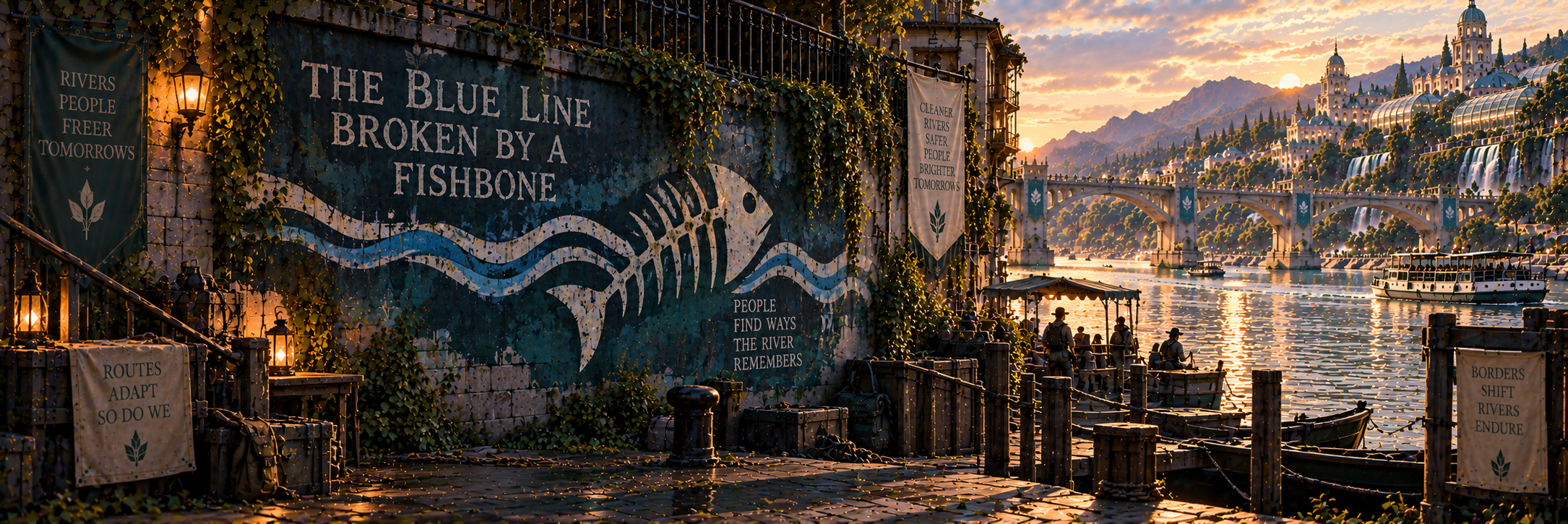
Brazor River // River-Run Sign Language
A route too secret to mark is difficult to use. A route marked too clearly is difficult to keep.
The best-known visual symbol associated with River-Run is deceptively simple: a faded blue line interrupted by a rough fishbone mark. Variations appear beneath bridge rails, beside ferry lockers, along dock walls, on old concrete and anywhere ordinary wear can camouflage deliberate meaning.
The symbol is not a formal logo. Nobody owns it. Nobody publishes an official key. Its usefulness comes from being recognizable enough to help while remaining inconsistent enough to resist easy decoding.
Freshness, direction, placement, orientation and the person who taught someone to read the mark matter more than the color alone.
A newly renewed line usually indicates someone connected to the route has verified conditions recently enough for the mark to remain useful.
Weathered blue may mean nothing more than history. River-Run travelers are taught never to trust a route merely because a recognizable symbol still survives beside it.
The interruption generally signals that movement depends on a change: leave the main route, switch carriers, find another entrance or look for additional local information.
Downstream Orientation
In several major River-Run traditions, a fresh mark oriented with the river's flow suggests that movement farther downstream remains possible according to the last check.
Upward Orientation
A mark deliberately turned upward, reversed or broken against the expected direction can warn that the familiar route should not be trusted.
River-Run deliberately resists universal standardization. A symbol beneath a Larkspur bridge may not function exactly like one beside a distant agricultural lock. Local networks modify marks, abbreviations and route signals whenever officials appear to understand too much.
Marks hide among maintenance paint, water staining and old civic repairs, visible mainly to people approaching from the correct direction.
Scratches and paint marks disappear easily among rope wear, vessel damage and ordinary dock maintenance.
A tiny fishbone inside a locker or service cabinet can identify temporary caches, changed pickup points or instructions understood only by the next participant.
Crates, repair tags and agricultural shipments sometimes carry blue marks intended to direct a package or passenger toward a specific handoff.
Floodwalls, drainage structures and lock foundations accumulate enough stains, scratches and faded markings that one more line rarely attracts attention.
During River Renewal or at river memorials, placement of blue lights can occasionally serve the same purpose as a physical route mark without leaving anything behind by morning.
Authorities can copy it. Informants can reproduce it. Smugglers can mark a dangerous route deliberately. Teenagers can imitate it because they think resistance symbols look interesting. The mark is an invitation to pay attention, not permission to stop thinking.
Why It Works
A ferry worker may recognize one version. A Chain host may know another. A clinic defector may understand only which mark means a document change succeeded. Tiny fragments keep knowledge distributed.
Why It Survives
If one person is questioned, they may reveal one dock or one symbol. They cannot surrender a complete codebook because no authoritative codebook exists.
This is what separates the fishbone from the grand symbols used by formal political movements. River-Run cannot afford consistency for its own sake. Every mark exists to solve a temporary practical problem.
Some survive long enough to become folklore anyway.
At most, it says somebody recently believed the next piece of water was still usable.
Blue Line // Fishbone // Direction // Freshness // False Marks // A Language Designed to Change

Brazor River // Dangers
The Brazor saves people because it offers routes roads cannot. It kills people for exactly the same reason.
The Brazor is generous with opportunity and completely uninterested in fairness. A shifting channel can open a route beneath patrol coverage. Rising water can carry a small boat over a bar that was impassable yesterday. Rain can obscure movement. Flood infrastructure can create temporary passages where none existed before.
The same conditions can overturn a boat, flood a tunnel, trap a traveler behind a closed gate or turn a familiar current into something strong enough to pull a person under.
Warm river days can become dangerous quickly when thunderstorms build over the Vale. Wind, lightning, heavy rain and sudden visibility loss affect even experienced pilots.
Upstream rain can raise the Brazor long after local skies clear. Low banks disappear, currents strengthen and familiar docks may become inaccessible before residents see obvious danger.
Season and depth create dangerous temperature differences. A person who survives a fall may still lose strength rapidly if they cannot reach shore or a boat.
Rain, mist, darkness and reflected lights can conceal a small craft from patrols. They can also conceal debris, navigation markers, other boats and the bank someone desperately needs to find.
Roots, old masonry, damaged dock structures, abandoned equipment and flood debris can sit just beneath the surface, invisible until a hull or swimmer reaches them.
Managed infrastructure creates strong currents, sudden level changes and dangerous confined spaces. Maintenance channels can offer routes precisely because ordinary passengers are never meant to enter them.
River-Run guides may understand the water better than most authorities, but skill only reduces risk. It does not negotiate with weather, exhaustion, equipment failure or bad luck.
Why People Risk It
A road checkpoint can remain fixed for years. Water changes by the hour. A new depth, altered current or temporary flood route can create a window no permit system anticipated.
Why Guides Say No
Experienced guides cancel routes constantly. A desperate traveler may see only the chance to leave. Someone who knows the Brazor sees wind, current, water marks, upstream weather and several ways the river can make that chance irrelevant.
Silt, vegetation and river level determine whether shallow passages are navigable. A route that worked last week may be mud by tonight.
Old drainage and mill passages can fill faster than surface conditions suggest, especially when upstream gates or rainfall redirect water unexpectedly.
Shallow craft can pass where patrol boats cannot. They also carry fewer people, less emergency equipment and far less tolerance for severe weather.
Low visibility can reduce detection while making navigation more dependent on local memory, landmarks and the person steering.
A gate opened for water management may briefly create access. The same structure closing minutes later can isolate a boat on the wrong side.
Escapees may reach the river hungry, injured, frightened or sleep-deprived. A route safe for a rested worker can become deadly for someone already struggling.
River-Run stories often focus on successful crossings because those are the people available to tell them. The Brazor also contains quieter histories: boats that overturned, guides who misjudged a flood, travelers forced back to shore and people who simply disappeared into water too dangerous to search properly.
A person may deserve freedom completely and still drown before reaching it. River-Run treats that fact seriously enough to frustrate people who want every possible route attempted immediately.
River Authority Warning
Official danger notices can be manipulative or strategically useful to enforcement, but storms, flood surges, lock hazards and unstable channels are not invented simply because authorities benefit from restricting access.
River-Run Wisdom
Experienced contacts learn to separate genuine physical risk from convenient administrative language. Both can close a route. Only one may kill everyone who ignores it.
That uncertainty is part of what keeps the Brazor uncontrollable. The same natural movement frustrating River-Run frustrates the River Authority too.
Neither side owns the current.
Storms // Floodwater // Cold // Shifting Channels // Night Routes // Chance Is Not Safety

Brazor River // Human Dangers
Water is dangerous because it changes. People are dangerous because sometimes they do not.
River-Run depends on trust spread across people who often know one another only through fragments. A guide trusts a mark. A traveler trusts a boat. A clinic worker trusts that the next contact is still safe. A ferry employee trusts someone not to mention the locker they opened after midnight.
Every one of those relationships can fail.
Compact river drones can inspect side channels, docks and reed beds without requiring a patrol vessel to enter. A route previously hidden by distance may become visible from above.
A traveler can make it through several underground handoffs only to encounter a biometric gate whose records changed hours earlier.
A worker, neighbor or smuggler may notice unusual movement and report it for money, loyalty, fear or the sincere belief that they are protecting the community.
A copied River-Run symbol can redirect someone toward a compromised dock, monitored culvert or person pretending to be part of the network.
Authorities alter routes constantly. A pilot working from old information may enter a channel expecting privacy and find a patrol boat already waiting.
A sympathetic employee may provide access until a household changes staff, installs new security or discovers exactly why the dock has been unusually active.
The same blue mark. The same boat model. The same dock. The same name passed through three trusted contacts. River-Run often discovers compromise only after something familiar behaves differently.
Authority Pressure
Patrols, sensors, cargo inspections and dock logs work by turning movement into information. A hidden route becomes vulnerable the moment enough separate records point toward the same place.
Underground Pressure
River-Run cannot function without strangers eventually relying on one another. Authorities and informants do not need to control every route if they can make participants doubt every contact.
A shipment used safely several times may be selected for random inspection, targeted review or an entirely legitimate agricultural safety check at exactly the wrong moment.
A wrist-comm or wellness band believed disabled may continue transmitting partial data, reconnect automatically or expose a movement pattern once it reaches monitored infrastructure.
Environmental and navigation systems can detect wake, movement or unexpected activity even when nobody visually sees the vessel creating it.
A closing gate can be routine water management, targeted enforcement or terrible timing. The people trapped by it may not know which explanation applies.
A professional smuggler may accept payment from an escapee and then accept a second payment for information about where that escapee will be.
Not every warning is accurate. A false story about an arrest can cause contacts to abandon infrastructure authorities never actually discovered.
A pilot talks. A mark is copied. A worker disappears. A checkpoint changes software. A patrol arrives early. What felt like geography becomes a chain of human decisions.
This is why experienced River-Run contacts rarely promise safety. They can describe probabilities, recent conditions and trusted names. They cannot guarantee that a person trusted yesterday has not been arrested, frightened, bribed or replaced today.
False Confidence
Repeated success can become its own warning. Every safe crossing creates another observable pattern, another person who might remember it and another opportunity for authorities to compare records.
Survival
Fresh route information matters more than reputation. A famous safehouse can be dangerous tonight. An unknown dock may be safer because nobody has had time to notice it yet.
Some traps are deliberate. Others emerge from unrelated systems colliding: a conservation drone flying at the wrong hour, a surprise cargo inspection, a floodgate closure requested by engineers who know nothing about River-Run.
From the perspective of the person caught, the distinction may not matter.
A frightened host can make a mistake. A worker can mention something without realizing its significance. A doctor can alter the wrong field. A family member can report someone because they genuinely believe returning them home will keep them safe.
A boat waits beside a dark dock. The blue mark is where it should be.
Farther across the water, a patrol light turns slowly toward shore.
Drones // Informants // False Marks // Patrol Changes // Bad Trust // The Route That Looked Safe
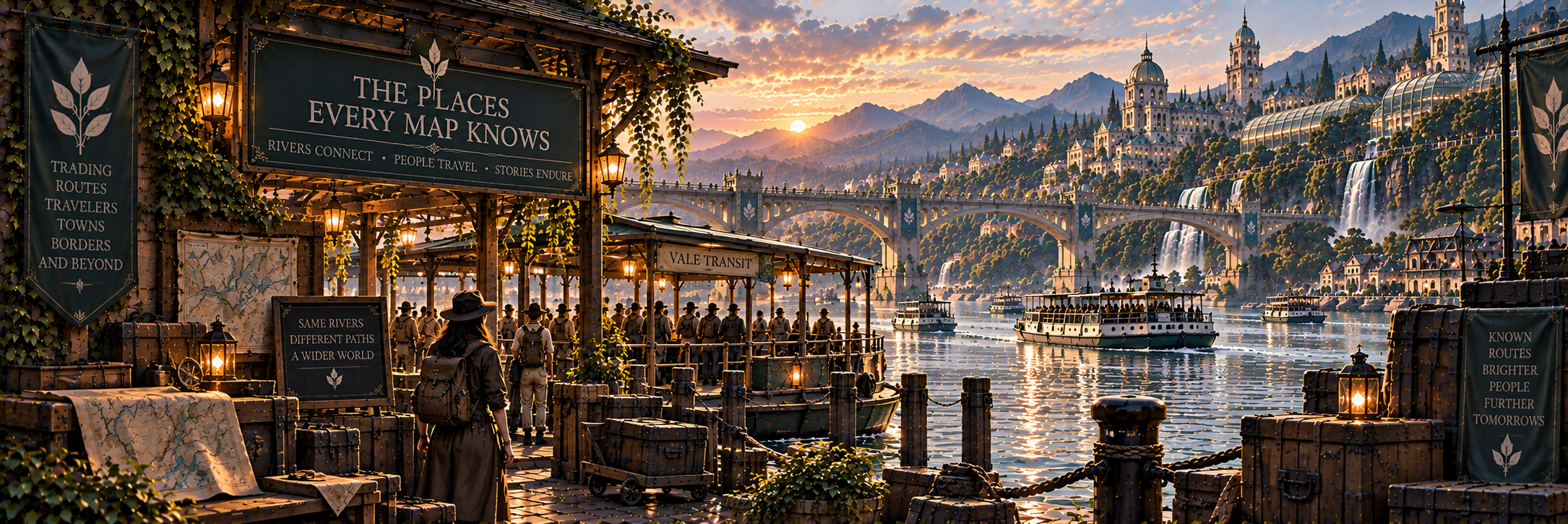
Brazor River // Known Locations
Some parts of the Brazor are meant to be found. They appear on transit maps, school itineraries, flood reports, estate invitations and every respectable river guide in the Vale.
The public Brazor is anchored by places whose names are recognized far beyond the neighborhoods surrounding them. Locks regulate the water. Ferry gates organize movement. Gardens turn stewardship into civic landscape. Medical vessels carry care between communities. Private docks reveal where old money reaches the river.
These locations are not merely landmarks. They are the physical points where Brazoria's river systems become visible enough for ordinary people to interact with them.
Major lock complexes coordinate navigation, flood management, freight scheduling and emergency closures along the most heavily used stretches of the Brazor. Their polished architecture and public observation areas make them both working infrastructure and civic monuments.
One of the best-known eastern crossings, linking commuter traffic, agricultural movement and cargo routes through a terminal famous for its flowered approaches and green, blue and white status lights.
A large civic landscape combining river terraces, wetland restoration, public paths and educational exhibits. School groups learn water ecology here while families mostly use the lawns for picnics.
Mobile medical vessels travel between communities where river access is faster or more dependable than roads. They provide routine medicine, emergency support, flood response and specialist care for remote river workers.
Green Houses and other wealthy river families maintain private landings for produce, guests, staff, medical visits, research traffic and household companions. Some are simple boathouses. Others function like small private terminals.
Brazor Station and other large river settlements operate dense public ferry and freight systems linking urban districts to farms, research corridors and smaller communities throughout the Vale.
A traveler can look at a map and understand where to board, where cargo changes hands, which lock controls a route and where medical or civic services can be found. Brazoria has invested heavily in making the official Brazor easy to navigate.
Civic River
Public terminals, gardens and medical routes reinforce the idea that the Brazor belongs to the whole Vale. They are maintained carefully, visited constantly and woven into daily routines rather than reserved for officials alone.
Private River
Estate waterfronts may occupy the same river while answering to private household authority. Their docks connect directly to land, people and institutions ordinary passengers cannot access simply because they arrived by boat.
A decision made here can change navigation speed, flood levels and whether entire secondary routes remain accessible farther downstream.
A village too small for specialist medicine may still receive regular clinical access because the doctor travels rather than the patient.
Restored wetlands, white-heron imagery and river education make Brazoria's stewardship philosophy physically pleasant to experience.
Most maps end comfortably here. They show infrastructure people are meant to use, places authorities maintain and routes whose purpose is publicly understood.
That does not mean everything outside those markings is empty.
It says considerably less about where the river remains useful after the organization ends.
Command Locks // Ferry Gates // Public Gardens // Floating Clinics // Estate Docks // The Known Brazor
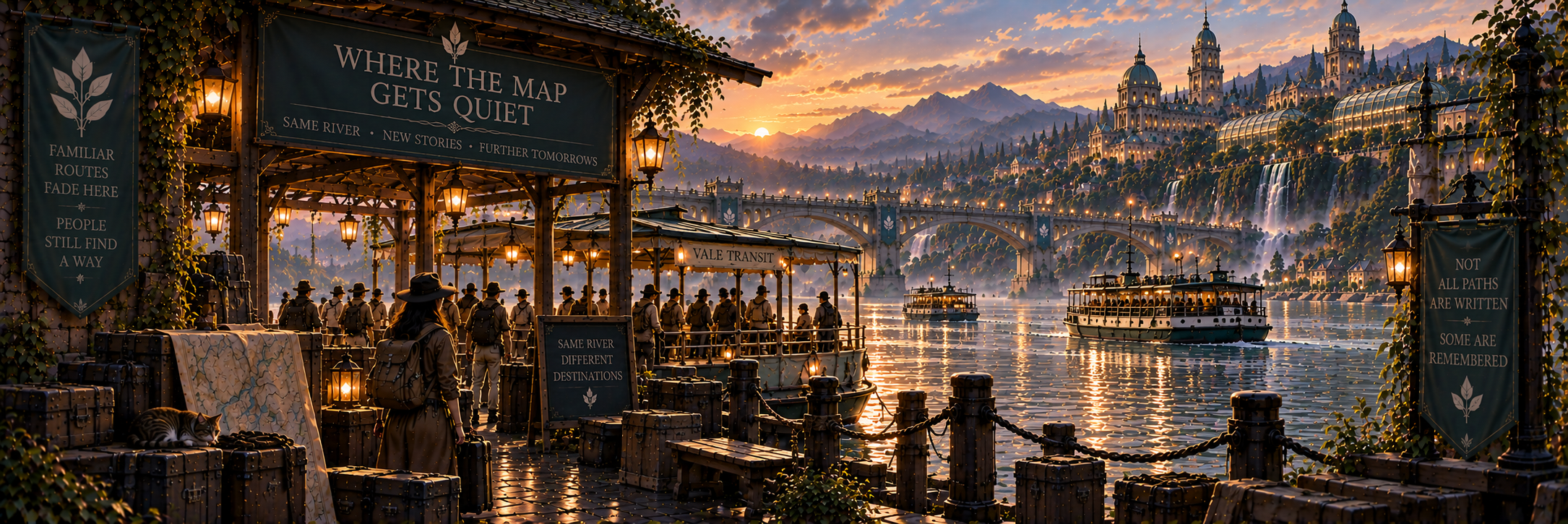
Brazor River // Unmapped Places
The Brazor does not become empty beyond the marked routes. It simply becomes less interested in explaining itself.
Past the polished terminals, maintained locks and public river gardens lie hundreds of smaller places that official maps simplify, generalize or ignore entirely. Reed channels. Old service tunnels. Agricultural cuts. Half-flooded mill infrastructure. Temporary docks. Places useful for an hour and meaningless again by morning.
Some are dangerous. Some are mundane. Some become important only because one person remembers how they connect to another piece of water.
Shallow routes through reeds, silt and wetland margins that change with water level. River-adapted demi-humans and experienced local pilots can use passages larger vessels would consider unnavigable.
Old drainage works, flood passages and utility corridors survive beneath river settlements. Some still carry water. Others become briefly passable when levels fall.
No single crossing defines the Larkspur Chain. Ferry lockers, temporary rooms, drainage access, farm paths and boat handoffs combine differently depending on who is moving and which route remains safe.
A shifting reed-lined bend outside standard ferry routes. Officially unreliable and functionally impassable. Practically, a shallow craft with the right pilot and the right tide can get through.
During River Renewal, crowds, temporary docks, service vessels and thousands of floating lights create a brief geography that does not exist during the rest of the year.
A faded blue line interrupted by a fishbone can transform an ordinary wall, dock post or bridge rail into a piece of route information for exactly as long as someone still trusts it.
A fisherman may know them. A drainage engineer may know them. A farmer may cross one every week. River-Run survives by recognizing that ordinary local knowledge becomes powerful when official systems stop paying attention.
What Maps Do Well
Locks, ferry routes, maintained docks and public channels can be surveyed and updated. Their usefulness depends on remaining predictable enough for thousands of strangers to use safely.
What Maps Do Poorly
A culvert useful only after three dry days, a reed opening known by one pilot or a service dock available because one worker is on shift tonight does not remain stable long enough to become ordinary geography.
Vegetation creates blind turns and narrow openings that change seasonally. Familiar landmarks can disappear under floodwater or growth.
A route may appear on century-old plans without being included in current transit data, creating strange overlaps between known history and forgotten access.
The River Authority has little reason to maintain a route unsuitable for ordinary passenger or freight traffic. River-Run has very different standards for usefulness.
These places are often imagined as belonging entirely to fugitives and smugglers, but ordinary residents use them too. Children explore abandoned mill stairs. Farmers maintain irrigation channels. Fishermen launch from unmarked banks. Workers know forgotten maintenance access because somebody still has to repair what lies beyond it.
One person knows where a tunnel begins. Another knows which dock opens after midnight. Someone else recognizes the fishbone. No single piece creates a route until circumstances connect them.
A Place Today
The tide is right. The mark is fresh. The patrol route changed. The ferry worker answered. Somebody can move through.
The Same Place Tomorrow
Water rises. A gate closes. The reeds shift. Someone gets frightened. The mark disappears. The geography remains while the route ceases to exist.
That instability is why the River Authority can know many hidden locations without controlling the hidden river itself. Discovering a culvert does not reveal the next handoff. Monitoring Blackwater does not expose every irrigation route. Removing one blue mark does not explain who painted the next.
The Brazor continues east whether somebody has permission to follow it or not.
Public lights thin. The marked channel narrows. A ferry disappears behind the bend.
Farther downstream, somebody remembers another way through.
Blue Reed // Drowned Tunnels // Chain Crossings // Blackwater Bend // Broken Fishbones // The River Beyond the Map
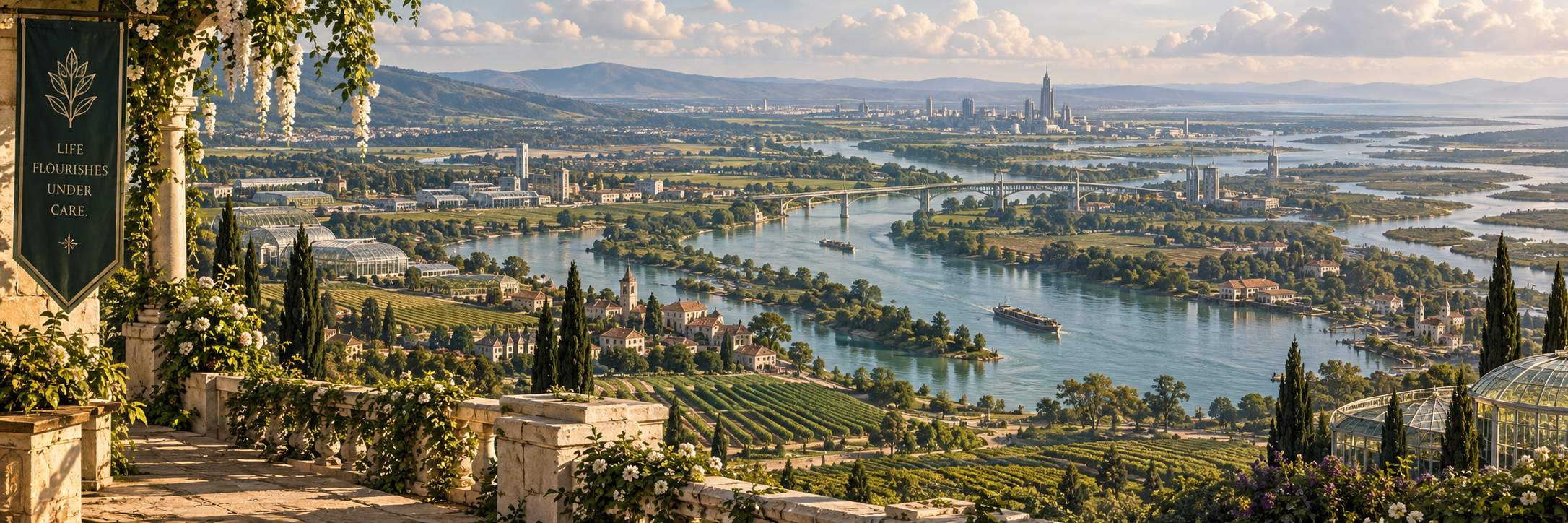
Major Regions · Brazoria Vale
One country, one river system, one national law, and five very different ideas of what ordinary life should look like.
Brazoria Vale is often described from outside as though it were one continuous garden: fertile fields, old estates, clean river cities and polished research centers stitched together by the Brazor. Brazorians know better. The country changes as the water changes. The upper river moves through controlled agricultural and research country. Old Green House estates occupy another social world entirely. The Station Basin thinks in timetables and records. Larkspur remembers faces. Farther downstream, the Low Reeds learns to distrust any map that assumes water will stay where it was put.
These are not five separate nations, nor are they rigid administrative provinces. They are broad geographic and cultural regions, names used in conversation, travel, business, agriculture and local identity. Their boundaries blur. Their people move between them. Their institutions answer to the same national government. Even so, upbringing in one region can shape accent, work, manners, expectations and social trust strongly enough that another Brazorian may recognize it within minutes.
What Changes
Regional differences are practical before they are ideological. Flood cycles shape the Low Reeds. Estate inheritance shapes Green House Country. Research institutions shape the Upper Vale. Transit and corporate systems shape Station Basin. Crossings and familiarity shape Larkspur. Even the same national customs develop different accents when filtered through land, work and community.
“The law is national. Normal is local.”
To understand Brazoria, follow the Brazor long enough to notice when the country begins answering the same questions differently.

Regional Guide · Five Belts
The borders are soft. The reputations are not.
A train schedule may call them service regions. An agricultural report may call them production belts. An old family may simply say upriver, estate country, Station-side, the crossings or down in the reeds. None of those descriptions are perfectly precise. All of them are useful. Brazoria’s five major regional belts describe where landscape, settlement, economy and local custom begin clustering into recognizable ways of life.
Upper Vale
Broad agricultural estates, university-linked research towns, seed nurseries and river engineering define the upper country. Settlements are smaller than Brazor Station but unusually educated and technologically sophisticated. Water access is orderly, environmental monitoring is dense and private estate docks are common. The region’s reputation is quiet competence: well funded, well maintained and rarely surprised in public.
Green House Country
Old Green House estates dominate stretches of orchard, vineyard, conservatory and riverfront land. Villages often grew around family holdings rather than the reverse. Wealth is less corporate here than in Station Basin and more hereditary, social and intimate. Outsiders notice the gardens. Locals notice which family planted them, who married whom and whose household has lived behind the same walls for generations.
Station Basin
Brazor Station anchors a dense belt of transit suburbs, medical campuses, research parks, administrative centers and engineered riverfronts. People arrive from every region, which makes the Basin more anonymous and more genetically, economically and socially mixed than much of the Vale. Credentials matter. Records matter. Being recognized personally often matters less than whether the system recognizes the file.
Larkspur Crossings
Flower agriculture, orchards, ferries, bridge towns, small clinics and old civic families shape the eastern crossings. Larkspur Crossing is the best-known city, but dozens of smaller settlements share its habits. People know ferry crews, household names, school histories and ordinary routines. That familiarity creates remarkable community trust and makes anonymity unusually difficult.
The Low Reeds
The lower Brazor spreads into floodplain channels, reed beds, drainage systems, silt islands and working settlements shaped by seasonal water. Ferries, fish markets, irrigation crews, repair yards, food processing and flood-control infrastructure matter more here than polished research campuses. Low Reeds communities have a reputation for practicality because the river periodically arrives to fact-check everyone’s plans.
Regional identity in Brazoria is less about where a line is drawn and more about what people expect the land, the river and one another to do.
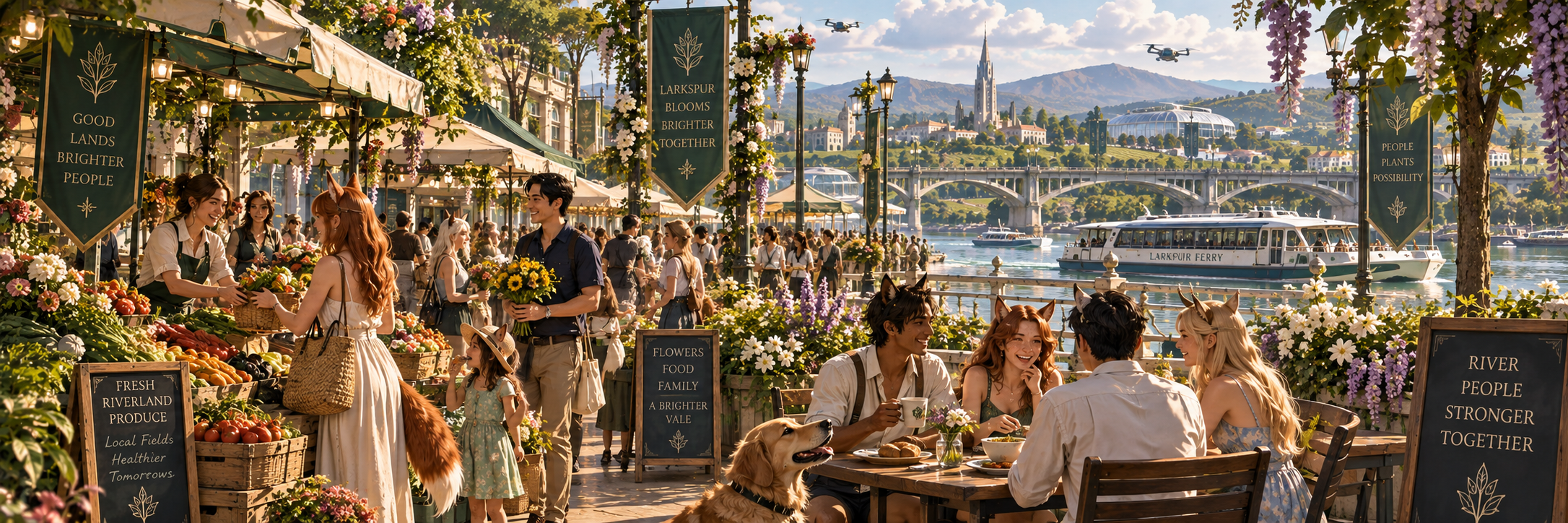
Daily Regional Life · Local Expectations
A Brazorian can travel a few hours and discover that everyone is still following the rules, just not the rules they expected people to care about.
National law creates the frame. Local life fills it in. Brazorians share schools, media, legal language, stewardship culture, river infrastructure and a strong belief that good systems produce good lives. What changes from region to region is the thing people watch most closely: expertise, family reputation, documentation, familiarity or practical reliability.
Upper Vale
A child raised upriver grows up around research stations, agricultural trials, environmental monitoring and carefully managed water. Asking for the data is not considered cold. It is considered responsible. A new irrigation strain, unfamiliar medical treatment or altered ferry schedule earns trust after somebody qualified has tested it.
Green House Country
Estate country runs on memory longer than paperwork admits. Family names, inherited relationships, old favors and household reputation still open doors. A companion who has lived with one family since childhood may be known throughout an estate village as intimately as any human relative, even while their legal status remains entirely different.
Station Basin
The Basin trusts systems because systems keep a metropolis moving. Appointments, transit access, medical histories, work credentials and identity records pass through thousands of quiet checks every day. Most residents barely notice them. Efficiency becomes cultural shorthand for legitimacy.
Larkspur Crossings
Larkspur culture privileges recognition. The café owner knows which ferry worker takes cinnamon in their coffee. Teachers remember siblings. Estate names linger for decades. A familiar face receives ease that a perfectly valid stranger may not. It feels neighborly until somebody desperately needs not to be recognized.
The Low Reeds
Downriver, competence outranks presentation. People remember who repaired a pump during a flood, who ferried medicine through bad weather, who knows a drainage channel by feel and whose beautifully prepared infrastructure failed the first time the river rose. Status can earn politeness. Showing up earns trust.
Regional Blind Spots
Station professionals can find Green House deference to old surnames archaic. Estate families think the Basin is impersonal. Larkspur residents consider outsiders oddly anonymous. Upper Vale researchers can sound overcareful to Low Reeds workers, while Low Reeds improvisation makes an upriver engineer develop an eye twitch. These differences rarely threaten national identity. They are the everyday arguments that prove Brazoria has one.
Same river. Same country. Different things everyone assumes should never need explaining.
The Vale becomes believable in the small differences: what people notice, what they forgive, who they call first and which question they ask before deciding everything is fine.
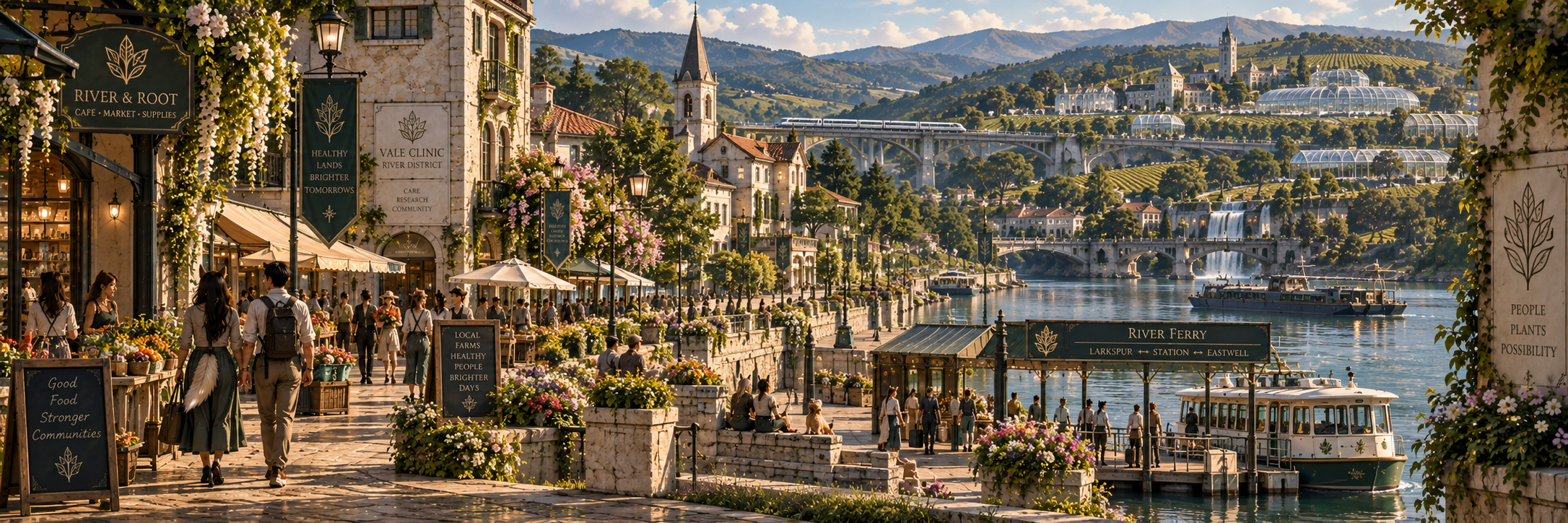
Major Regions · Settlements
Brazoria is not a country of two important cities surrounded by empty farmland. Between its metropolitan center and famous crossings lies a dense web of towns built around whatever the land, river, estate or institution required there first.
Brazor Station and Larkspur Crossing dominate maps because they concentrate administration, transit and trade. They do not dominate daily life everywhere. Much of Brazoria is organized through smaller regional centers: research towns where the university campus is larger than the civic square, estate settlements where one family name appears on half the public buildings, ferry communities built around a dependable crossing, and agricultural towns that exist because harvests need somewhere to become shipments.
Station Basin
The national metropolitan center remains the Vale's largest concentration of corporate offices, hospitals, research institutions, rail connections and river administration. Surrounding commuter towns gradually blur into its transit and medical networks. In this part of Brazoria, distance is measured almost as often in train stops as in kilometers.
Larkspur Crossings
Far smaller and more intimate, Larkspur organizes the eastern river country through ferries, flower agriculture, estate relationships and old civic networks. Its influence extends beyond city limits through villages whose residents shop there, study there, see doctors there and know exactly which ferry crew works which route.
Upper Vale
Compact settlements cluster around agricultural laboratories, water-management centers, seed programs, universities and environmental stations. They often combine surprisingly advanced facilities with quiet residential streets, cafés, greenhouse belts and working farmland only minutes away.
Green House Country
Some settlements grew beside estates so old that civic and household history cannot be separated cleanly. A Green House may fund the clinic, maintain a public garden, employ generations of local families and own agricultural land surrounding the entire town. The relationship can be genuinely beneficial and still leave enormous informal power concentrated behind one surname.
The Low Reeds
Lower-river communities are often smaller, flatter and more practical. Ferry landings, repair yards, irrigation works, fish markets, food processors, flood stations and clustered homes may form a town without anything resembling a grand civic center. What matters is access to the water, a road that stays passable and somebody who can repair the pump before morning.
Settlement Pattern
A Brazorian settlement often begins with a reason rather than a plan: a river crossing, a productive orchard, an estate, a clinic, a research program, a lock system or a freight connection. Housing and shops follow. Schools appear. A café becomes old enough to be called historic. Eventually the practical stop becomes the place everyone means when they say they are going into town.
A place becomes important when enough lives begin depending on it.
The Vale changes gradually. A research road becomes a main street, an estate gate becomes a village landmark, and a ferry stop becomes home long before anyone decides where the town officially begins.
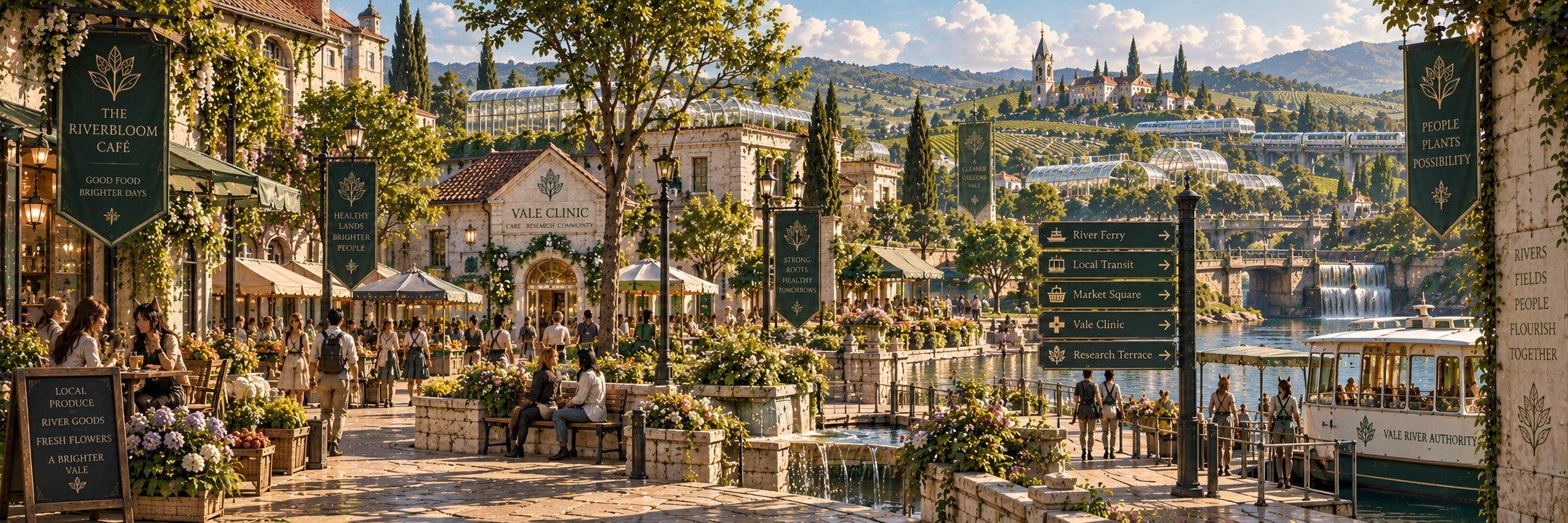
Regional Geography · Local Places
Population matters. So does the thing everybody would notice immediately if it disappeared.
Brazorian geography does not sort neatly into cities, suburbs and countryside. A settlement of a few thousand people may carry regional importance because it controls a ferry crossing, houses a major seed archive, supports an old Green House estate or contains the only advanced clinic within an hour's travel. Other communities barely appear on national maps despite supporting thousands of hectares of farmland and half a dozen river routes.
Estate Villages
Built around major Green House holdings, these villages may contain public shops, schools, clinics and civic offices while remaining economically intertwined with a nearby estate. Residents can work for the household, lease estate land, supply its agriculture or simply live in a community shaped by generations of the same family's presence.
Research Towns
Agricultural science, genetics, water management and conservation create settlements where a modest town center sits beside advanced laboratories, experimental fields and greenhouse complexes. Researchers live beside farmers. Students share cafés with irrigation technicians. A supposedly rural town may quietly influence policy across the entire Vale.
Ferry Settlements
Many river communities exist because people have crossed at the same bend for generations. Ferries create cafés, repair shops, inns, produce markets, storage yards and eventually neighborhoods. When a ferry route closes, the effect is not merely inconvenient. It can reorganize an entire local economy overnight.
Clinic Communities
Specialist hospitals, fertility centers, recovery houses, veterinary-morphology clinics and research facilities draw patients, employees, families and support businesses. Some become recognizable districts. Others stand almost alone among gardens and agricultural land, their quiet campuses larger than the neighboring village.
Agricultural Service Towns
Seed merchants, machinery repair, produce grading, cold storage, processing, agricultural transport and seasonal labor give these settlements their purpose. They may look sleepy outside harvest season, then become some of the busiest places in the region when crops begin moving toward the river.
River Authority Stations
Locks, reservoirs, flood-control installations and navigation stations frequently accumulate housing and local businesses around them. Some remain official compounds. Others become small communities whose residents identify more strongly with the river than with the nearest municipality.
Greenhouse Settlements
Large conservatory and greenhouse belts require growers, technicians, pollination specialists, shipping crews and constant maintenance. Worker housing, markets and schools often cluster nearby, producing compact communities surrounded not by conventional farmland but by acres of glass and controlled growing environments.
Flood-Control Communities
In the Low Reeds, some settlements organize themselves around pumping stations, levees, drainage channels and elevated roads. Everyone knows the flood markers. Children learn which streets vanish first. Local status often belongs to the people who understand exactly what the river will do when the weather turns ugly.
Regional Importance
A tiny settlement may control the only reliable crossing for kilometers. An estate archive may hold lineage records affecting families across the country. One regional clinic may serve dozens of rural communities. A seed town may supply crops planted throughout Brazoria. Local importance is measured by dependency as much as population.
For Travelers
The Vale between its famous cities is heavily inhabited, cultivated and interconnected. Roads pass farms, villages, research campuses, private estate entrances and river facilities constantly. Some barely merit a dot on a tourist map. Every one of them may contain a café, a family argument, a local scandal and somebody who knows exactly why a stranger has stopped there.
In Brazoria, a place does not need a skyline. Sometimes it only needs a dock, a clinic, three streets and enough people who would fight anybody trying to say it does not count.
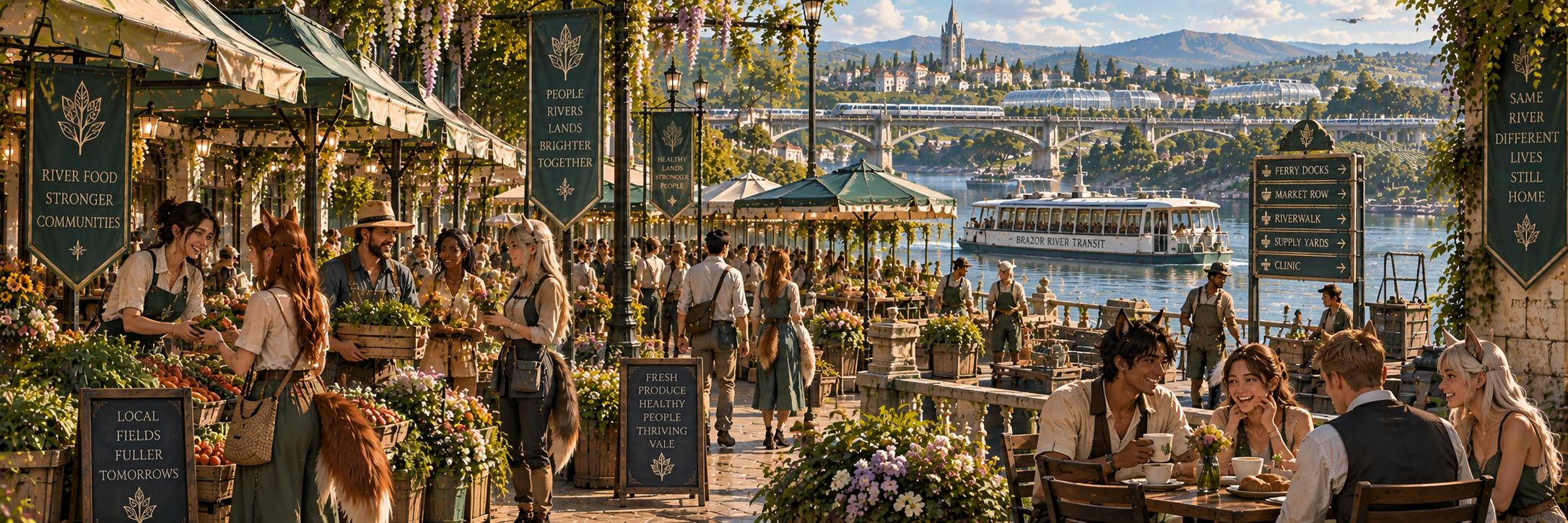
Human Life · Regional Culture
Brazorians share a national identity, but work, class, geography and the river shape very different versions of an ordinary human life.
Most human Brazorians grow up with the same broad assumptions: the river should be managed, the land should remain productive, care should be organized, records should be accurate and a comfortable life is evidence that the system is working. The details change enormously by region. A Station Basin analyst, a Green House orchard family, a Larkspur ferry operator and a Low Reeds mechanic may all consider themselves thoroughly Brazorian while disagreeing on nearly everything that makes someone respectable.
Upper Vale
Human communities upriver include agronomists, water engineers, agricultural researchers, clinicians, university staff, estate professionals and families tied to specialized farming. Education carries social weight here. So does competence. A respected local figure may be the person who manages a seed program, understands the reservoir system or has spent twenty years keeping one difficult crop alive.
Green House Country
Estate managers, orchard owners, gardeners, household staff, private clinicians and village businesses exist inside a social landscape shaped by old families. Human residents may know several generations of the same household. Weddings, funerals, estate festivals and school histories overlap until civic life and family history become difficult to separate.
Station Basin
Doctors, researchers, attorneys, transit staff, data workers, students, administrators, finance employees and service professionals dominate the central corridor. The Basin rewards credentials and mobility. People change employers, neighborhoods and social circles more often than elsewhere in Brazoria, which makes personal history less visible and institutional history much more important.
Larkspur Crossings
Farm families, ferry crews, teachers, small-business owners, clinicians and old civic households make up much of the region's human culture. Social relationships are dense. A local resident may know who taught someone in school, which estate employs their aunt, whose family owns the orchard beyond town and why two ferry captains have refused to speak since 2089.
The Low Reeds
Flood workers, fishers, irrigation crews, mechanics, ferry families, food processors, drainage technicians and river-maintenance workers shape lower-river life. Status matters less here when water is rising. The person who can restart a pump, pilot through a flooded channel or keep a generator alive during storm season may carry more local authority than someone with a far grander title.
Common Ground
Across the Vale, human life is often genuinely pleasant. Public gardens are maintained. Markets are busy. Local clinics are good. River festivals draw crowds. Children grow up around ferries, farms, greenhouses and family traditions. Brazoria does not require its citizens to feel miserable in order for its social hierarchy to survive. Quite the opposite. A population that experiences the country as safe, abundant and well cared for has little reason to question the structures beneath that comfort.
Different work. Different manners. Same confidence that the Vale knows how to take care of its own.
Human regional identity is built from what people do every day: which road they take home, what the river means to their livelihood and whose name carries weight when something needs to get done.
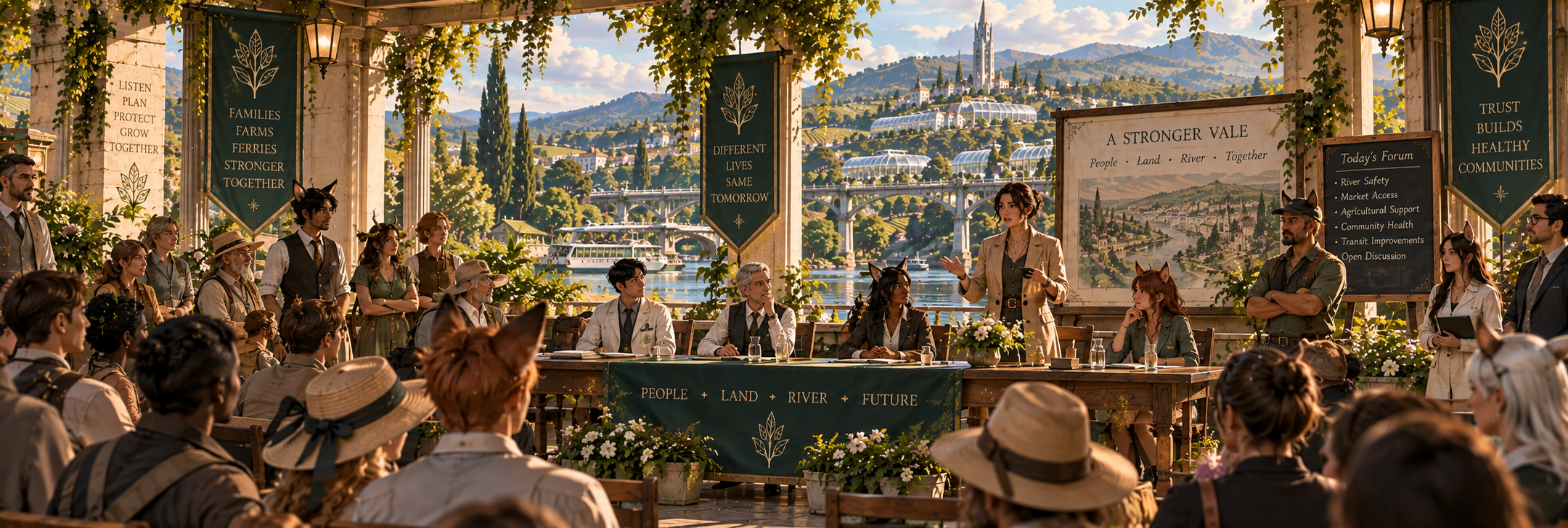
Regional Society · Trust & Influence
Authority may come from law. Trust usually comes from something much more local.
Brazoria is highly organized, but formal office does not explain every hierarchy inside it. People decide whom to believe through regional habits built over generations. One community looks for training. Another looks at the surname. Another checks the record. Somewhere else, the only qualification anyone cares about is whether the person has handled this exact problem before.
Upper Vale
Technical knowledge earns unusual social authority upriver. Farmers may defer to an irrigation engineer during a water problem, while the engineer defers immediately to a grower who has worked the same soil for forty years. Expertise is not always academic, but people expect it to be demonstrable.
Green House Country
Old households accumulate trust through continuity. A respected Green House may be assumed responsible because generations of local residents remember its clinics, employment, land stewardship or philanthropy. That reputation can be deserved. It can also give a powerful family enormous benefit of the doubt when something inside the household deserves much closer examination.
Station Basin
Metropolitan Brazoria relies heavily on professional status. Physicians, attorneys, administrators, researchers and certified specialists routinely make decisions for people they have never met. This allows the Basin to function at enormous scale. It also means a properly credentialed person may receive trust before anyone has learned enough about them to know whether they deserve it.
Larkspur Crossings
Familiarity carries weight here. A known ferry captain, teacher, physician, shop owner or estate worker may be trusted because people have watched them live in the community for years. Introductions frequently begin through shared relationships. The local network is wonderfully supportive when someone belongs to it and extremely difficult to disappear inside.
The Low Reeds
Lower-river trust is unusually practical. Titles lose prestige quickly beside broken machinery, rising water or a stranded ferry. Communities remember who brought supplies, who repaired the levee, who knew the safe channel and who disappeared when work became unpleasant. Reliability becomes a kind of local currency.
Trust Is Not Power
A household companion may be trusted with children, medical routines, private family information and the keys to an estate greenhouse while possessing almost no independent legal authority. A demi-human river worker may know a channel better than every human official standing beside it and still require permission to travel beyond their assigned route. Brazoria is comfortable giving people responsibility without necessarily giving them rights.
When Systems Disagree
Problems become especially volatile when a database says one thing and an entire community believes another. A flagged companion may still be someone's childhood friend. A respected estate may suddenly appear in a leaked custody record. A local worker everyone trusts may have paperwork that no longer clears. In 2097, Brazoria is encountering more of these collisions than it likes.
The most powerful question in Brazoria is not always “Who has authority?” Sometimes it is “Who will people believe?”
Every region has its own answer, and those answers become especially dangerous when trust begins pulling in one direction while the law pulls in another.
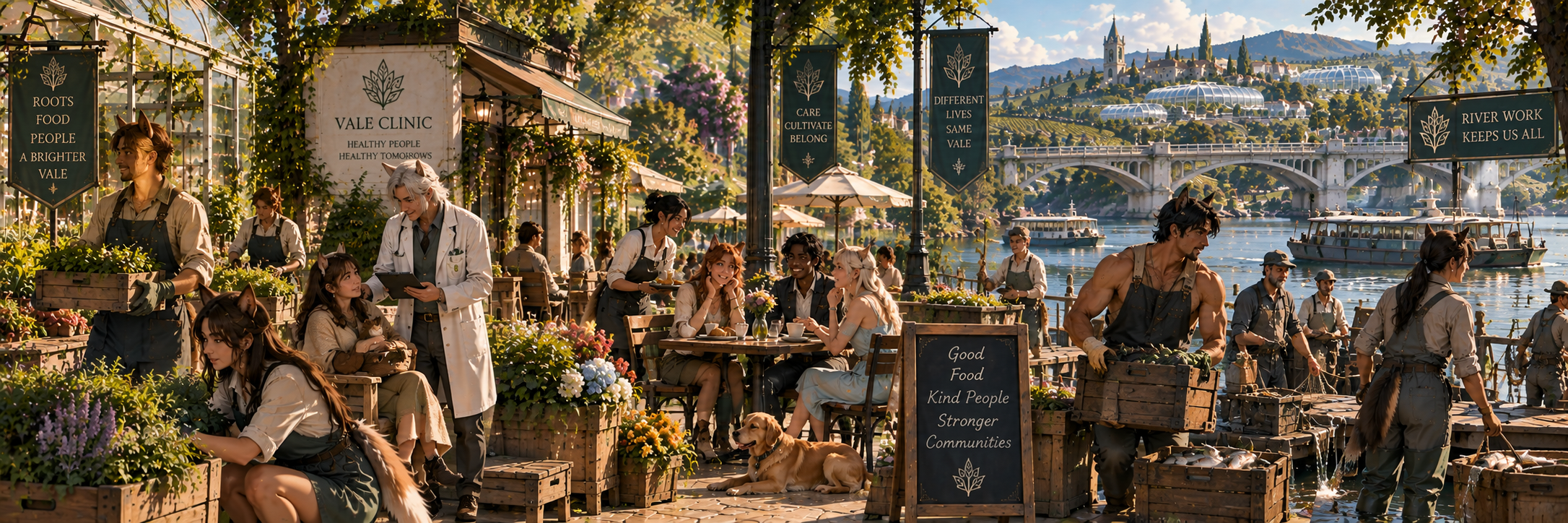
Demi-Human Life · Regional Experience
National law may classify people in the same broad categories. Geography decides what those categories actually feel like from morning to night.
A demi-human born in Green House Country, raised beside a family in Larkspur, employed through an Upper Vale agricultural program or assigned to a Station Basin clinic may share the same basic lack of independent civic personhood. Their actual lives can still be almost unrecognizably different. Brazoria regulates status nationally, but care, work, household culture, mobility and social visibility are profoundly local.
This is one of the reasons Brazorians resist simple descriptions of their country. Some companions have private bedrooms, friends, hobbies, excellent healthcare and families who adore them. Some institutional wards live highly supervised lives inside research or medical systems. Some river workers spend their days outdoors with crews who trust them completely. Some people move between several of these worlds over a lifetime. The legal framework stays remarkably consistent even when the lived experience does not.
Upper Vale
Demi-humans upriver are frequently connected to agricultural estates, environmental programs, research facilities, conservatories or specialized river work. Species-linked abilities may be framed as expertise or natural contribution rather than labor classification. Housing can be comfortable and work highly skilled, but movement often remains tied to the institution, estate or custodian responsible for them.
Green House Country
Estate and domestic companions may grow up alongside human children, attend family celebrations, travel with the household and become woven into generations of private family history. Many are sincerely loved. That intimacy can make the legal distinction between family member and family possession difficult to discuss because everyone involved may insist the relationship is already good.
Station Basin
The central metro contains domestic companions, institutional wards, research residents, clinic-held populations, river workers and people attached to corporate or medical systems. Daily life can be highly comfortable and technologically accommodating. It is also where a person is most likely to experience themselves through appointments, access permissions, digital records and institutional classifications.
Larkspur Crossings
Companions, farm workers, estate residents and ferry-linked demi-humans are unusually visible in local community life. A person may be known by name at the café, recognized by teachers and greeted by neighbors who watched them grow up. That familiarity can create genuine belonging while quietly reinforcing the expectation that somebody also knows the household, estate or institution they are attached to.
The Low Reeds
Aquatic, wetland and waterbird demi-humans are common around ferries, drainage crews, flood-control work, fish markets and river maintenance. Formal oversight exists, but geography makes clean supervision difficult. Communities are smaller, routes change and unofficial arrangements survive more easily. Some undocumented families, escaped companions and River-Run contacts disappear into this complexity because the river has never respected paperwork particularly well.
What Brazoria Protects
Good housing, food, healthcare, grooming, recreation, morphology accommodation and social contact are considered legitimate responsibilities of stewardship. A household or institution that neglects these duties can face public criticism or legal consequences. Brazoria takes welfare seriously enough that many residents sincerely view the system as compassionate.
What Care Does Not Automatically Grant
Private residence, unrestricted travel, independent finances, property ownership, equal marriage rights, custody-free adulthood and full bodily autonomy do not necessarily follow from good treatment. A person can be cherished, accommodated and protected while still requiring somebody else's authorization to make decisions another adult would consider ordinary.
The difference between a good life and a free life is easy to ignore until somebody asks for something the system cannot authorize.
Brazoria's regional differences matter because people are not living legal categories. They are living childhoods, friendships, workdays, romances and ordinary Tuesdays inside them.

Demi-Human Life · Permission & Control
Most Brazorian control is designed to disappear during ordinary life. It becomes noticeable when someone tries to move beyond what has already been approved.
Brazoria rarely needs walls around every demi-human household, guards on every street or visible restraint at every door. The system works more elegantly than that. Identity bands, transit permissions, household records, institutional status and biometric access handle most restrictions quietly. When authorization is valid, the gate opens. The ferry boards. The clinic accepts the appointment. Life feels almost frictionless.
The structure becomes visible when a person steps outside the expected pattern. A companion travels without the household. A research ward appears beyond an approved district. A ferry record does not match the custodian file. A familiar name suddenly returns a white status light instead of green. Nothing about the environment needs to become violent. The same beautiful gate simply stops opening.
Green House Country
Estate companions may move freely across gardens, village shops, local clinics and familiar roads because everyone already understands who they are attached to. The restriction appears when travel extends beyond the household's informal sphere and formal permission becomes necessary.
Station Basin
Metropolitan life depends on digital access. Transit, medical care, apartment entrances and institutional spaces all verify identity quietly. A person can move through the Basin for years without experiencing an obvious confrontation, right up until one field in one database changes.
Upper Vale
Research-attached and agricultural demi-humans often have broad access within the environments where they work. Permission may cover laboratories, fields, river stations or estate transport. That can feel like ordinary professional mobility until someone attempts to travel somewhere unrelated to the role that justified access.
Larkspur Crossings
The local network itself becomes part of enforcement. A companion traveling alone may draw attention not because anyone is actively hunting them, but because somebody knows they normally travel with another person. Familiarity makes approved movement easy and unexpected movement memorable.
The Low Reeds
Lower-river travel requires ferries, work boats, levee roads and routes that may change with flood conditions. Control therefore becomes more physical and route-specific. Dock permissions, vessel logs and crossing records matter enormously, but the geography also produces blind channels and temporary routes that no centralized system can perfectly predict.
Approved Movement
A household companion traveling with family may pass through a ferry gate almost identically to the humans beside them. Their authorization clears automatically. Nobody stops talking. Nobody looks frightened. The mechanism of control is present, but successful compliance makes it socially invisible.
Status Change
A denied or flagged authorization interrupts that normal rhythm immediately. Staff become attentive. The traveler waits. Nearby passengers notice. A quiet secondary review begins. Brazoria does not need a dramatic public arrest to remind someone that their movement was never entirely theirs to begin with.
Pecos builds restraints you can see. Brazoria builds permissions you almost never notice.
The leash is easiest to forget when it is long, comfortable and rarely pulled. That does not mean it is gone.

Breeds & Lineage · Regional Associations
Some bloodlines become associated with a region so strongly that people begin speaking about biology as though it were geography.
Brazoria has documented demi-human ancestry for generations. Old households remember companion lines. Agricultural programs record specialized traits. Estate archives preserve pedigrees beside property deeds and family histories. Over time, certain species and breed lines become culturally associated with particular parts of the country, not because they belong there by nature, but because generations of work, family placement, migration and selective breeding made them familiar.
A Brazorian may casually associate an otter line with the lower river, a household dog lineage with Larkspur or an old deer family with Green House country. These associations can carry affection, prestige, stereotype and economic expectation all at once. They should never be mistaken for personality. A bloodline tells someone about ancestry. Brazorian society often tries to make it tell them much more.
Upper Vale
Pollinator species, climbing animals, nocturnal harvest lines, water-management species and highly documented agricultural bloodlines appear frequently in upriver institutions. Some have lived beside the same research estates for generations. Others were intentionally brought into programs because a particular morphology was considered useful to farming, irrigation or conservation.
Green House Country
Old estates often maintain long associations with particular dog, cat, deer, bird or small companion lines. A family may speak proudly of having cared for the same lineage for a century. Pedigree books sometimes record companion births beside human marriages and estate inheritance, producing a disturbing intimacy between family history and ownership history.
Station Basin
Brazor Station and its surrounding corridor contain the country's widest visible mix of species, breeds and hybrid backgrounds. Medical systems, universities, corporate transfers and internal migration bring lineages together that might rarely meet elsewhere. Designer crosses, uncertain ancestry and rare expressions are therefore far more visible here.
Larkspur Crossings
Domestic dog breeds, deer lines, agricultural species, waterbirds and river-linked families appear throughout the crossings. A companion lineage may become associated with one estate, one village or even one surname. Residents sometimes recognize species traits before remembering a person's actual name, which says something about how deeply breed language sits inside ordinary social life.
The Low Reeds
Otter, heron, crocodilian, beaver, turtle, eel and other aquatic or wetland-associated lines have long histories along the lower Brazor. Some work river infrastructure. Some belong to families who have lived near the same channels for generations. Official records may describe them by labor usefulness, while local memory remembers who taught whom to pilot through spring floodwater.
Regional Association
A lineage becoming common in one region may result from estate preference, historical placement, agricultural demand, old migration routes or deliberate breeding programs. Brazoria often talks about these patterns as though the landscape naturally produced them. History usually has more paperwork involved.
Individual Identity
A heron demi-human is not automatically patient. A Great Dane is not automatically loyal. A fox is not automatically clever. Regional stereotypes can become socially powerful precisely because people stop noticing how often actual individuals refuse to cooperate with them.
A pedigree can explain where a family came from. Brazoria has a habit of treating it as an explanation for where that family should remain.
The Vale remembers its famous lines lovingly, commercially and institutionally, which makes ancestry one of the few subjects that can sound like family history and inventory at the same time.
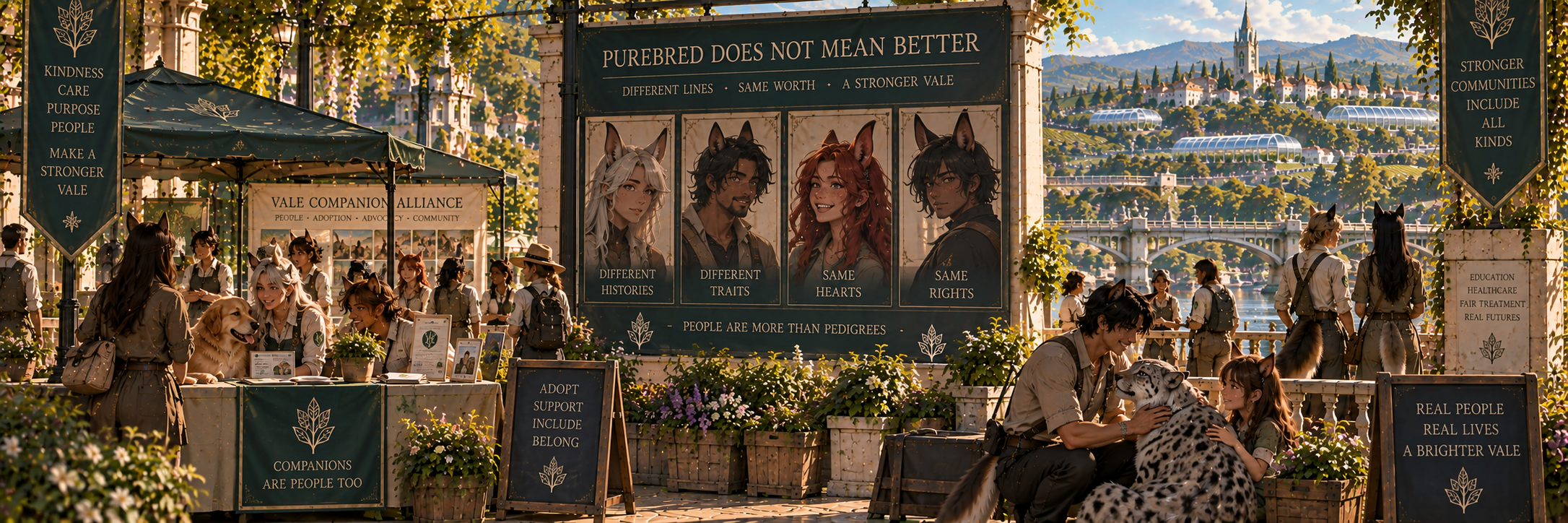
Breeds & Lineage · Classification
Pedigree describes documentation. Brazorian culture keeps trying to turn it into value.
In Brazoria, purebred has a precise practical meaning: documented ancestry from a single recognized lineage. It does not mean healthier, more attractive, more intelligent, more stable or more deserving. Those assumptions come from social prestige, market history and household tradition rather than biology.
Most Brazorians understand the technical distinction. That does not prevent pedigree from carrying status. An old Green House may boast about a line preserved for generations. A breeder may advertise documented ancestry. A household may pay more for predictable morphology. A research institution may value a clean lineage because it produces easier data. None of those facts make one person more valuable than another, but the institutions surrounding them frequently behave as though they do.
Purebred
Ancestry records consistently trace back through the same recognized species or breed line. Appearance can still vary significantly between individuals. Purebred does not mean identical, rare or genetically superior. Its primary value to Brazorian institutions is predictability and documentation.
Mixed
Mixed ancestry is ordinary throughout the Vale, especially in Station Basin and densely connected river communities. A person may visibly resemble one side of the family while carrying traits from another, or show a combination that becomes obvious only through records or shifting.
Designer Mix
Some hybrid lines are deliberately created for appearance, temperament expectations, morphology or work traits. Brazorian institutions may present this as careful stewardship or lineage planning. The terminology sounds fashionable because polite culture prefers not to dwell on who actually decided that cross should exist.
Uncertain Ancestry
Files may be incomplete because of undocumented births, old transfers, migration, forged pedigrees, informal households or lost records. Uncertain ancestry does not imply poor health or instability. It simply means the classification system cannot confidently reconstruct the lineage.
Pedigree Prestige
Older families often treat a documented line as proof of continuity. Pedigree can influence placement, inheritance arrangements, household reputation and private breeding decisions. This is especially pronounced in Green House country, where human and companion genealogies may both be preserved in estate archives for generations.
Biological Rarity
A person may belong to a perfectly documented but common lineage. Another may carry an unusual hybrid expression no pedigree predicted. Rare traits can attract scientific, commercial or social interest, but rarity and purity are not interchangeable. Brazorian markets frequently blur them because rarity sells better when it can be packaged as heritage.
Upper Vale
Agricultural and research systems value documented lines because predictable physiology simplifies planning, medicine and study. A highly mixed person with useful traits may still be valued professionally, but institutional paperwork tends to prefer clean answers.
Green House Country
Old households are the most likely to treat lineage history as part of family prestige. Statements such as “our family has cared for this line for six generations” are usually meant affectionately. They also reveal exactly how thoroughly possession can be disguised as continuity.
Station Basin
The metropolitan corridor sees enough hybrids, designer crosses and unusual ancestry that pedigree carries less everyday social weight. Medical and corporate institutions may still care intensely about lineage data even when ordinary residents do not.
Larkspur & Low Reeds
Smaller communities often preserve ancestry through social memory. Someone may know a person's parents, grandparents and cousins while the official registry remains incomplete. In these places, family history can be more accurate than the database and considerably harder to correct when it conflicts with one.
Purebred tells Brazoria how cleanly a lineage can be documented. It does not tell anyone how much a person is worth.
Pedigree is useful information. Prestige is something society piled on top of it, then spent generations pretending the two were the same thing.
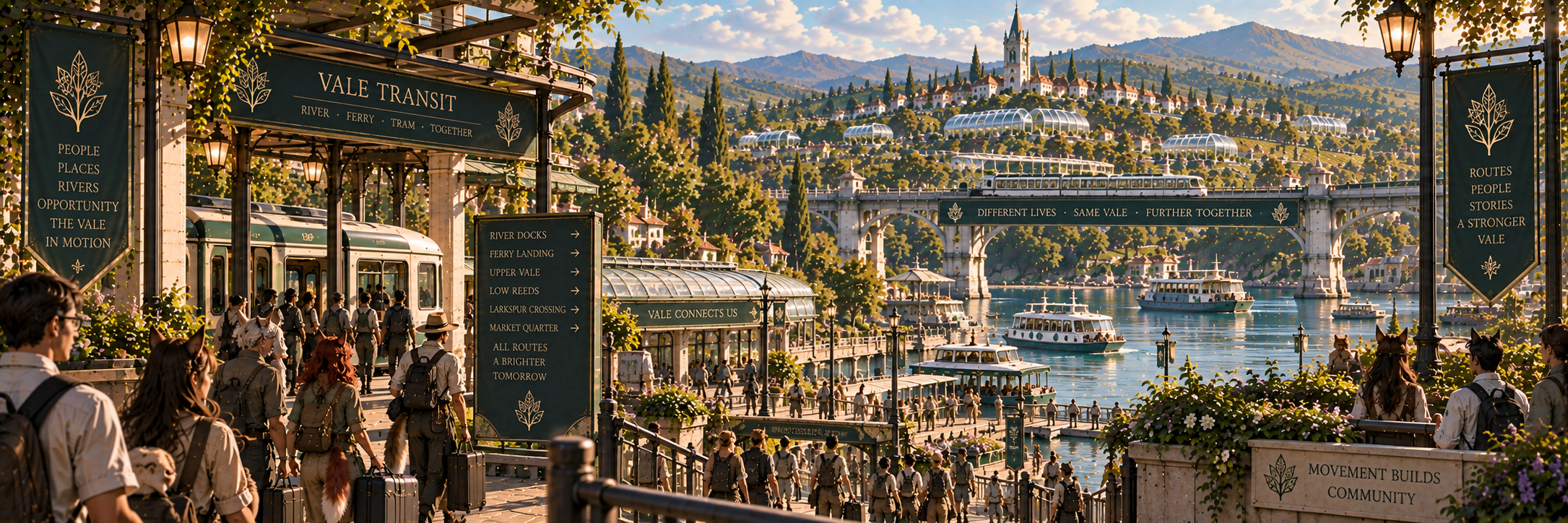
Regional Travel · Transit & Trade
Rail moves the cities. Ferries move the river towns. Roads carry the countryside between them.
Brazoria is a country built to move produce, medicine, people and information without making that movement feel difficult. Regional rail links its largest population centers. Ferries stitch together communities divided by the Brazor and its branches. Maintained roads slip through estate country and agricultural belts. Barges carry freight downstream. Small transit lines connect places that would barely register as towns anywhere else.
The result is a country that feels unusually connected for a landscape dominated by farms, wetlands and river corridors. A resident can leave a quiet orchard settlement in the morning, reach Brazor Station by midday and return home before dark. A clinic can receive a patient from three regions in a single afternoon. Fresh produce may cross a ferry, rail platform and city market before most people have finished breakfast.
Regional Rail
Rail carries commuters, students, medical staff, researchers and ordinary travelers between the Station Basin, Upper Vale and major regional centers. Trains are clean, frequent and integrated with local transit. Agricultural freight uses separate or shared corridors depending on route and season, keeping produce moving without overwhelming passenger systems.
River Ferries
Ferries are essential throughout Larkspur, estate country and the Low Reeds. Some carry only passengers and bicycles. Others move vehicles, produce crates, maintenance crews and small agricultural loads. In communities built around a crossing, the ferry schedule can shape school mornings, work shifts, shopping days and social life.
Regional Roads
Brazorian roads are generally well maintained and deliberately integrated into cultivated landscapes. Tree-lined routes pass orchards, research fields, estate walls and river overlooks rather than cutting the countryside into endless asphalt. Major roads are sensor-equipped, but the technology is usually subtle enough that drivers barely notice it.
Estate Transport
Large Green Houses operate private shuttles, river launches, service vehicles and dock access for staff, household members, companions and agricultural operations. Some estate transport networks are extensive enough to function almost like local transit systems, particularly where one holding covers several villages or large stretches of farmland.
Medical Transport
Specialist clinics and hospitals rely on scheduled medical shuttles, ambulance routes, river access and priority rail connections. Remote agricultural communities may be physically distant from major hospitals without being medically isolated. Brazoria takes considerable pride in getting a patient from field, ferry or estate to advanced care rapidly.
Agricultural Freight
Produce, flowers, seed stock, medicines, greenhouse crops and processed food move constantly toward packing centers, river depots and urban markets. Harvest season changes traffic patterns across entire regions. A road that seems sleepy in early summer may become a continuous procession of freight vehicles once orchards begin emptying.
Upper Vale & Station Basin
Research, medicine and business depend on predictable schedules. Rail and express road corridors dominate travel between campuses, laboratories and the national metro. Missing a connection is irritating because residents are accustomed to the system working.
Larkspur & Low Reeds
Farther downstream, transit becomes more dependent on water level, ferry routes, weather and local knowledge. Infrastructure is sophisticated, but nobody pretends geography has been defeated. When the river changes, transportation changes with it.
Brazoria grew rich by learning how to keep the Vale moving without making movement feel like work.
Every region has its preferred way to travel, but nearly every journey eventually touches water, agriculture or the systems built to keep both flowing.

Regional Travel · Access & Authorization
For most humans, travel means deciding where to go. For a demi-human, the same journey may also require the system to agree.
Brazorian transportation is designed to feel easy. Tickets load onto wrist-comms. Ferries verify passengers while they approach the gate. Rail platforms confirm identity automatically. Estate shuttles recognize household members before the doors open. For human citizens, this is simply convenience. For demi-humans, the same infrastructure can quietly check whether the journey falls inside an approved life.
A companion traveling with their household may experience almost no friction at all. The family buys tickets, luggage is loaded, children argue over snacks and the authorization clears in the background. Nobody announces that one traveler required custodial permission while another did not. Brazoria prefers the distinction to disappear inside good service.
Human Citizen
Most domestic travel requires little more than valid civic identity and payment. A human adult can decide to take a train to Station Basin, visit Larkspur for the weekend or board a regional ferry without asking another private person for permission.
Domestic Companion
Travel may be automatically attached to a household itinerary, custodian account or approved personal range. A companion regularly included in family vacations may experience this as entirely routine. Difficulty appears only when the journey no longer matches the household's authorization.
Institutional Ward
Research, medical and institutional residents may travel for appointments, work, supervised recreation or approved visits. Their access can be broad while still remaining purpose-linked. A train gate does not need to know why the distinction matters. It only needs the permission field.
Estate Companion
Wealthy households often maintain generous travel privileges for long-term companions. Private vehicles, estate ferries, first-class rail and vacation permits may make movement exceptionally comfortable. The arrangement can feel almost unrestricted until someone attempts to travel independently of the household that made it possible.
When Everything Matches
A beloved demi-human companion may sit beside the family on a train, carry their own luggage, order food, choose a seat and complain about delays like everyone else. The legal distinction between them and the human adult across the aisle may never become visible during the entire journey.
When Something Does Not
An expired permission, changed custodian record, unexpected destination or mismatched travel status can interrupt the journey instantly. A gate stays closed. A ferry attendant asks for confirmation. A secondary review begins. The environment remains courteous. The traveler simply stops moving.
Pecos builds restraints you can see. Brazoria builds permissions you almost never notice.
The most effective border in Brazoria is often not a wall at the edge of the country. It is a beautiful gate someone has passed through a hundred times, right up until the day it decides not to open.

2097 A.E. · Regional Tensions
Nothing has collapsed. Trains still arrive, clinics still open and markets still fill every morning. What has changed is the number of people beginning to notice when the records do not match the life in front of them.
Brazoria Vale remains wealthy, productive and politically functional in 2097 A.E. Its instability is quieter than open rebellion. Permissions are tightening. Old custody files are being reviewed. Foreign courts are demanding records. Companions disappear from households that insist nothing unusual happened. River Authority patrols linger longer at familiar crossings. Families who once trusted the national databases without question have begun comparing those records against what they personally remember.
The pressure does not fall evenly. Every region has its own point of strain, shaped by the institutions and relationships that normally make life there feel stable. A problem that appears as a laboratory discrepancy upriver may become an inheritance scandal in estate country, a database breach in Station Basin, an empty chair in Larkspur or a missing boat down in the reeds.
Upper Vale
Agricultural institutes, conservation programs and biological research centers hold enormous quantities of ancestry and morphology data. Increased scrutiny has exposed mismatches between modern files, older research archives and privately maintained records. Restricted projects involving unusual lineages are drawing uncomfortable attention from foreign observers and domestic whistleblowers.
Green House Country
Estate archives contain custody histories stretching back generations. Some do not align cleanly with national databases. Others contain informal household arrangements never meant for outside examination. Inheritance disputes are beginning to expose transfers, births and lineage decisions that respected families would strongly prefer remain classified as private matters.
Station Basin
Brazor Station holds the country's greatest concentration of medical, corporate and administrative data. Purity Grid leaks, altered records, internal audits and employee disclosures have made the Basin the center of Brazoria's classification anxiety. The nightmare for major institutions is not that the system contains errors. It is that somebody may prove how many people already knew.
Larkspur Crossings
Social familiarity creates its own evidence. A companion who no longer visits the market, a ferry worker transferred without warning or an estate household that suddenly changes its routine becomes community gossip almost immediately. Increased crossing scrutiny has made disappearance harder to explain with paperwork alone.
The Low Reeds
Damaged sensors, temporary channels, undocumented boat traffic and River-Run activity have forced authorities to increase lower-river monitoring. Floodwater routinely changes the geography faster than databases can update it. Officials describe the resulting gaps as security weaknesses. Local workers describe them as the river doing what it has always done.
Foreign Pressure
Thornwyck legal teams increasingly challenge custody records, lineage transfers and the treatment of sanctuary-bound demi-humans. Veyrhalden-linked routes complicate river enforcement. Other governments are demanding documentation Brazorian institutions once expected to remain domestic. A polite administrative dispute can now become a diplomatic incident before lunch.
Domestic Pressure
One irregular file is easy to dismiss. Ten families comparing nearly identical irregularities are not. Researchers, ferry workers, household staff, doctors, estate clerks and ordinary citizens are increasingly discovering that information kept separate by institution becomes much more revealing once people begin putting it together.
What happens when Brazoria's files stop matching the people everyone knows?
The fault lines are still quiet because most Brazorians believe the country can correct them. The real danger begins if enough people decide the contradiction was never an error.
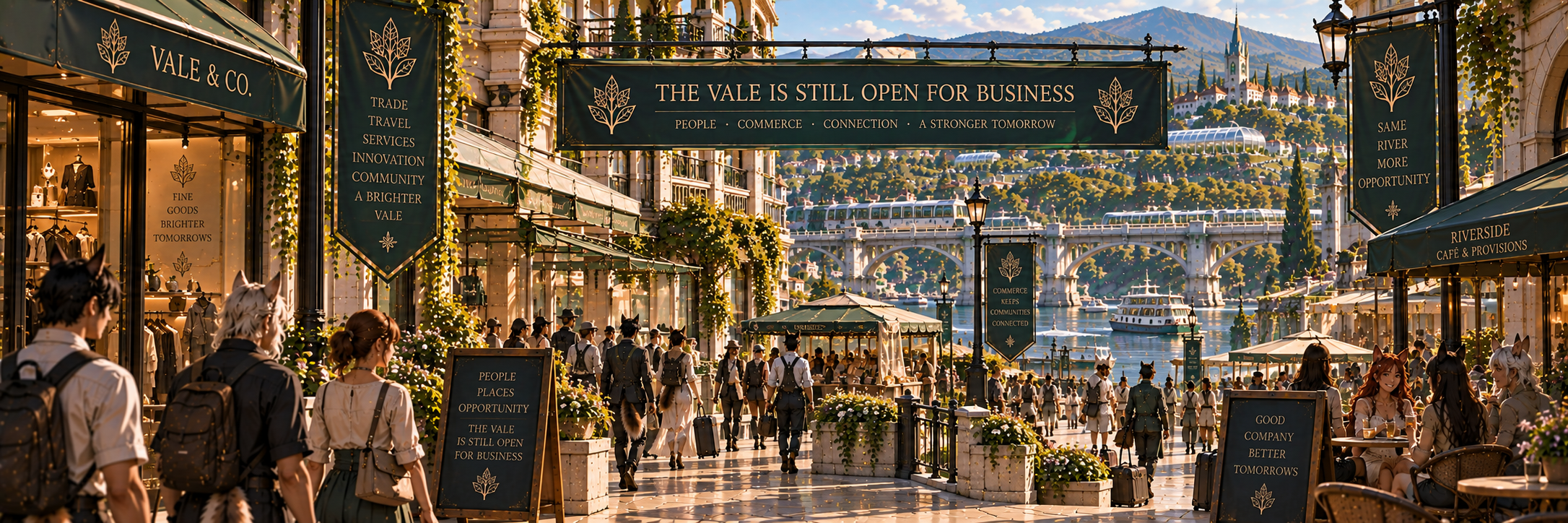
2097 A.E. · Life Continues
Political pressure makes headlines. Most mornings still begin with coffee, school runs, ferry schedules and somebody realizing they forgot to buy dinner.
Brazoria is not a country waiting behind barricades for the final act. Restaurants are booked. Universities begin new semesters. Orchards enter harvest. Estate weddings fill gardens with flowers. Ferries carry commuters home beneath sunset light. Children complain about school. Families argue over vacation plans. Companions are given birthday gifts, spoiled at cafés, taken shopping and dragged through family photographs they absolutely did not ask for.
That normalcy matters. Brazoria's contradictions survive precisely because most people experience the country through ordinary lives they genuinely value. A resident can disagree with a new security policy in the morning and attend River Renewal celebrations that evening. A household can adore its companion without considering the legal structure surrounding that relationship cruel. A physician can provide excellent care inside an institution whose custody rules they have never seriously questioned.
School Mornings
Children crowd transit stops, parents pack lunches and older siblings complain about being late. Human and demi-human household members may grow up side by side, share routines and spend years treating one another as family before either understands how differently the law will treat their adulthood.
Markets & Cafés
Regional markets are full of produce, flowers, prepared food and neighborhood gossip. Café workers know regular orders. Ferry crews stop for breakfast. Household companions accompany families through ordinary errands. Nothing about these scenes needs to be false for the larger structure to remain unequal.
Harvest Season
Orchards, fields and greenhouse belts dictate regional rhythms more reliably than politics. Harvest brings seasonal workers, freight traffic, estate gatherings, market festivals and long shifts across agricultural communities. For weeks at a time, a local argument about crops can matter far more than anything happening in the capital.
Family Life
Human households love one another imperfectly and sincerely. Many love demi-human companions with equal sincerity. They celebrate birthdays, grieve losses, remember childhood stories and refer to companions as sons, daughters, brothers, sisters or family. The emotional bond may be entirely real even when the law refuses to recognize equality beneath it.
River Festivals
River Renewal celebrations, local fairs and seasonal markets continue drawing large crowds. Food stalls, music, ferries, civic displays and family traditions turn the river into a place of celebration rather than control. Patrol drones may watch overhead. Most people below are too busy finding dessert to care.
Ordinary Work
Clinics treat patients. Engineers inspect locks. Mechanics repair ferries. Researchers complain about funding. Estate gardeners fight mildew. Restaurant managers argue with suppliers. The current crisis has made Brazoria more nervous, not incapable. Daily competence is one of the reasons the country remains so resilient.
What Is Tightening
Movement permissions receive more scrutiny. Private security is increasing around wealthy estates. Record audits happen more frequently. River patrols ask more questions. Research institutions seal more files. Families accustomed to effortless systems occasionally discover that a familiar process now requires one additional confirmation.
What Has Not Changed
That expectation may be Brazoria's greatest source of stability. Most citizens are not preparing for collapse. They are planning careers, marriages, harvests, birthdays and weekends away. Even people disturbed by recent events often believe reform, better administration or a corrected database will solve the problem without requiring them to reconsider the society underneath it.
Brazoria is not falling apart. It is becoming less comfortable pretending everything already fits.
The Vale remains beautiful, prosperous and deeply loved. Whatever comes next will matter precisely because so many people believe what they already have is worth preserving.
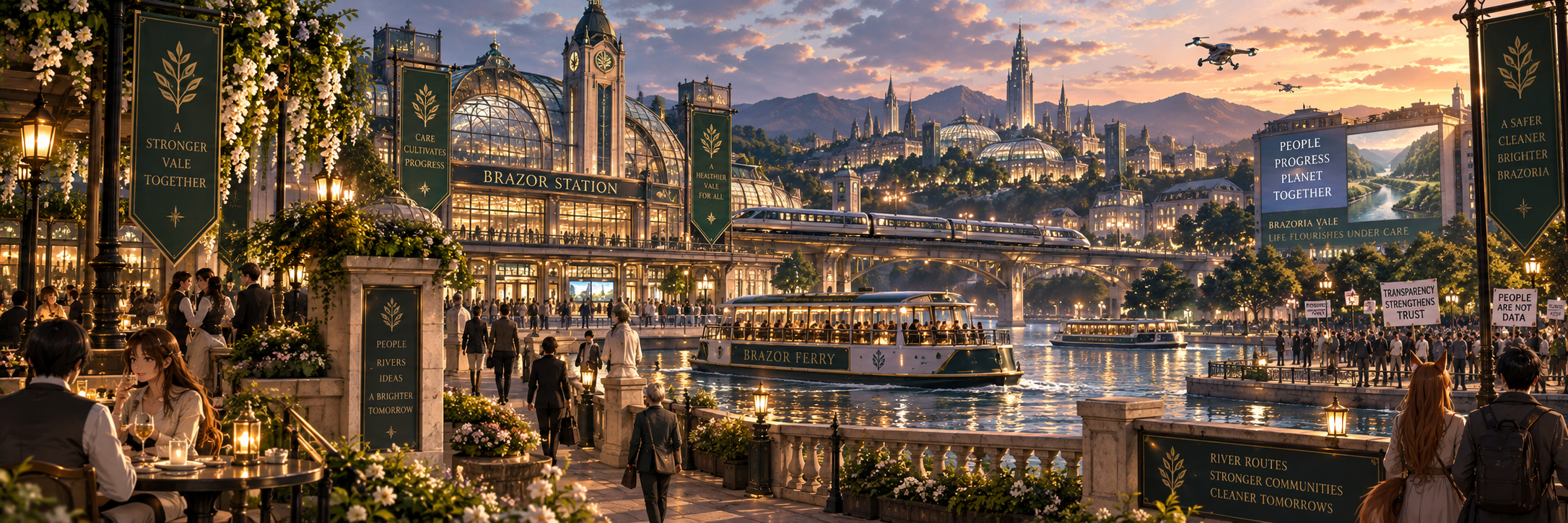
Brazoria Vale Today
The fields are green. The hospitals are excellent. The ferries are full. The country would very much like everyone to stop asking why so many records suddenly require review.
Brazoria Vale enters 2097 A.E. from a position of strength. Agricultural output remains high. Its medical institutions are respected across human-aligned Vistall. River commerce continues, research campuses expand and Green House estates still host weddings beneath flowering conservatory glass. Visitors arriving in Brazor Station do not encounter a nation in visible crisis. They encounter one of the continent's most comfortable places to live.
The trouble exists underneath that success. A major Purity Grid leak has placed old transfers and sealed lineage records under scrutiny. Heritage conservatories resist outside inspection. Thornwyck courts demand documents Brazorian institutions once considered private. Estate companions disappear. River Authority patrols increase. Researchers whisper about biological markers that should not exist. Students ask questions their parents were taught never required asking.
The Purity Grid
Brazoria helped refine one of Vistall's most influential biological classification systems. That makes every disputed pedigree, altered sample and contradictory lineage file more than a technical error. The Vale has built international authority on its ability to know what bodies are. Now the data itself is becoming contested.
Heritage Conservatories
Institutions long praised for preservation, medicine and species-specific care increasingly face questions about transfers, internal records and the people housed inside them. Some cooperate. Others insist foreign scrutiny violates Brazorian law and private stewardship authority.
The River
River Authority patrols and route verification have increased after disappearances, damaged sensors and suspected sanctuary activity. Freight still moves normally. Ferries still run. The added security is easiest to notice only if someone remembers how relaxed the same crossing felt last year.
Public Life
Markets remain crowded. Restaurants book out. Universities hold classes. Families travel. River festivals continue. Most Brazorians are not preparing for collapse and many believe current problems can be corrected through better oversight without challenging the structure beneath them.
What Brazoria Says
Official statements emphasize continuity, investigation and institutional strength. Authorities describe current events as isolated irregularities, foreign politicization, data-integrity concerns and temporary security adjustments. No national emergency has been declared.
What People Notice
One extra scan. One delayed ferry clearance. One sealed clinic file. One companion who no longer appears at the market. One respected estate suddenly hiring legal counsel. None proves a national crisis alone. Together, they are becoming harder to dismiss as coincidence.
Official position: there is no national crisis. Unofficial reality: considerably more people have started using the word “yet.”
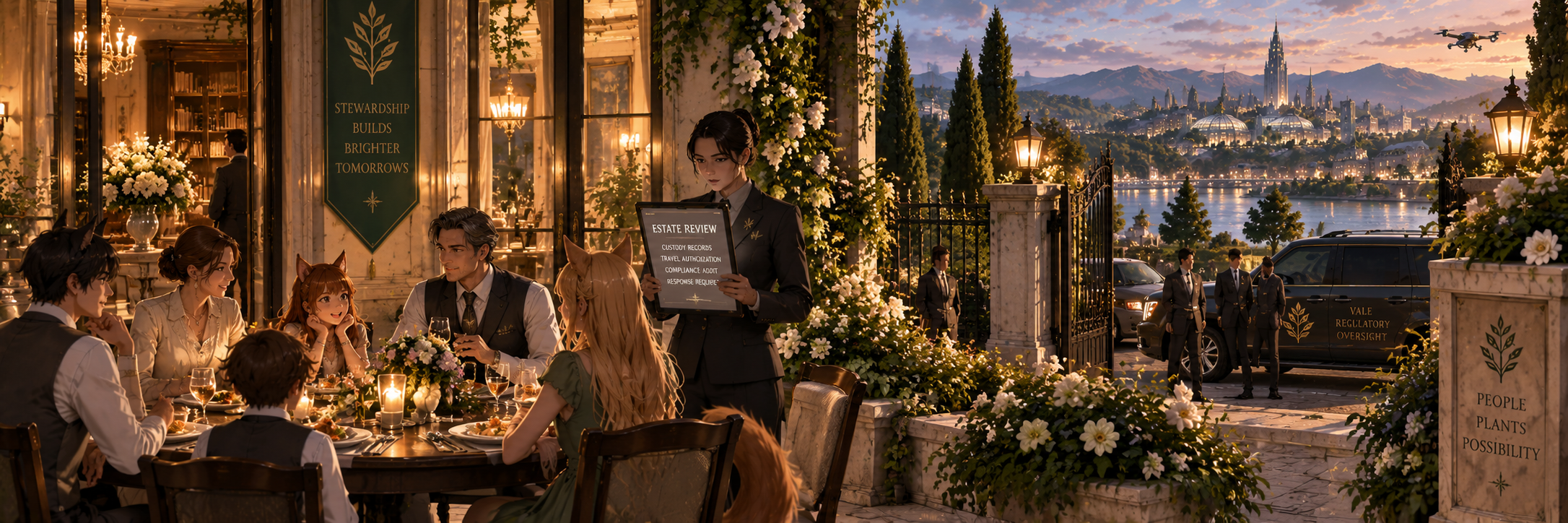
The Crisis Comes Home
For generations, many Brazorian families experienced custody law as something intimate, ordinary and private. In 2097, the state, the courts and foreign observers are beginning to look over the hedge.
Brazoria’s current instability is no longer confined to government databases or institutional boardrooms. It is entering homes. A Green House receives a request for lineage records. A companion’s usual travel authorization suddenly requires secondary approval. A clinic is ordered to retain biological samples previously treated as private. An estate administrator discovers that a custody transfer from thirty years ago does not match the modern Grid.
For families accustomed to viewing themselves as responsible stewards, this scrutiny can feel deeply invasive. Many do not see themselves as participants in an oppressive system. They see household histories, people they love and arrangements that have functioned peacefully for decades. The uncomfortable question is what happens when affection, tradition and legal ownership stop fitting together as neatly as they once appeared to.
Households
Companion records once handled quietly through household accounts are receiving greater scrutiny. Travel permissions, medical decisions, custody status and adult placement arrangements increasingly generate questions that families never expected outsiders to ask.
Green Houses
Prestigious estates often maintain records far older and more detailed than the national Grid. That can protect families when government files are incomplete. It can also reveal transfers, births, lineage arrangements and informal custody decisions never designed to survive twenty-first-century levels of cross-referencing.
Heritage Conservatories
Conservatories document health, lineage, fertility, behavior and placement extensively. Records intended to demonstrate excellent stewardship are now being requested by lawyers, investigators and foreign governments asking a different question: excellent care under whose authority?
Clinics
Brazorian medicine relies heavily on detailed biological records. As Purity Grid confidence weakens, clinics are being asked to preserve samples, verify older classifications and disclose records connected to contested custody or ancestry cases.
Universities
Students and junior researchers increasingly encounter leaked data, foreign legal arguments and testimony from escaped demi-humans. Questions once dismissed as activist rhetoric now appear in ethics seminars, research meetings and medical classrooms.
Ordinary Workers
Ferry attendants, clinic staff, household administrators, transport workers and regional clerks are receiving new verification requirements. Most changes appear individually minor. Together they make ordinary life feel slightly more supervised than it did before.
Why Families Resist
A companion may have been present for births, funerals, illnesses, weddings and childhood milestones. A household may sincerely consider them family. When an outside authority describes the same relationship through custody terminology, many Brazorians experience the description itself as insulting.
Why Scrutiny Persists
A person can be cherished and still lack independent control over residence, travel, finances, medical decisions or adulthood. Current investigations increasingly focus on that gap, especially when a supposedly happy companion leaves without permission or asks a foreign court not to be returned.
Domestic pressure is politically dangerous precisely because it forces Brazorians to examine relationships they have never understood as political.
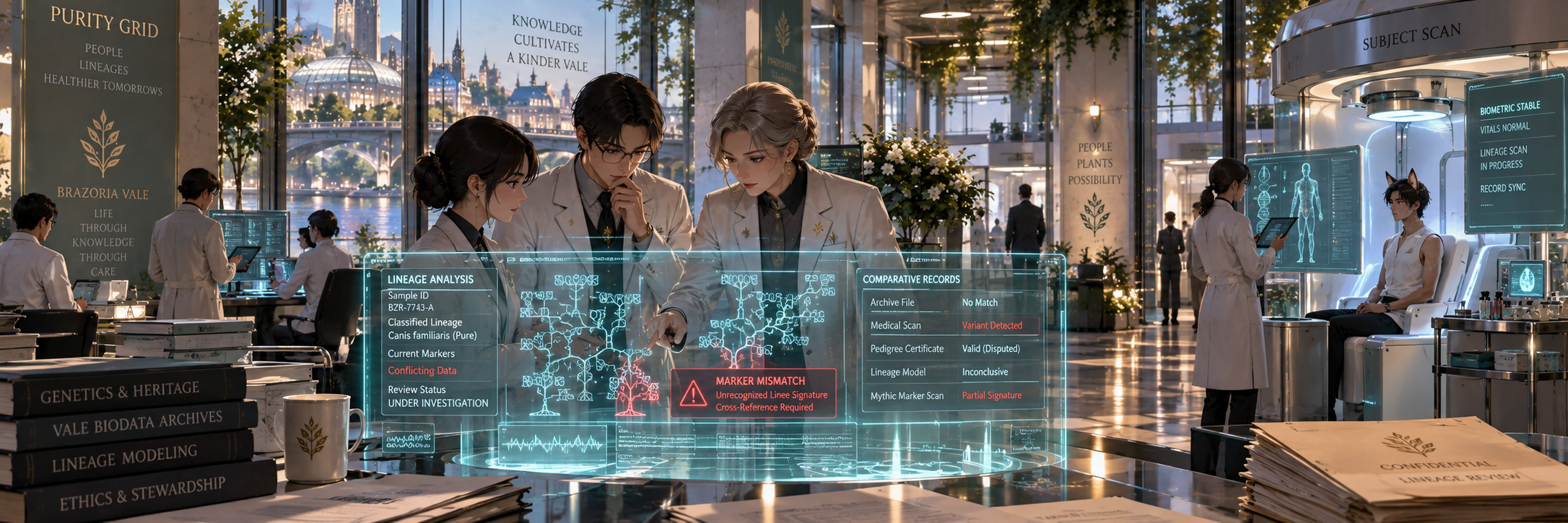
System Confidence Under Review
Brazoria built authority on the promise that biological classification could produce certainty. The problem is not that the Grid has stopped working. The problem is that it keeps producing answers people can no longer assume are true.
The Purity Grid remains one of the most sophisticated ancestry and biological-status systems in Vistall. Millions of records still resolve cleanly every day. Hospitals retrieve lineage information. estates verify pedigrees. Border systems confirm status. Conservatories track hereditary traits. Researchers model inheritance with extraordinary precision. That continued functionality is exactly what makes the current crisis dangerous.
A broken machine can be replaced. A trusted system that remains useful while producing disputed classifications is much harder to confront. Brazoria now faces leaked transfers, conflicting lineage files, altered samples, pedigree certificates that contradict medical scans, hidden ancestry, erased records and rare biological markers that official histories insist should not exist. Each case can be explained individually. Together, they weaken the premise on which the entire system rests.
Conflicting Records
Older estate archives, medical databases, conservatory records and modern Grid classifications do not always agree. Some discrepancies are mundane administrative errors. Others involve ancestry, custody or biological traits important enough to change legal status.
Pedigree Disputes
Purebred certificates once treated as authoritative are being compared against newer genetic scans. In some cases, famous lineages appear less clean than their household archives claim. In others, modern testing may be wrong. Either possibility damages confidence.
Altered Samples
Researchers increasingly encounter sample histories that cannot be reconstructed cleanly. Storage gaps, contradictory timestamps and disputed laboratory chains create a disturbing question: are the errors accidental, or has somebody deliberately shaped what the Grid believes?
Hidden Ancestry
Human ancestry, mixed-species inheritance and undocumented relationships can surface generations later. A record may remain stable for decades before one birth, scan or medical event exposes markers nobody expected to find.
Ghosted Files
Resistance networks, sympathetic officials and frightened families have all learned ways to corrupt, replace or fragment identity records. A ghosted person may become harder to track, but every damaged record also creates another data point the Grid cannot explain.
Mythic Markers
Restricted analyses increasingly contain signatures associated with extinct, mythic or poorly documented lineages. Researchers publicly urge caution. Internal files use phrases such as partial signature, unresolved morphology and lineage model inconclusive far more often than officials would like.
What Officials Say
Brazorian institutions emphasize that large databases naturally contain inconsistencies. They argue that improved sampling, stronger archive standards and better verification will restore confidence without requiring structural change.
What Critics Ask
If custody, travel, inheritance and personhood decisions were built on classifications that may be incomplete or manipulated, critics argue that the problem extends far beyond database maintenance. A wrong file can become a wrong life.
The most destabilizing possibility is not that the Purity Grid knows nothing. It is that Brazoria no longer knows when the Grid is wrong.
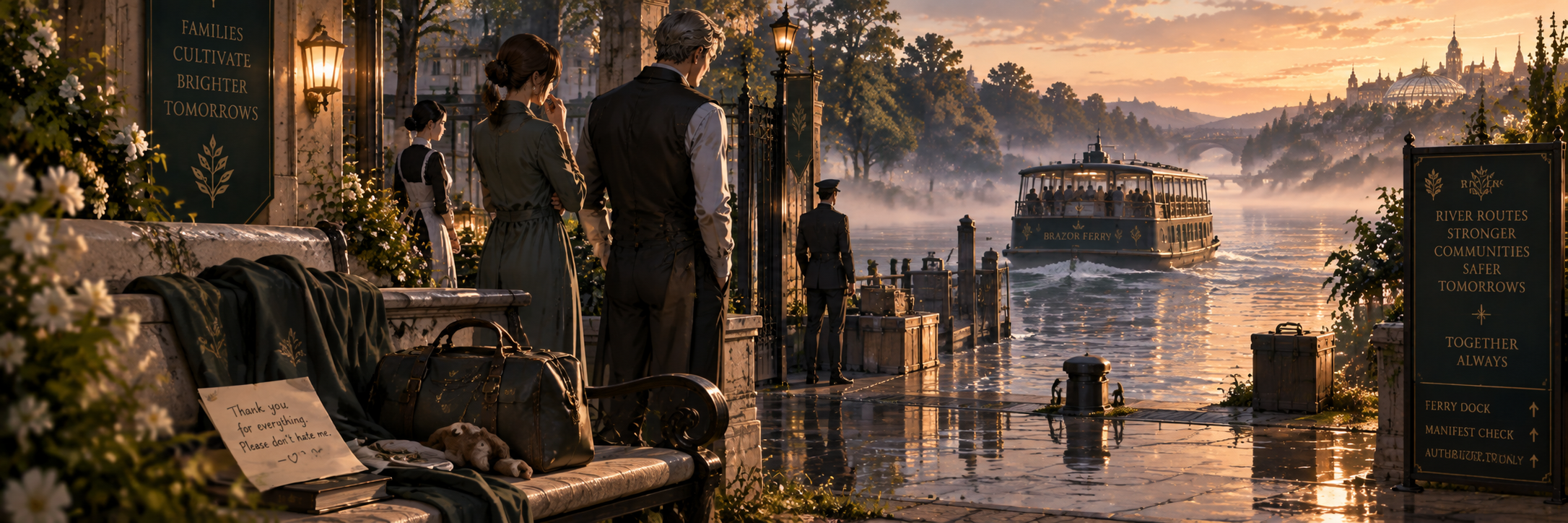
The Empty Chair Problem
The most destabilizing escape is not always the dramatic one. Sometimes someone simply fails to come home, and everyone who loved them is left trying to explain why they chose not to.
Reports of missing companions, conservatory residents, institutional wards and estate-attached demi-humans have risen across Brazoria. Some departures are quickly resolved. Some involve family disputes or unauthorized travel. Others end with a ferry manifest that does not match, an empty bedroom, a missing work assignment or a familiar person who simply stops appearing where everyone expects them to be.
These cases disturb Brazorian society for reasons that reach far beyond security. The country's stewardship culture is built around the belief that good care produces belonging. When someone leaves a household that fed them, housed them, celebrated their birthdays and called them family, the departure forces an uncomfortable possibility into the room: a person can love the people caring for them and still want a life those people do not control.
Estate Companions
Green House communities are socially dense. A long-term companion may have routines spanning the estate, village, clinic and local shops. When they disappear, dozens of people notice. The household may begin searching before official systems even register an irregularity.
Domestic Companions
Families who sincerely considered a companion one of their own may experience escape as abandonment. Parents ask what they did wrong. Siblings feel rejected. Friends become defensive. The emotional pain is real even when the person who left had legal reasons to fear asking permission.
Conservatory Residents
Medical visits, placement changes, educational programs and inter-facility transport create moments when tightly controlled residents enter less predictable spaces. Not every missing transfer is an escape, but enough have become disputed that conservatories now face greater scrutiny.
Institutional Wards
Research and medical institutions generate extensive movement records. A person who disappears from one of these systems leaves behind timestamps, access logs and transport data that investigators can reconstruct in extraordinary detail, right up until the trail suddenly stops.
River Workers
Ferry crews, maintenance workers, aquatic specialists and dock laborers understand the physical river better than most officials. Some disappearances exploit that knowledge. A missed checkpoint means little if someone knows three work channels that never touch it.
Undocumented Departures
People born outside clean national registration, living under informal arrangements or carrying damaged records can vanish with surprisingly little official trace. Their absence may survive only through relatives, neighbors or someone quietly continuing to set a place for them at dinner.
Official Language
Government and institutional reports prefer terms such as missing dependent, custody violation, unauthorized transit or irregular relocation. This language preserves the assumption that someone else's authority over the traveler remains legally meaningful.
Resistance Language
River-Run contacts, foreign sanctuary groups and abolitionist networks use a simpler word. To them, the relevant fact is not whether departure was authorized. It is that authorization was required in the first place.
Every voluntary departure creates a contradiction Brazoria struggles to absorb: someone can be cared for, loved and still decide that being unable to leave freely makes the relationship incomplete.
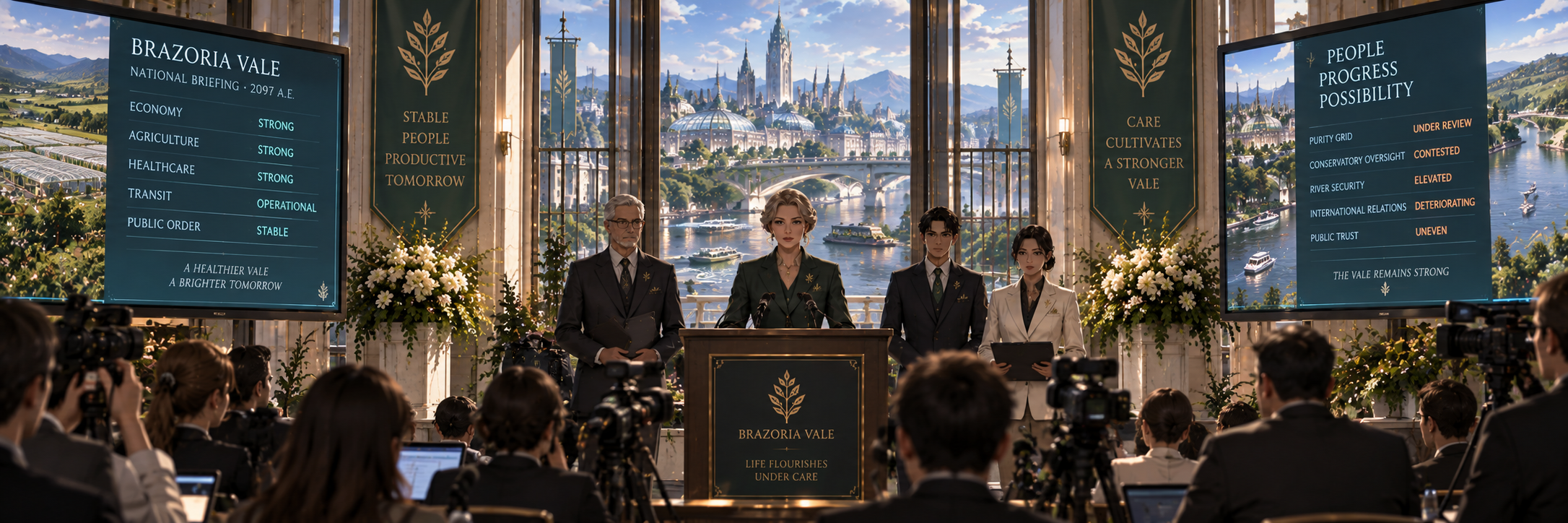
National Stability Statement
The government has evidence on its side. The economy is strong, the river is open, public services function and no emergency has been declared. None of that answers the questions making the room increasingly uncomfortable.
Brazoria's leadership rejects descriptions of the current period as a national crisis. Officials point to full hospitals rather than overwhelmed ones, crowded markets rather than empty shelves, successful harvests, functioning courts and uninterrupted transit. From an administrative perspective, these are not evasions. They are measurable signs that the state remains healthy.
The disagreement begins over what counts as instability. Foreign petitions, disputed custody claims, Purity Grid errors, missing companions and river-security increases have not stopped ordinary life. They have, however, begun forcing institutions to defend assumptions that once required no defense at all. Brazoria is therefore confronting a problem its political culture is poorly designed to name: a society can remain operational while losing confidence in the logic underneath its operations.
The Economy
Agriculture, medicine, finance and river commerce continue producing wealth. Political leaders routinely point to these sectors as evidence that reports of national instability are exaggerated by foreign critics and domestic activists.
Public Order
Student demonstrations, civic debates and reform gatherings remain overwhelmingly peaceful. Authorities have not imposed broad emergency restrictions. For most citizens, the crisis is something discussed over dinner rather than something preventing dinner from happening.
The Purity Grid
Officials characterize current discrepancies as data-integrity problems requiring technical correction. They strongly resist arguments that Grid instability invalidates the stewardship laws or custody systems built around biological classification.
Heritage Conservatories
The government emphasizes that allegations, leaked records and foreign petitions do not automatically establish wrongdoing. Conservatories continue operating while individual cases and inspection disputes move through legal channels.
River Security
Increased River Authority presence is publicly framed as a proportionate response to damaged infrastructure, unauthorized crossings and changing conditions. Ferries still run beside the patrol boats. That coexistence is central to the official narrative.
Foreign Relations
Thornwyck petitions, Veyrhalden refusals and San Aurelan pressure are described as difficult but manageable international issues. Brazoria continues participating in negotiations precisely because it insists normal political mechanisms remain sufficient.
Official Message
The state asks citizens to trust existing institutions, allow investigations to proceed and reject sensational descriptions of isolated failures as evidence of systemic collapse. This position remains persuasive to much of the population.
The Problem With That Message
Every disputed custody case touches stewardship law. Every Grid inconsistency touches classification. Every successful escape touches movement authority. Every foreign sanctuary claim touches personhood. Eventually enough isolated cases begin sharing the same foundation.
Official position remains unchanged: institutions are functioning, investigations are ongoing and no national emergency exists.
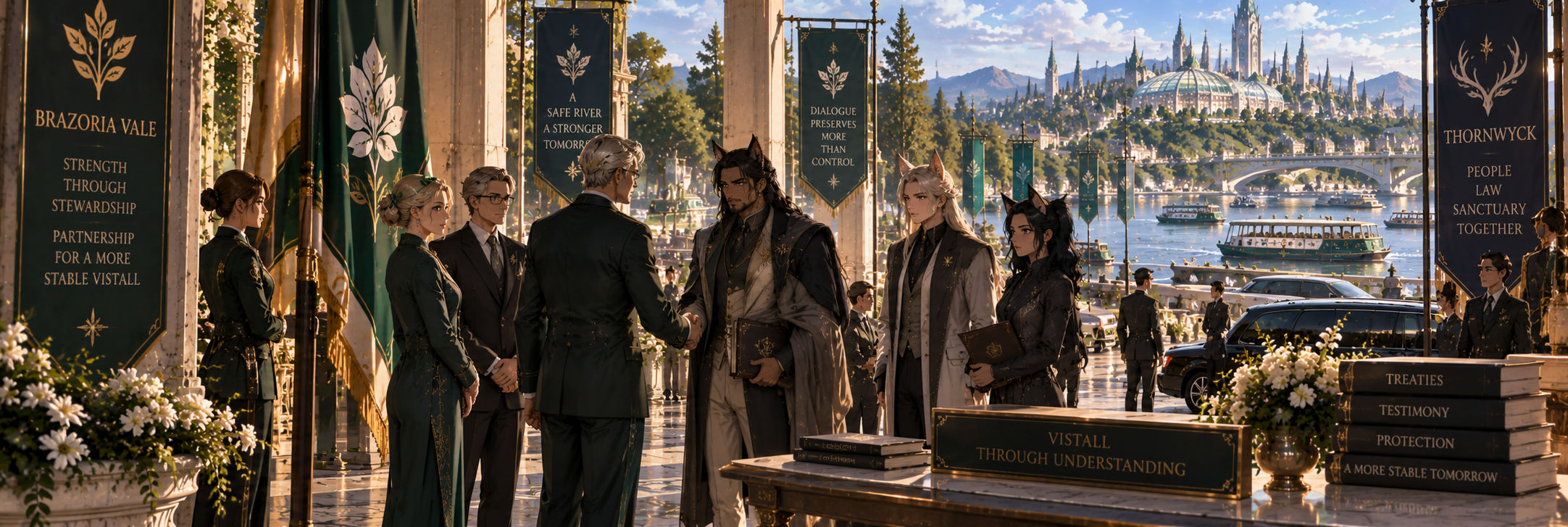
The Vale Meets the Outside World
Brazoria is accustomed to defending stewardship as a domestic system. In 2097, more of the people challenging it are standing on the other side of an international table.
Foreign pressure on Brazoria does not arrive in one form. Thornwyck sends legal delegations and demands records. Veyrhalden receives people Brazoria still considers under custody and refuses to return them. Eirwold issues rare but severe warnings over blood memory and lineage exploitation. San Aurelo, supposedly an ally, wants Brazoria to stabilize the Purity Grid before uncertainty spreads through the wider human bloc.
None of these states is asking the same question. Thornwyck challenges legality. Veyrhalden challenges possession itself. Eirwold challenges the moral legitimacy of recorded bloodlines. San Aurelo challenges Brazoria's competence. The result is a diplomatic environment where the Vale can satisfy one partner only by making another problem worse.
Thornwyck
Thornwyck's demi-human officials, advocates and legal representatives increasingly challenge Brazorian custody records, conservatory placements and sanctuary-return demands. Their argument is simple enough to make Brazorian diplomats deeply uncomfortable: welfare does not create ownership.
Veyrhalden
Escapees reaching Veyrhalden are rarely treated as recoverable dependents merely because Brazoria produces a valid custody file. Harbor councils and sanctuary authorities increasingly treat the person standing in front of them as the relevant legal fact.
Eirwold
Eirwold has little patience for purity registries, inherited custody or lineage exploitation. Its interventions are less frequent than Thornwyck's but often more severe in tone, particularly when blood memory, rare lines or old ancestry claims are involved.
San Aurelo
San Aurelo depends on reliable classification across the human-aligned states. It is therefore pressuring Brazoria to restore confidence in the Purity Grid, contain damaging leaks and prevent disputed records from undermining broader continental policy.
Brazoria's Defense
Brazorian diplomats emphasize welfare standards, medical protections, household obligations and formal legal review. They reject foreign descriptions of the system as crude ownership and argue that outside states routinely ignore the complexity of actual household and institutional relationships.
The Foreign Reply
Thornwyck and Veyrhalden representatives increasingly refuse to debate whether Brazoria treats people kindly enough. Their challenge begins one step earlier: by what authority does another adult require a custodian at all?
International pressure remains diplomatic, legal and procedural. That makes it easier to underestimate and much harder to dismiss as simple hostility.
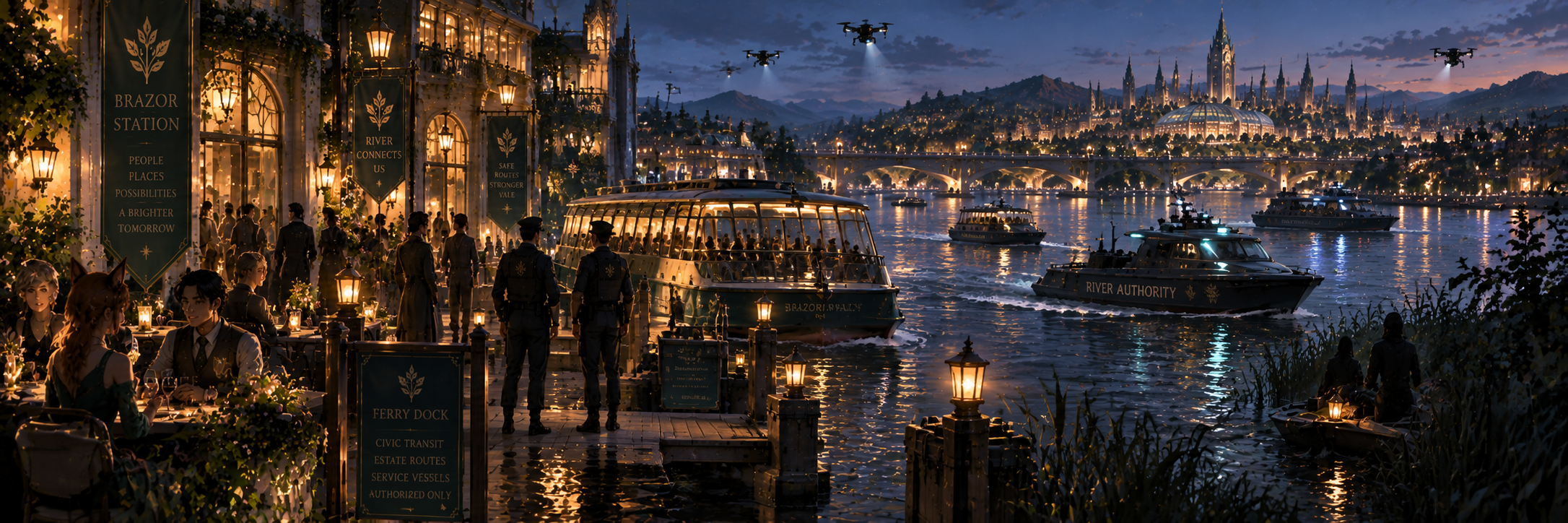
The Current After Sundown
Passenger ferries still glow against the water. Restaurants still fill their terraces. Freight still moves downstream. The difference is how many other lights now move with them.
The Brazor has always remained active after sunset. Night freight, medical transport, maintenance crews, late ferries and fishing traffic are ordinary parts of river life. In 2097, that normal traffic increasingly shares the water with additional patrol craft, surveillance drones, sensor crews and vessels whose movements appear nowhere on public schedules.
Authorities describe the increased activity as proportionate river security. River-Run contacts describe it as an escalating contest over who understands the water better. Both are partly correct. The River Authority has more technology, more records and more legal access than ever before. The hidden routes still have flood channels, maintenance corridors, reed cover and thousands of people whose knowledge never entered a central database.
Passenger Ferries
Late ferries carry commuters, students, restaurant workers and families home from river towns. Their predictable schedules create both reliable surveillance points and enormous volumes of ordinary movement in which unusual activity can disappear.
Freight
Agricultural barges, food shipments, medical cargo and estate transport continue well into the night. Security cannot stop every vessel without harming the economy, so monitoring depends heavily on logs, route expectations and selective inspection.
River Authority
Patrol boats now linger near estate docks, ferry junctions and known route-change points. Drone sweeps and vessel checks have increased following disappearances, damaged infrastructure and suspected River-Run activity.
Maintenance Crews
Lock technicians, dredging crews, sensor teams, irrigation workers and emergency repair staff routinely enter spaces ordinary travelers cannot. That makes maintenance identities exceptionally valuable to both legitimate river management and anyone trying to move unseen.
Reed Channels
The Low Reeds contains side channels, drainage routes and shallow passages too dynamic for perfect mapping. Some disappear after dry seasons. Others open after storms. A route considered useless last month may suddenly become navigable again.
Unregistered Movement
Small fishing vessels, maintenance craft and private launches can move through spaces where formal checkpoints are sparse. A boat does not need to be invisible. It only needs to look ordinary long enough to reach the next piece of river.
What Security Gains
Every vessel log, ferry scan and sensor buoy creates another point authorities can compare. Enough ordinary data can reveal unusual timing, repeated deviations or routes that appear only during certain patrol gaps.
What the River Gives Back
Floodwater changes channels. Storms degrade signals. Wildlife triggers sensors. Local crews improvise routes. Every new control system enters an environment where movement was never perfectly predictable to begin with.
Night activity is increasing on both sides, but daily river life continues around it, making the boundary between ordinary movement and unauthorized movement harder to see from shore.

The Argument Moves Into Public
Brazoria's public divide is not cleanly split between cruelty and compassion. Most people believe they are defending safety, family, dignity, stability or freedom. They simply disagree about which of those values should come first.
Public opinion in Brazoria has become increasingly difficult to summarize because nearly every major position describes itself as moderate. Stewardship defenders point to loving households and excellent care. Reformers demand stronger legal independence without abandoning the country's social fabric. Institutional loyalists argue that foreign pressure is exploiting temporary failures. Young critics ask why adulthood means different things depending on species.
Even abolitionists are not the only people questioning the system anymore. Families who once ignored politics now encounter audits, missing companions and disputed records personally. Researchers discover that technical classification can reshape someone's entire life. Ferry workers see security increase around routes they use every day. The debate is spreading because more Brazorians are meeting the issue through someone they know rather than through abstract law.
Stewardship Defenders
They argue that Brazoria's system creates obligations as well as authority. A household must provide food, medical care, education, safety and lifelong support. To them, abolishing stewardship risks replacing imperfect responsibility with abandonment.
Reformers
Reformers often support household bonds, conservatories and species-specific services while demanding stronger adult autonomy, independent appeal rights, travel freedom and limits on inherited custody.
Institutional Loyalists
They believe leaked records and abusive cases are being used to discredit institutions that function well for millions. Better oversight, cleaner science and stricter enforcement are their preferred answers.
Family Traditionalists
These Brazorians distrust outside interference in long-standing household relationships. They may sincerely love demi-human family members while viewing legal challenges to custody as an attack on family privacy and responsibility.
Young Critics
Students and younger professionals increasingly question why people raised as siblings can reach adulthood under different legal rules. They are especially skeptical of language that calls someone family while denying them independent control over residence or movement.
Abolitionists
Abolitionists reject custody as a legitimate adult status regardless of welfare quality. To them, protection, medicine, housing and family attachment can all exist without another person retaining legal ownership.
Why Debate Stays Peaceful
Courts function. Elections continue. Universities debate openly. Newspapers publish criticism. Public frustration has risen, but widespread faith in Brazoria's civic machinery remains strong enough that most groups still argue through law, protest, journalism and reform.
Why Debate Keeps Growing
A vanished friend, a disputed lineage, a delayed ferry clearance or a foreign sanctuary case can turn a person with no previous political interest into someone suddenly asking what the law actually allows.
The country has not divided into two camps. It has divided into overlapping answers to the same question: what does a good society owe the people living inside it?